
Faculty Spotlight: Richard Bono
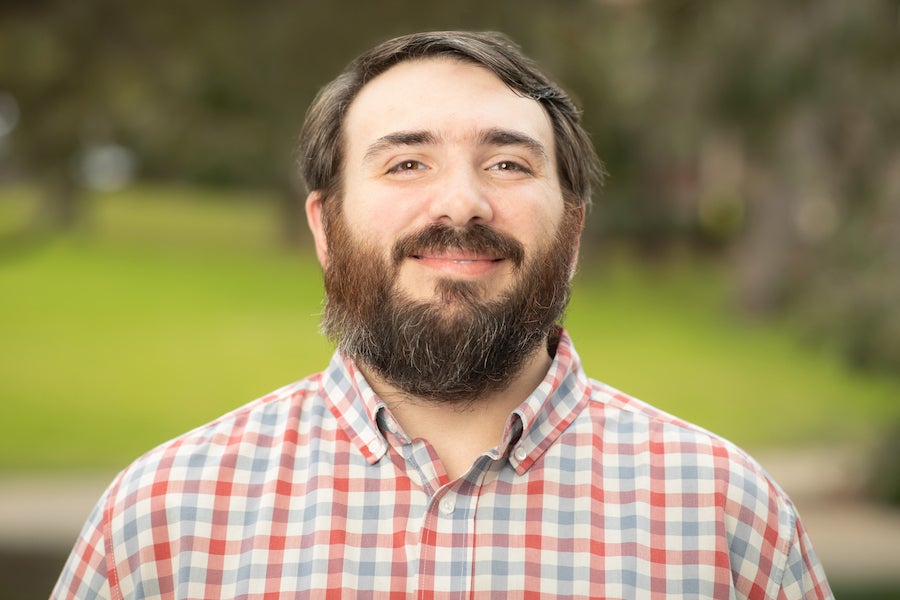
Richard Bono is an assistant professor of geology in Florida State University’s Department of Earth, Ocean and Atmospheric Science, part of the College of Arts and Sciences. His research focuses on paleomagnetism and the evolution of Earth’s deep interior throughout history. Specifically, he studies how ancient magnetic fields preserved in rocks can reveal the history of Earth’s core and the conditions that make planets habitable. At FSU, Bono leads the Paleomagnetic and Geodynamo Evolution Modeling Laboratory. He also helps maintain PINT, a global database for the geodynamic and geomagnetic communities of all published, peer-reviewed absolute paleointensity measurements extending back to early Earth, in collaboration with the University of Liverpool in England, and he helps organize MagNetZ, an online seminar series for the paleomagnetic community. In 2024, Bono received the American Geophysical Union’s Takesi Nagata Early Career Award for his contributions to geomagnetism, paleomagnetism and electromagnetism.
Tell us a little about your background, where you’re from and what brought you to FSU.
I grew up in New Hampshire and later moved to western New York to attend the University of Rochester, where I earned both my undergraduate and graduate degrees in geology. After completing my doctorate in 2016, I joined the Determining Earth Evolution Using Paleomagnetism, or DEEP, research group at the University of Liverpool, which is housed in one of the longest-running paleomagnetic labs in the world. In 2022, I joined the EOAS department at FSU where I now teach geology courses, including structural geology.
What inspired you to choose your field of study?
I’m drawn to the big-picture questions about Earth, especially why our planet can support life. A key part of that is because of Earth’s magnetic field and its evolution over time. Studying geology and geophysics allows me to explore when Earth’s magnetic field first developed and how processes deep within the planet influence conditions on the surface. These questions help us better understand what makes Earth habitable.
Can you break down your areas of research for us?
My research focuses on how Earth’s magnetic field has changed over millions and billions of years. When certain rocks form, magnetic minerals within them align with Earth’s magnetic field and preserve a record of the field’s direction and strength at the time the rock formed. By collecting rock samples in the field, running laboratory experiments, and building statistical and numerical models, we can reconstruct how the direction and strength of the magnetic field changed throughout time. These patterns provide insight into what was happening deep within Earth’s core and interior during different points in the geologic time scale.
What makes you passionate about your topics of research?
I enjoy being able to ask large, fundamental questions about Earth’s history and then work directly with the rocks that help answer them. Each project brings new challenges, whether that means traveling to remote field sites, studying minerals at very small scales, or reconstructing where rocks were located hundreds of millions of years ago. We’re learning more about how Earth’s interior has influenced habitability, and that ongoing discovery is what keeps me excited about the work.
What do you want the public to know about the importance of your research?
Earth’s magnetic field plays a critical role in everyday life. It helps guide navigation for ships, airplanes, and satellites while acting as a protective shield that prevents Earth’s atmosphere from being eroded by solar wind. Understanding how the magnetic field has changed over time also helps scientists study how space weather interacts with our atmosphere. Over long timescales, a magnetic field appears to be one of the key ingredients for a habitable planet, which makes this research relevant beyond Earth as well.
You’re currently the principal investigator for the Paleomagnetic and Geodynamo Evolution Modeling Laboratory. How does this position contribute to your research?
Serving as principal investigator has allowed me to build a new paleomagnetic laboratory at FSU that combines traditional laboratory research with advanced computing. The lab includes a magnetically shielded enclosure that reduces Earth’s magnetic field by 99.9 percent, allowing us to accurately measure the ancient magnetic signals preserved in rocks. Developing this lab has been essential for my research and has allowed me to collaborate with talented students.
What’s your best memory so far from working at FSU?
One standout moment came at the end of 2023 when I saw the first successful experiment results produced in the laboratory that my students and I built at FSU. The data was collected by my first graduate student using samples we gathered in the field. That experience brought together research, teaching and mentorship, marking the beginning of what I saw as an exciting new chapter.
Who are your role models? Are there certain people who have influenced you most in your life and career?
My work is highly collaborative, and I’ve been influenced by many people throughout my career. My family and partner have provided constant support. I’m especially grateful to my advisers John Tarduno, professor of earth and environmental sciences, professor of physics and astronomy, and the dean of research, arts, sciences and engineering at the University of Rochester; and Andrew Biggin, professor of geomagnetism and DEEP research team leader at the University of Liverpool. I’ve also benefited from the support of other colleagues from research groups at the University of Rochester and the DEEP group in the United Kingdom.
Do you have any exciting upcoming projects or goals you’re working toward?
Graduate students in my research group are studying volcanic rocks along eastern North America that formed about 200 million years ago during the breakup of the supercontinent Pangea. This period was marked by major changes in Earth’s magnetic field, making it an especially interesting time in Earth’s history to investigate.
If your students only learned one thing from you, what would you hope it to be?
This is an oldie, but one that I think remains true: the best geologists are the ones who have seen the most rocks!