Rather than relying on traditional guest lectures, the course was built and taught through an equal partnership between faculty and librarians, with jointly designed instruction, multiple integrated library sessions throughout the semester and collaboratively developed assignments that embed information literacy throughout the curriculum.
Students learn to recognize underrepresented and marginalized perspectives within systems that produce and disseminate information, drawing on viewpoints ranging from author Victor Hugo to filmmaker Ladj Ly. By the end of the semester, students independently formulate research questions, identify gaps in scholarship and organize information in meaningful ways, demonstrating research as inquiry and searching as strategic exploration.
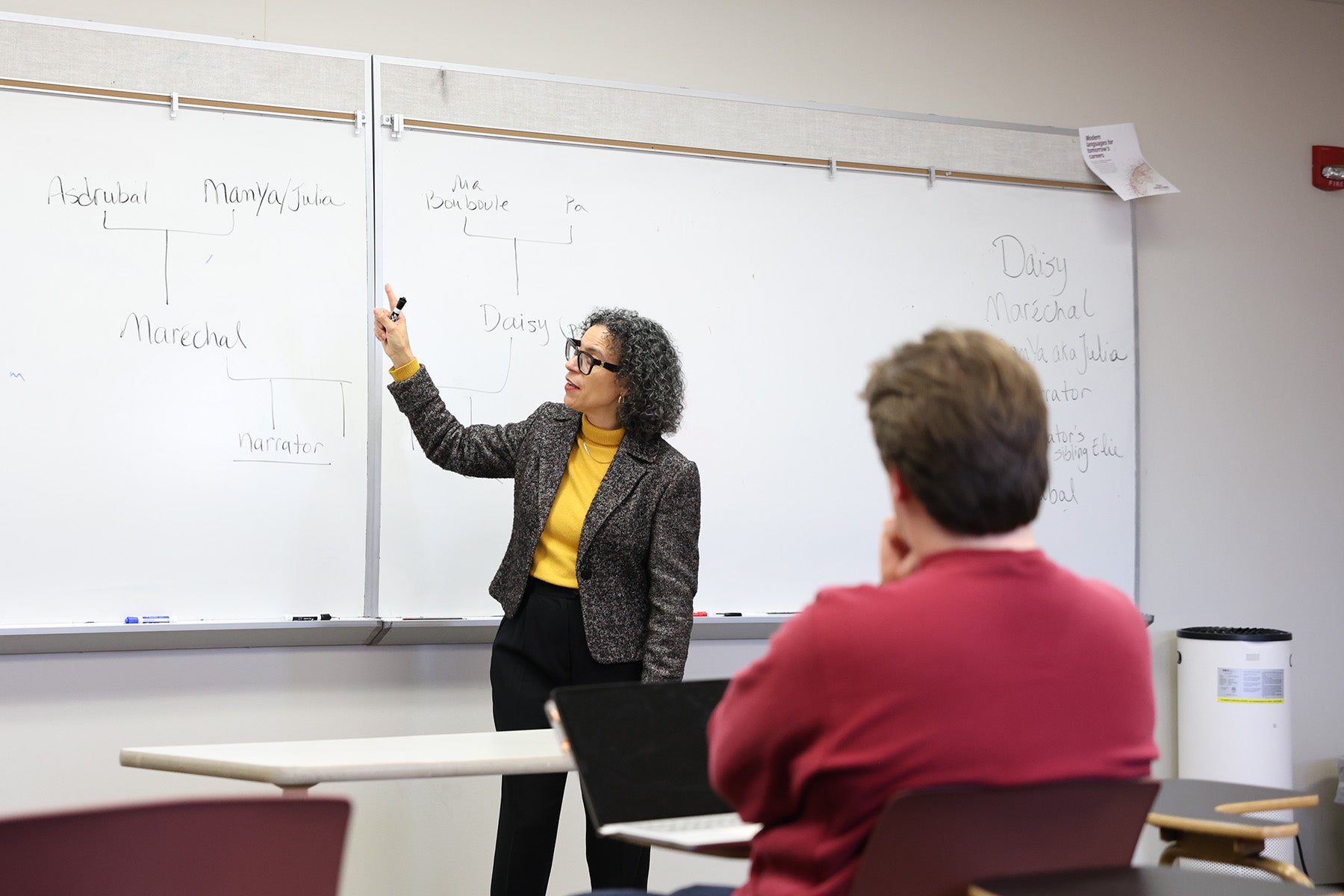
“The classroom is really my favorite place to see our materials come alive,” Duke said. “Being able to watch students experience that moment of discovery when primary sources or rare materials suddenly click is incredibly rewarding.”
“Paris World Capital,” first taught in spring 2025, also fulfills CoreFSU’s digital literacy requirement and aligns with the Association of College and Research Libraries’ Framework for Information Literacy for Higher Education.
Hands‑on activities include working with archival materials in FSU Special Collections and Archives, such as the Turgot map and Haussmann‑era guidebooks, and creating interactive StoryMaps that visualize spatial relationships among Parisian landmarks.
“Interactive StoryMaps allow students to engage creatively with their research and explore ideas at their own pace,” Grove said. “Even if they don’t use this exact tool later, the experience helps them connect abstract concepts to real, physical places.”
Students range from experienced French learners to those new to academic research. By the end of the course, students demonstrate an increased ability to critically evaluate sources and move beyond stereotypical representations of Paris while being introduced to the role artificial intelligence is beginning to play in academic research.
Rather than treating AI as a shortcut, instructors guide students in understanding how these tools fit into the research process, emphasizing the importance of questioning outputs, verifying sources and maintaining responsibility for their own work.
“Knowing where your information comes from goes a long way in judging whether it’s accurate and reliable,” DaSo said. “Information literacy is about developing the ability to find, assess and use information in a wide range of contexts.”
Learn more about the Collaboration for Information Literacy Prize at mla.org.
For more information about FSU Libraries and the FSU Department of Modern Languages and Linguistics, visit lib.fsu.edu and mll.fsu.edu.