
Research to impact: Five FSU professors named National Academy of Inventors Senior members
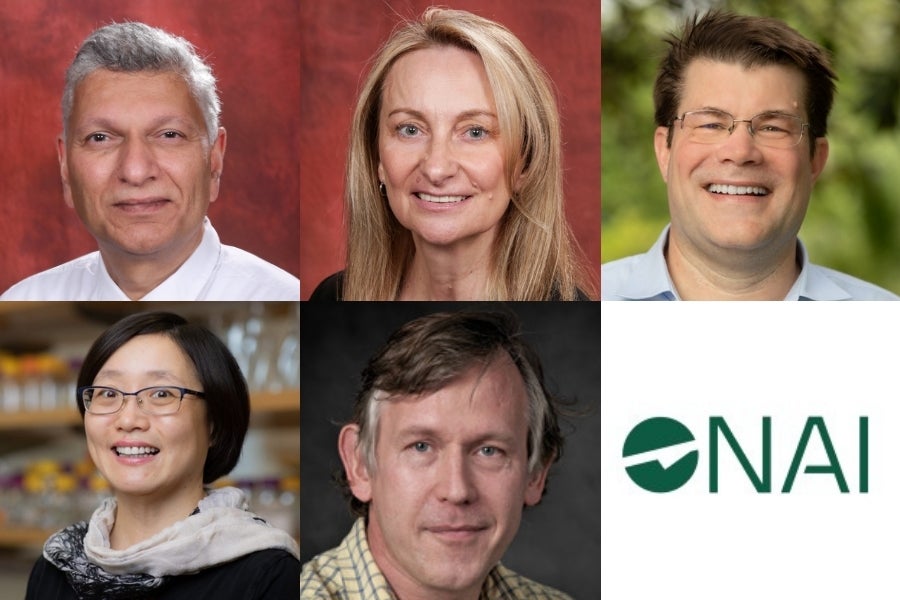
The National Academy of Inventors, or NAI, has named five Florida State University faculty members as 2026 NAI Senior Members.
NAI Senior Members are active faculty, scientists and administrators with success in patents, licensing and commercialization and have produced technologies that have had significant impact on the welfare of society. There are more than 945 Senior Members holding over 11,000 U.S. patents.
This year’s class of NAI Senior Members is the largest to date, hailing from 82 NAI Member Institutions across the globe and collectively holding over 2,000 U.S. patents. FSU’s 2026 inductees are Pradeep Bhide, Ava Bienkiewicz, Christian Bleiholder, Yan-Yan Hu and Ulf Trociewitz. The university now counts 10 Senior Members among its faculty.
“This recognition from the National Academy of Inventors is a testament to the inventiveness and impact of these faculty members,” said Vice President for Research Stacey S. Patterson. “Their research is making positive change in the world, and I’m proud to celebrate their achievements.”
The 2026 class of Senior Members will be honored during the Senior Member Induction Ceremony at NAI’s 15th Annual Conference June 1-4 in Los Angeles.
Pradeep Bhide
Bhide is a professor in the College of Medicine and director of the Florida Institute for Pediatric Rare Diseases. As the Jim and Betty Ann Rodgers Eminent Scholar Chair of Developmental Neuroscience, he directs interdisciplinary teams of physicians, scientists and genetic counselors who leverage gene therapy and precision medicine approaches to improve outcomes for children affected by rare diseases. His work has been supported by the National Institutes of Health, the Department of Defense and private foundations, and his comprehensive approach to developing innovative diagnostic and therapeutic technologies has earned national recognition.
In 2024, Bhide helped launch the Sunshine Genetics Pilot Program, which allows Florida families to opt in to no-cost whole genome sequencing for newborns to identify serious but treatable conditions before symptoms appear. As director of the Institute for Pediatric Rare Diseases, Bhide remains committed to advancing translational research, expanding public outreach and training the next generation of healthcare professionals dedicated to combating pediatric rare diseases.
Ava Bienkiewicz
Bienkiewicz is an associate professor in the College of Medicine, where she integrates research and teaching in the doctoral, M.D., and physician assistant programs in the Department of Biomedical Sciences. Her research focuses on protein structure, stability and biomolecular interactions in the context of human disease and therapeutic intervention.
Bienkiewicz’s work centers on intrinsically disordered proteins and their roles in neurodegenerative and vascular injury-related conditions, including Alzheimer’s disease, stroke and traumatic brain injury. By investigating protein misfolding and structure-function relationships, her research seeks to uncover molecular mechanisms that drive neuronal degeneration and survival.
She leads collaborative research efforts that translate fundamental molecular discoveries into medically relevant applications. Her work contributes to the development of new therapeutic strategies aimed at improving outcomes for patients affected by neurodegenerative and cerebrovascular diseases.
Christian Bleiholder
Bleiholder is a professor in the Department of Chemistry and Biochemistry, where he leads an interdisciplinary laboratory that integrates physical chemistry, analytical chemistry and biophysics to address longstanding challenges in protein structure analysis.
His research centers on advancing analytical chemistry methods, such as tandem‑trapped ion mobility spectrometry, or tandem‑TIMS, a powerful tool that reveals how proteins fold, assemble and change shape. His lab combines experimental and computational approaches to connect protein structure across multiple scales, opening new windows into complex systems such as monoclonal antibodies and protein assemblies linked to neurodegenerative disease and biotherapeutics.
Bleiholder has received multiple honors for his work, including a National Science Foundation CAREER Award, a Postdoctoral Research Award from the American Chemical Society, and a fellowship from the Alexander von Humboldt Foundation.
Yan-Yan Hu
Yan‑Yan Hu is a professor in the Department of Chemistry and Biochemistry and a faculty affiliate of the National High Magnetic Field Laboratory. Her work sits at the crossroads of chemistry, materials science and the MagLab’s world‑class magnetic resonance capabilities.
Her research is focused on advancing solid‑state NMR and MRI techniques to reveal how energy and biomaterials function at the atomic level. Her discoveries have reshaped understanding of ion transport and structure in solid‑state batteries and other energy‑storage materials, with results published in leading journals such as Nature Materials, Science Advances and Angewandte Chemie.
Hu has earned major honors including a National Science Foundation CAREER Award and the Marion Milligan Mason Award from the American Association for the Advancement of Science. She has also served in editorial roles for journals such as Materials Today Chemistry, Journal of Magnetic Resonance, and Chemistry of Materials.
Ulf Trociewitz
Trociewitz is a research faculty member at the National High Magnetic Field Laboratory, where he serves as senior personnel and deputy in magnet technology within the Applied Superconductivity Center. His research focuses on the development of high-temperature superconducting magnets and materials designed for ultra-high magnetic fields and exceptional homogeneity, particularly for nuclear magnetic resonance applications.
He holds six patents and has authored more than 80 peer-reviewed publications in international journals, reflecting his significant contributions to superconducting magnet innovation. His work supports the advancement of next-generation research instrumentation critical to scientific discovery in chemistry, biology and materials science.
He leads a $1.2 million, four-year research project funded by the National Institute of General Medical Sciences to develop ultra-high-field NMR magnets using multifilament high-temperature superconductors. Through his research, Trociewitz continues to push the technological boundaries of magnet design, strengthening the nation’s leadership in advanced scientific infrastructure.