
Student Spotlight: Lei Yan
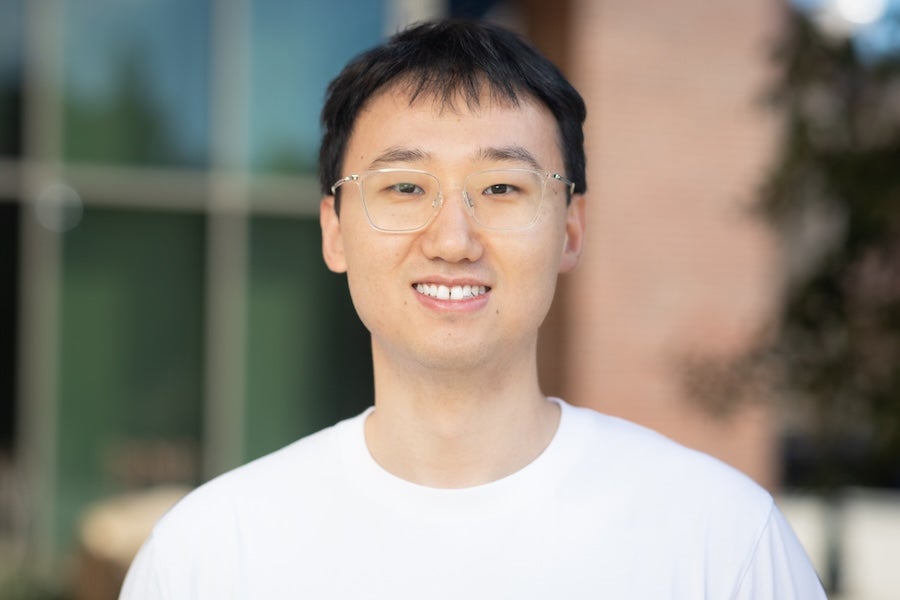
Lei Yan is a fifth-year doctoral candidate in Florida State University’s Department of Statistics, part of the College of Arts and Sciences. Yan develops machine learning and statistical methods that analyze large, complex datasets and identify meaningful patterns in biomedical and categorical data to support scientific research. He has earned the Dean’s Award for Doctoral Excellence, the Korwar Family Graduate Fellowship, a Student Presentation Award at the Florida Chapter of the American Statistical Association’s annual meeting, and a Student Paper Award from the American Statistical Association’s Biopharmaceutical Section. Yan is set to graduate in Spring 2026.
Tell us about your background, where you’re from and what brought you to FSU.
I was born and raised in Xinxiang, China. I earned my bachelor’s degree in mathematics from Xiangtan University in 2019 and my master’s degree in statistics from the Southern University of Science and Technology in 2021, both in China. During my master’s studies, I became interested in dimension reduction and chose FSU for its outstanding research in the field and the opportunity to study under professor of statistics Xin Zhang.
Break down your main areas of research.
My research, guided by professor Zhang, focuses on developing statistical methods to identify patterns in high-dimensional data using three main approaches: dimension reduction, hypothesis testing and object-based data analysis.
In dimension reduction, I study how to simplify complex datasets by integrating variable selection with clustering to identify important patterns. For example, in fields like finance or engineering, data may contain thousands of variables. My work helps condense information into a smaller set of key variables and group similar observations.
In hypothesis testing, I work with electroencephalogram, or EEG, data collected by placing electrodes on the scalp to measure brain activity over time. This creates a dataset that I analyze to compare how brain regions differ between healthy and diseased groups.
In object-based data analysis, I work with imaging data from Alzheimer’s disease neuroimaging studies and apply statistical models, such as regression techniques, to identify genes that may be linked to brain changes associated with the disease.
What makes you passionate about your research topics?
My mother is an elementary math teacher, so I was exposed to mathematics at an early age. After earning my bachelor’s, I became especially interested in how statistics can be applied to real-world problems. I’m passionate about developing computationally efficient methods that can analyze real data without taking weeks or months to produce results.
Tell me about your role as a graduate research assistant.
Since 2021, I’ve worked closely with my adviser, professor Zhang, and professor of statistics Qing Mai. At the beginning of each semester, we identify a compelling research problem and develop it over the following months. I conduct a comprehensive review of the existing literature on the subject and discuss how to develop a new methodology to address the problem. Afterward, I implement the methods in code, test their performance using simulated and real data, and help write the first drafts of our papers. I’ve also had the opportunity to collaborate with researchers at institutions including Harvard University in Cambridge, Massachusetts, and Temple University in Philadelphia, Pennsylvania.
What do you want the public to know about the importance of your research?
Statistics is not just about collecting data but also making sense of it. Today, it’s easy to obtain large amounts of data, but the real challenge lies in identifying meaningful patterns hidden within. My research in high-dimensional statistics helps researchers across health, finance, and engineering fields to focus on the information that truly matters. This leads to better decisions, improved treatments and new technologies.
What on-campus resources help you achieve success?
One of the most important resources for my research has been FSU’s High Performance Computing Cluster. I run almost all my simulations there, and the support team is incredibly helpful. Another resource I really value is the Bobby E. Leach Student Recreation Center. After a long day of research, exercising helps me clear my mind and keep a healthy balance.
How has your time at FSU prepared you for professional success?
My classes at FSU have challenged me to think critically and approach problems like a researcher. Working closely with my adviser also taught me how to identify meaningful questions, review literature, and refine ideas through trial and error.
Do you have any exciting upcoming projects or goals you’re working toward?
I’m currently working on a project that combines statistics with deep learning. Deep learning models are powerful, but they often function as a “black box,” meaning you input data and receive predictions without fully understanding how the model reached its conclusion. In this project, my goal is to combine the strengths of deep learning and statistics to make reliable predictions and understand the reasoning behind them.
Have any faculty or staff members played a significant role in your time at FSU?
My adviser, professor Zhang, has had a big impact during my time at FSU. When I first arrived here five years ago, I didn’t fully understand how to conduct strong, independent research. His mentorship has helped me grow into a strong researcher and secure an internship at Takeda Oncology in 2024, a pharmaceutical company focused on developing innovative cancer treatments. My research there led to a published clinical trial titled “Optimizing Quality Tolerance Limits Monitoring in Clinical Trials Through Machine Learning Methods,” for which I received an honorable mention in the American Statistical Association’s Biopharmaceutical Section Student Paper Award in 2025.
What are your plans after graduating? Even though you might miss FSU, what are you looking forward to in your next chapter?
After graduating, I plan to work in the pharmaceutical sector. During my internship with Takeda Oncology, I realized how much I enjoy applying statistics in clinical trials. Statisticians play a key role in designing studies and analyzing results submitted to the U.S. Food and Drug Administration, and I’m excited by the idea that my work could help bring new medicines to patients.