Alumni Spotlight: Mariana Aguirre Nunes
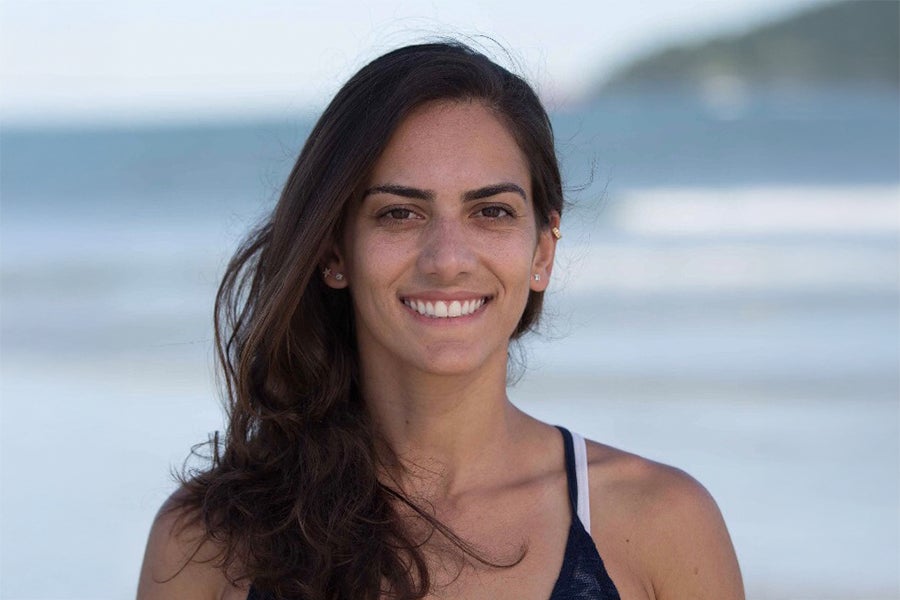
Mariana Aguirre Nunes earned her master’s degree in oceanography in 2023 from the Department of Earth, Ocean and Atmospheric Science, part of the Florida State University College of Arts and Sciences. Since graduating, Aguirre Nunes has worked as a research technician for the Ocean Observation Initiative’s Coastal Endurance Array, operated by Oregon State University, where she also serves as a faculty research assistant. In this role, Aguirre Nunes programs and monitors oceanographic instruments and analyzes data to amplify open-access research on the ocean’s physical properties.
Tell us a little about your background, where you’re from, and what brought you to FSU.
I earned my undergraduate degree in oceanography from the Federal University of Paraná in Brazil, where I’m originally from. For my thesis, I researched wave energy potential along the coast of the three southern states of Brazil, and I also evaluated the viability of specific types of wave energy converters for each region.
In 2021, this thesis caught the attention of my soon-to-be FSU adviser and then-director of the Geophysical Fluid Dynamics Institute, Kevin Speer, who was interested in hiring me as a GFDI graduate research assistant and encouraged me to apply to FSU. This opened the doors for my master’s degree. I knew FSU was one of the best schools in the U.S., so I happily took the opportunity!
What inspired you to pursue a degree in oceanography?
I was always very connected to nature in general, but the beach was even more special for me. The mystery of the ocean has always intrigued me. As a kid, I’d watch documentaries about the ocean, and I wanted to be a diver so I could explore coral reefs and see sharks. When I learned that oceanographers study the ocean, I knew I wanted to be one.
Tell us about your current work as a research technician for Ocean Observatories Initiative and faculty research assistant at Oregon State University.
At the Ocean Observing Center at OSU, I work as the lead technician for coastal surface piercing profilers — autonomous platforms equipped with tools used to measure a variety of oceanographic parameters, such as oxygen, chlorophyll and ocean currents. CSPPs are designed to gather data from the deeper ocean layer to the water surface, providing a vertical profile of the water column to deepen our understanding of the ocean and its interaction with other earth systems.
I’m responsible for programming and taking care of the instruments’ refurbishment, calibration, quality tests, data processing and more. The CSPPs are deployed as part of a larger network of observing systems, including moored buoys with a larger variety of sensors that measure ocean variables and collect meteorological data. OOI is part of an effort to create a long-term network of sensors and to provide open-access data not just for scientists but also for policy makers and the public in general. At OSU, I work exclusively for OOI. However, we can lend our time to collaborate with other principal investigators at the university on their research if there’s a specific skill they need from us.
What do you want the public to know about your research?
I want the public to understand the importance of having open-access data networks like OOI. It’s essential to monitor the ocean and understand how long-term changes can affect our lives. Keeping these monitoring systems working, which is my job, is key to this understanding.
Tell us about your previous work as a research assistant with the Geophysical Fluid Dynamics Institute at FSU.
I worked as a graduate research assistant at GFDI during my two years as a master’s student, mainly developing my thesis, “Contribution of Storm Waves to Bed Shear-Stress and Sediment Movement near the Florida Panhandle Coast.” My work involved coastal wave data processing, preparing field trips for data collection, testing and inventorying oceanographic instruments, and assisting as needed in additional lab activities. I learned a lot in the lab and had great colleagues to count on.
How did your time at FSU prepare you for professional success?
Many of the skills that I either acquired or polished during my time at FSU were very important to getting me to where I am now. Additionally, FSU always had events such as job fairs that were very helpful in improving my professional and life skills.
Are there any faculty or staff members who inspired you?
GFDI research faculty Cathrine Hancock was a postdoc during my time at FSU, and she was extremely helpful in my research. I also worked under recently retired GFDI director Kevin Speer, who –– along with GFDI staff Thomas Greenhalgh –– taught me a lot about Florida’s hydrogeology. Everyone at GFDI had a hand in my success and will always be part of my good memories at FSU.
What are some upcoming goals or projects you are working toward?
I would love to keep working with ocean data and monitoring! I plan to pursue a doctoral degree eventually, perhaps at FSU, and focus on ocean data monitoring and technology development.
What advice do you have for current students?
My advice is to ask questions — lots of them! Your professors are there to help you, and curiosity will help you go far. Take advantage of every opportunity that presents itself to you, but don't just wait for them to appear. Search for them yourself. Getting involved in volunteer work is a great opportunity; you’ll make connections and learn things you might never know otherwise.
Enjoy the process, university life, the energy on campus, and your friends — you will miss them. Lastly, when it comes to making big life decisions, analyze them, but don’t overthink. Every option will have its positives and negatives, and no matter what you choose, you will always learn something from it.