
Student Spotlight: Josh Briley
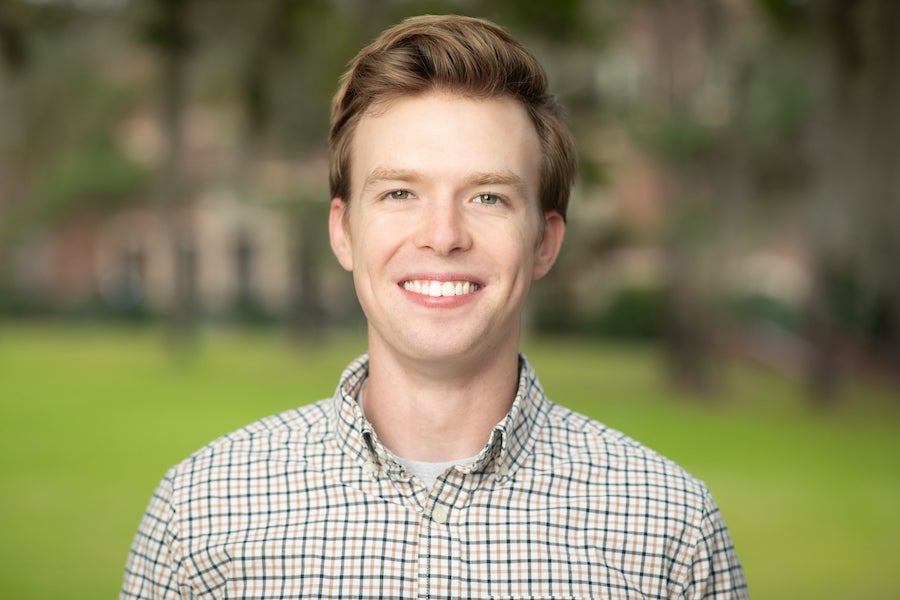
Josh Briley is a Florida State University senior pursuing dual degrees in computational science through the Department of Scientific Computing, part of the College of Arts and Sciences, and music through the College of Music. Briley is a high-performance computing documentation intern at FSU’s Research Computing Center, and he’s worked in the College of Music’s Instrument Library since 2023. He joined FSU’s Marching Chiefs in 2022 and has participated in the Gamma Nu chapter of Kappa Kappa Psi, a national band fraternity, since 2024.
Tell us about your background and what brought you to FSU.
I'm from Palm Bay, Florida. I wanted to stay in state for Florida’s Bright Futures Scholarship Program, and FSU had the best interdisciplinary focus and a strong emphasis on research.
What inspired you to pursue dual degrees?
I always wanted to do something STEM related. In high school, I was also really involved in band. I play the trumpet, which is diverse as it’s used in marching, concert and jazz band. I earned enough college credits in high school to allow me to pursue dual majors in music and STEM and still graduate in four years.
Music and science are two things I’m passionate about. While I don’t know yet how they merge into my future, I know I want both in my life.
Break down your research for us.
My freshman year, I researched wildfire spread using convolutional neural networks, a deep learning model that analyzes image data for tasks like object recognition, through the Undergraduate Research Opportunity Program. I had a great experience and wanted to continue doing research. My mentor, Xin Tong, was then a postdoctoral researcher who worked with associate professor of scientific computing and Geophysical Fluid Dynamics Institute faculty associate Bryan Quaife, so she introduced us. That led to my future with “N Bugs on a Circle,” a paper that Dr. Quaife and I published in October 2025 in the Physical Review E journal.
Going into my junior year, I participated in a National Science Foundation Research Experience for Undergraduates in Applied and Computational Mathematics. I worked with other students and University of Central Florida’s associate professor of mathematics Carlos Borges to research, predict, and efficiently model how a wave will bounce off thin domains, or objects, like used in medical imaging.
Other things that contribute to my research include the intangibles that music and playing an instrument at a high level teaches you, like dedication, pattern recognition, compartmentalization, and self-awareness of your weaknesses. You ask yourself, ‘Where am I weakest? How can I work to improve that?’ It’s easier to hear it in music, but those skills are transferable to everything.
Tell us about your paper “N Bugs on a Circle.”
This paper expanded on “Four Bugs on a Square,” a 1957 magazine puzzle that asked questions about the patterns of bugs, like how far they travel when chasing one another, what shapes their paths create and more. The problem’s idea was expanded by mathematicians in 2011 when the square was replaced with a rectangle, and Dr. Quaife and I extended it by replacing it with the surface of a circle.
We discovered three potential steady states that the system of N bugs (as many or as few as we want) will result in. Their initial position dictates the final steady state, either they all meet at a single point on the circle, infinitely chased one another, or were exactly opposite to each other so they wouldn’t move one way or another. This new geometry allows students to practice their mathematical skills. We worked on this project from my sophomore to senior years, so it helped further our research by having time to consistently meet.
What do you want the public to know about the importance of your research?
Ideas from the past can always be expanded. In applied mathematics and scientific computing, you build upon past concepts and ideas and see how they are still relevant.
Tell us about your work at FSU’s Research Computing Center.
The high-performance computing cluster is a powerful computer that allows FSU researchers to submit requests for a program to run using specific resources that need a lot of computing power.
I document all the programs, packages, and updates we add or install to the website so researchers know what the computer has available for their use. I’m currently benchmarking the HPC, which shows researchers how powerful and fast our computer is and allows them to see the different software resources available. Benchmarking shows researchers which set of parameter combinations their job will use based on the resources it needs.
Tell us about your time as a section leader with the FSU Marching Chiefs.
Last fall, I was a trumpet section leader with two other students. Our responsibilities for the 55-person section included leading music and directing the section members, preparing everyone for pregame activities, and bringing freshmen up to speed on school songs and our musical and physical movements.
What parts of your research do you find most rewarding?
I’ve had a lot of opportunities to apply what I learn in the classroom to real-world situations, like in my research with Dr. Quaife, my work with the RCC and being a section leader.
What on-campus resources have helped you?
The Department of Scientific Computing has been beneficial in my journey; it helped with funds when I traveled to Montreal, Québec, Canada, last summer to present “N Bugs on a Circle” at the Third Joint Society for Industrial Applied Mathematics/Canadian Applied and Industrial Mathematics Society Annual Meeting.
I’m so appreciative to have met my mentors, including Dr. Tong with UROP, Dr. Quaife with our publication, and Marcelina Nagales, RCC scientific applications manager and FSU alumna.
What are your plans following graduation?
I’m applying for fellowships and to graduate schools. I’m looking forward to diving into research, producing novel work, and learning more about computational science.