

Uncertainty Experts
FSU’s actuarial science major prepares students for professional risk-assessment careers across industries
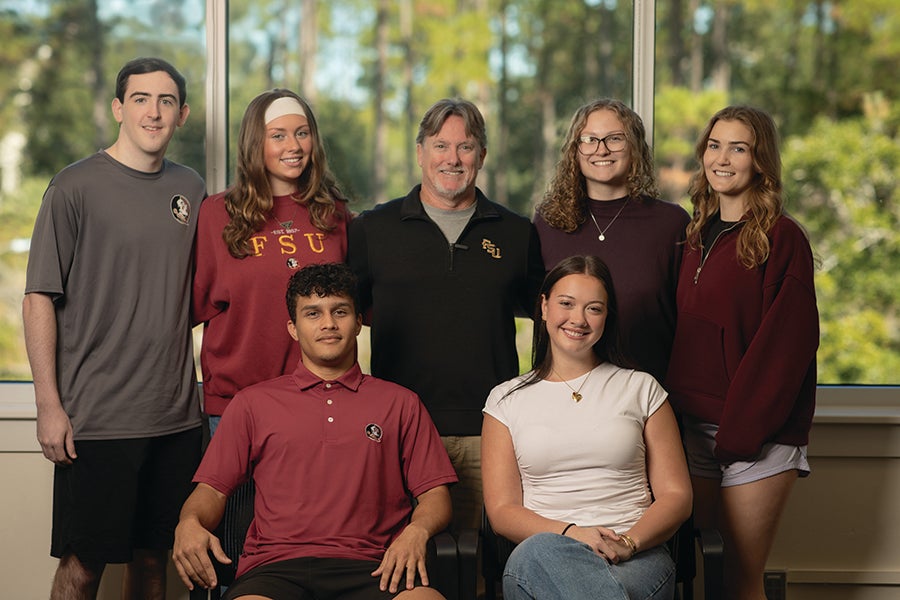
To a layperson, the exact meaning of actuarial science might seem ambiguous, but that’s exactly the point. Actuarial science is the science of uncertainty, and it’s a way to prepare and protect communities large and small from unpredictable conditions.
Actuaries thrive on data, which they use to analyze the financial impact of hurricanes and other natural disasters, manage catastrophe risk in business, forecast population growth or shrinkage, help individuals plan for retirement and more. They can be found in roles spanning industries from insurance companies and consultancies to technology and health care sectors, as well as local, state and federal governments. For almost three decades, Florida State University has prepared graduates to step into these crucial roles.
FSU is home to one of the nation’s leading actuarial science programs, which is known for its tight-knit community, rigor and professional preparation. This interdisciplinary undergraduate degree program, led by Stephen Paris, Department of Mathematics teaching faculty member, became the first to award actuarial science degrees at a state university in Florida in the 1990s and has graduated more than 1,000 undergraduate students since then. In addition to mathematics, the program is also supported by the Department of Statistics and Department of Computer Science, both in the College of Arts and Sciences, and the College of Business.
“Actuaries are in the business of managing risk, and that’s becoming increasingly important in today’s world,” said Paris, who has led the program for more than 20 years. “The program’s two faculty members, mathematics teaching faculty Brian Ewald and I, prepare outstanding students for the profession through coursework and actuarial exam preparation. Each semester, we get to see the hard work and commitment of our students rewarded by great jobs that make them excited about the next stage of their lives.”
Actuarial models combine mathematics, data science, and problem-solving skills to help decision-makers plan for the unexpected, and the science plays a vital role in shaping systems that keep economies and communities stable. Actuaries design sustainable health care models, assess cybersecurity risks, and advise governments on public policy and the financial impacts of extreme weather events.
“It’s hard to put words to the gratitude I have for Dr. Paris and the program. Coming to FSU was the best decision I could've made, and I’ve felt the utmost support here. The encouragement, opportunities, and sense of community have strengthened my skills and solidified my confidence in pursuing an actuarial career. It’s a community that genuinely wants you to succeed.”
— Caitlin Collier
FSU’s program stands out for initiatives like the actuarial exam reimbursement program, which covers exam costs for students who pass — or come close — to encourage persistence. It also operates a dedicated study hall staffed by students who have already passed the exams newer students are preparing to take. These resources, combined with a strong sense of community, foster an environment where students thrive.
“Our program feels like its own small school inside a big university,” said junior Caitlin Collier. “Everyone knows each other, and Dr. Paris makes sure we’re not just numbers. When I visited FSU as a prospective student, he personally gave me a tour of the math department. I could tell he really cared about his students, and that stood out.”
In the late 1980s, FSU math students petitioned for a degree reflecting their interdisciplinary studies in mathematics, statistics, economics and risk management. Through the efforts of Professor Emerita Bettye Anne Case, and with other faculty support, the actuarial science program took shape in the mid-1990s and welcomed its first students in 1998.
Today, FSU’s actuarial science community extends beyond academics through the Future Seminole Actuaries Club, which meets weekly for presentations, networking and social events. Collier, the club’s president, said it helps students bridge the gap between coursework and professional experience.
“We host résumé workshops, LinkedIn sessions and company presentations,” Collier said. “We also have fun with bowling, pizza socials and tailgates. It’s a balance of professional development and friendship.”
Each fall, the Actuarial Science Career Fair hosts more than 30 employers, many of whom are FSU alumni returning to recruit new Seminoles into early career opportunities. Collier, who passed one preliminary exam and is preparing for her second, interned with Liberty Mutual last summer, the world’s sixth-largest property and casualty insurer, and has already accepted a return offer for this summer.
Paris takes pride in seeing his students succeed, both in their studies and after graduation. Among his first students from 2003 is Kelsey Stevens, now a Fellow of the Society of Actuaries and CEO of Wakely Consulting Group, a top health care consulting firm.
Thanks to new courses and growing alumni engagement, Paris said the program is on an upward trajectory to continue its mission of developing professional actuaries. For Collier, that mission has already made a lasting impact.
“It’s hard to put words to the gratitude I have for Dr. Paris and the program,” she said. “Coming to FSU was the best decision I could've made, and I’ve felt the utmost support here. The encouragement, opportunities, and sense of community have strengthened my skills and solidified my confidence in pursuing an actuarial career. It’s a community that genuinely wants you to succeed.”
Rahaf Alshinhab is an FSU student pursuing dual degrees in marketing and accounting with minors in professional communication and computer science and a leadership studies certificate. She is set to graduate in May 2027.