
Forward Bound

Religion alumna Dianna Bell preserves and provides platforms for untold histories, research

Thu, 01/15/26
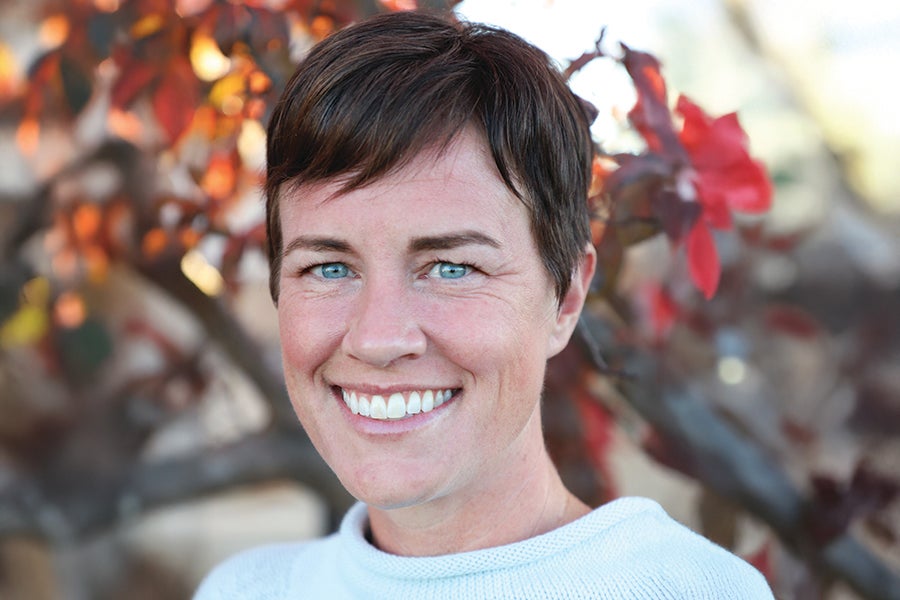
Dianna Bell, Department of Religion alumna.
Dianna Bell. Photo by Stephanie Jones.

Dianna Bell always wanted to live a rich, fulfilling life. The first graduate of the Florida State University Department of Religion’s history and ethnography of religion doctoral program has made her home in Cape Town, South Africa, nearly 4,000 miles down the coast from the region that first captivated her during her studies. Today, Bell travels the continent, roughly three times the size of the U.S., using her passion to amplify native African studies, bringing crucial research to the forefront.

As the assistant to legendary human rights activist Albie Sachs, who was appointed to the new Constitutional Court of South Africa by Nelson Mandela in 1994 and played a key role in establishing the country’s new government, Bell conducted preliminary research for The Albie Collection, a Ford Foundation-funded biographical project documenting Sachs’ life’s work, and the two have remained good friends.

But that’s not all. Bell presently works as an acquisitions and publishing manager at Brill Academic Publishing and as an editor of African studies for Pluto Press, a London-based independent publisher. These additional roles reflect her conviction that many of the best African studies scholars reside on the continent as members of the communities they research.

“There are thousands of academic journals published in Africa without publishing houses behind them, creating challenges in dissemination, visibility, and attracting high-quality manuscripts,” Bell said. “They have great editorial teams with high ambitions and low access to resources. The African Journals Initiative through Pluto Journals supports impressive journals throughout the continent to promote native scholars’ research.”

Before moving to Africa, Bell, a Utah native, earned a bachelor’s degree from Brigham-Young University in 2003 and master’s from the University of Idaho in 2008, both in sociocultural anthropology.
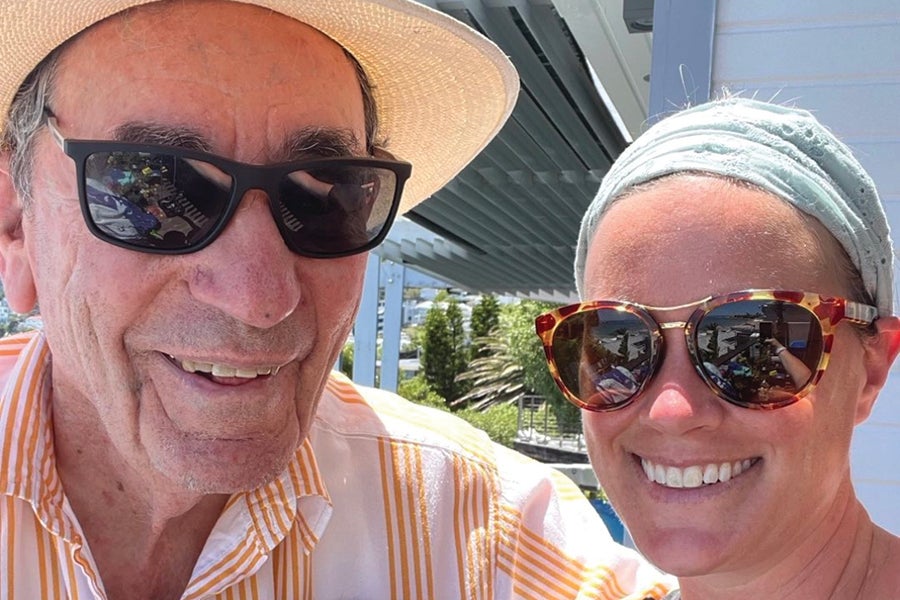
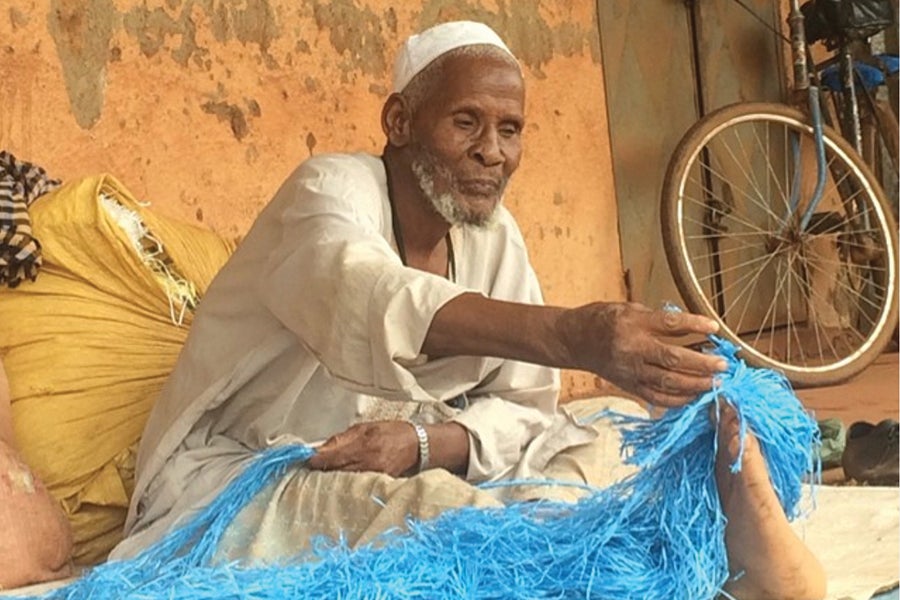
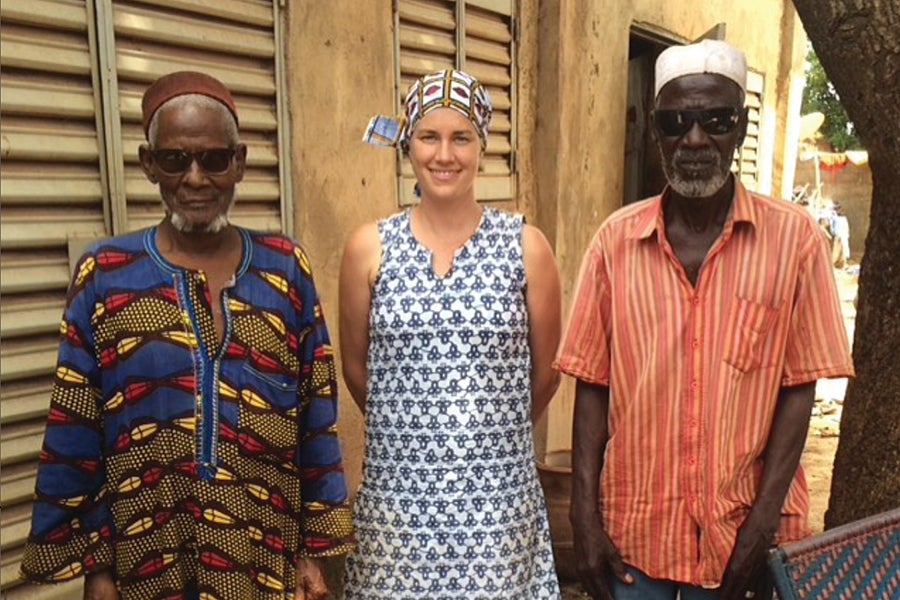
From top: Human rights activist Albie Sachs with Dianna Bell. Amadou Diallo making rope in Ouélessébougou, Mali. Bell with Diallo (left) and Koniba Doumbia (right), a welder who works next door to Diallo. Photos courtesy Dianna Bell.

In the final year of her master’s, Bell met FSU associate professor of religion Joseph Hellweg at the American Anthropological Association conference in Washington, D.C. The connection was instant — she was accepted to FSU’s new doctoral track in history and ethnography of religion the following year with Hellweg as her adviser and later, her dissertation committee chair.

“Dianna is a joy to work with and one of the kindest, most thoughtful and perceptive people I’ve ever met,” Hellweg said. “She's a superb researcher, as I saw firsthand when I had the opportunity to visit her at her research site, and she writes in a clear, accessible style. She moves easily between the fields of African studies and Islamic studies, on which she had the good fortune to work with my colleague in the religion department, professor Adam Gaiser.”

At FSU, Bell taught herself Bambara, a language spoken by the Mande people in Mali and other West African nations. While conducting research, she lived in Ouélessébougou, Mali, learning about its varied cultural and religious perspectives.

The subject of Bell’s dissertation, now her current book project, is Amadou Diallo, a Malian ropemaker from Ouélessébougou. Their friendship began when she shared bananas with him. In turn, he taught her to make rope, revealing his life story over the course of their daily weaving sessions.

“In learning rope-making from Amadou, Dianna was able to record his autobiography,” Hellweg said. “Her work has given scholars new insights into Islam in relation to the life cycle in West Africa with particular emphasis on the concept of baraji, a West African notion of Islamic merit, about which little else has been written.”

Bell’s book, “The Rope Maker’s Faith: Baraji in Everyday Islam,” is slated to publish in 2026 and covers West African and Islamic perspectives on  religious life and community in Mali, documenting the lives of Ouélessébougou residents and baraji’s influence on their daily practices.

“I was struck by Amadou’s story as he struggled for survival — he was a cattle driver who lived through one of the most devastating famines, and he was in Monrovia when the civil war in Liberia broke out,” Bell said. “He was involved in major historical events in such intimate ways, yet his stories would have been lost to history.”

This sparked her desire to focus on understudied areas of African scholarship. After earning her doctorate from FSU in 2013, Bell accepted a position at Vanderbilt University in Nashville, Tennessee, as a Mellon Assistant Professor of Religion and taught courses on Indigenous religious traditions of Sub-Saharan Africa. After realizing she wanted to feel more connected to her studies, she and her husband moved to Cape Town in 2017.

“Africa is massive — you can’t go a hundred miles without encountering a different history, culture, language group, or a completely distinct group of people,” Bell said. “What I love most about my work is that I’m giving Africans and their stories the visibility they deserve.”