
FSU mathematicians earn NSF grants to enhance algorithms and frameworks for use in tech, medicine and more
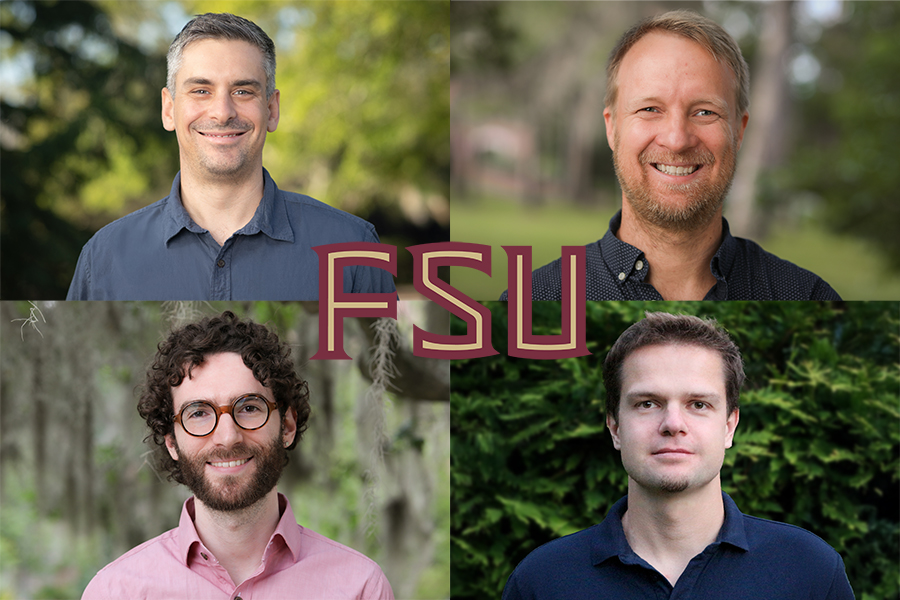
Four Florida State University faculty from the Department of Mathematics have received new funding from the National Science Foundation that will allow them to design mathematical mechanisms to improve understanding of theoretical mathematical concepts, support students’ professional and academic growth, and develop new methods and tools for use in a wide variety of applications.
The three grants, totaling more than $500,000, were awarded this fall to Associate Professor of Mathematics Thomas Needham, Professor of Mathematics Martin Bauer, Assistant Professor of Mathematics Wojciech Ożański, and Assistant Professor of Mathematics Jeremy Usatine.
“A common denominator in all three grants is innovation and advancement through the discovery of new, unexpected and cutting-edge results in their fields,” said Ettore Aldrovandi, Department of Mathematics chair. “From a broader point of view, their common goal is to maximize the impact their respective research activities have on the educational mission of the department by supporting students, seminars and more.”
Projects
Needham and Bauer received a $253,888 grant for the project, “Generalized Optimal Transport Models: Theory and Computation,” which will enhance developments in efficient algorithms and open-source software programs used in fields ranging from biomedical imaging to artificial intelligence.
The grant, for which Needham and Bauer will collaborate with University of Houston mathematics professor Nicolas Charon, focuses on optimal transport, a mathematical framework that breaks down the ideal process when moving production goods to consumers, such as estimating the correct amount of concrete needed for a construction project so workers don’t need to transport extra materials.
“Our research will provide new methods for handling complex data with additional internal structures, such as images, shapes and networks,” said Needham, the project’s principal investigator. “Suppose you have data from a collection of arterial networks from human retinas, and you wish to identify features in these networks that are early indicators of a disease. Our project develops a mathematical framework for performing statistical inferences on data like this.”
This framework will develop new tools that help solve fundamental problems in data science, engineering, and medical fields by strengthening systems’ interpretations of visual data to improve accuracy.
Ożański received a $145,000 grant for his project, “Instabilities in incompressible fluid flows,” to research how steady flows, or fluids like air and fuel, can become unstable. The project aims to advance the understanding of the intrinsic mechanisms of fluids, which are responsible for the emergence of instabilities, and will yield practical results related to operations, efficiency and accuracy in areas like transportation, energy and weather forecasting.
When a plane takes off, its wings disturb the air by creating wingtip vortices. These vortices are highly unstable and lead to turbulent behavior from the air behind the plane, a main reason for delays between planes taking off. Understanding these instabilities is a major problem of mathematical aerodynamics. An analysis of the equations determining such air flows is crucial to the advancement of aerodynamic designs, aviation technology and public safety.
“The project will investigate how instabilities develop in fluids by analyzing 3D incompressible Euler equations that govern the dynamics of inviscid fluids, or fluids that move with very little resistance,” Ożański said. “The project will allow us to research new scenarios where steady fluid flow suddenly becomes unstable due to disturbances, which can lead to unpredictable results like reduced efficiency or turbulent behavior. Improving our understanding of fluid instabilities can help improve the efficiency of various energy systems and enhance the technology used for weather predictions.”
Usatine’s theoretical research focuses on improving the understanding of smooth varieties, objects defined by equations that appear flat at high magnification but are actually not, such as spheres. Smooth varieties can help explain why small system changes lead to predictable changes in a system’s outcome and are present throughout different scientific fields such as physics.
His research also focuses on the properties of stringy invariants — measurements that describe the structures of irregular spaces — and Gromov-Witten invariants, measurements of complex curves within a space. Invariants don’t change even in a slightly deformed space, making them powerful tools for understanding complex geometries.
Educational Outreach
Furthering the educational mission of the department, Needham and Bauer’s work will provide opportunities for students through Python coding courses for graduate students and junior researchers and K-12 student outreach activities. The four faculty members from each grant all plan to organize activities related to their projects to exhibit at FSU Math Fun Day, an annual outreach event that engages K-12 students with hands-on activities each February.
To learn more about research conducted in the Department of Mathematics, visit math.fsu.edu.