
Student Spotlight: Samantha Bell
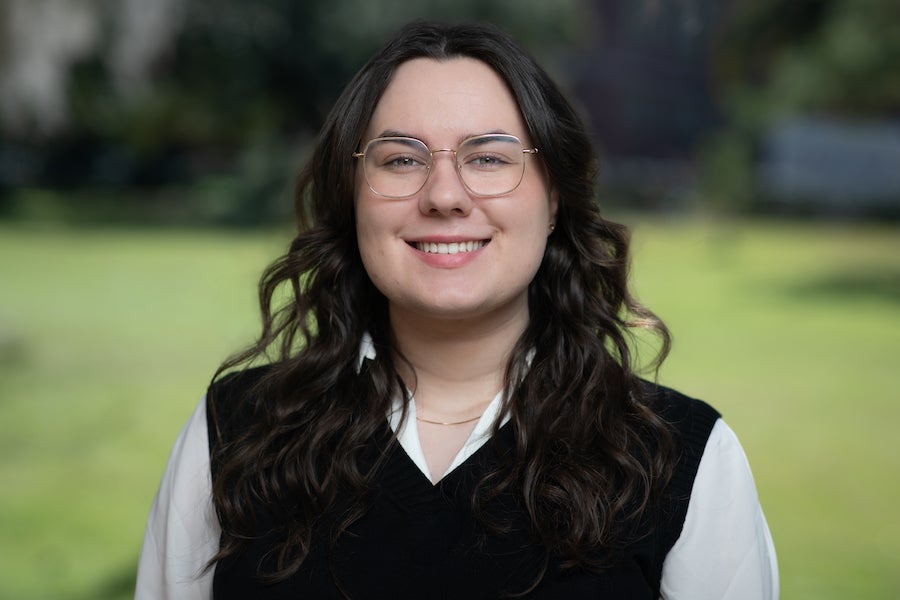
Samantha Bell is a Florida State University senior pursuing a degree in biochemistry, through the Department of Chemistry and Biochemistry with a minor in computer science, through the Department of Computer Science, both in the College of Arts and Sciences. Bell is part of FSU’s University Honors Program, a specialized program through the Division of Undergraduate Studies that offers engaging learning experiences through unique courses and research opportunities. Bell, who plans to graduate in Spring 2026, has received multiple awards for her research in biochemistry, including the 2025 American Chemical Society Division of Inorganic Chemistry Undergraduate Award and the 2025 Philip Schlenoff Endowment for Excellence in Undergraduate Research.
Tell us where you’re from and what brought you to FSU.
I’m from Jupiter, Florida. I was drawn to FSU for its academic reputation and rigor. It had a sense of community that made learning feel supported.
What inspired you to pursue a degree in biochemistry?
My interest in chemistry began in elementary school. In biology, I loved learning how systems worked mechanistically, while chemistry drew me to invisible interactions like bonding and electron sharing. I didn’t yet know the term biochemistry, but I was already drawn to the space where chemistry and biology overlapped.
When I started college, I initially pursued medicine. Through research, I realized what resonated most was using knowledge to explain, guide and empower others. Biochemistry became a natural bridge, allowing me to explore chemistry deeply while remaining connected to biology. This flexibility has been essential to my intellectual growth.
Tell us about your role as founding president of the American Chemical Society Student Chapter at FSU.
In this role, I’ve focused on building a space where students can explore how chemistry fits into their lives. Many students only experience chemistry through coursework, which can feel isolating. I wanted the chapter to reflect that science should be exploratory, welcoming and inclusive.
We create opportunities for undergraduates to engage with faculty research in an accessible way, and seeing students gain confidence in engaging with research has been incredibly rewarding.
As the chapter grows, we’re working toward expanding interdisciplinary connections and outreach. This role has been less about holding a title and more about creating space for exploration and learning.
Tell us about your research assistantship in the Strouse Lab, led by professor of chemistry and biochemistry Geoffrey Strouse.
Working in the Strouse Lab has been one of the most transformative parts of my time at FSU. When I first joined the lab in 2023, my role was largely observational. I now spend more time thinking critically about experiments, planning reactions, modifying variables and interpreting results. A typical day involves reading literature, preparing reactions, and performing characterization techniques on materials at the nanoscale.
Recently, I’ve focused on translating data into figures for manuscripts as well as emphasizing clarity in scientific communication. Along with contributing to ongoing projects, the overarching goal of my research is to learn how to think like a scientist, ask good questions, interpret results thoughtfully and recognize when data points to something unexpected.
What’s something people don’t know about studying biochemistry?
Biochemistry doesn’t have to function as a final destination. The major is inherently interdisciplinary, allowing students to build strong foundations in chemistry while remaining deeply connected to biology. It supports paths in research, medicine, education and industry.
Tell us about earning the 2025 Philip Schlenoff Endowment for Excellence in Undergraduate Research.
Receiving this endowment was incredibly meaningful. Beyond financial support, it validated work I care deeply about and connected me to a legacy rooted in curiosity and chemistry education. Learning about Philip Schlenoff’s passion for science resonated strongly with my own values, and the award felt like an honor and responsibility to uphold the same enthusiasm and dedication in my own work.
What on-campus resources have helped you achieve success?
FSU’s Honors in the Major program allowed me to earn credit for research and spend more time in the lab. The University Honors Program also encouraged exploration through honors coursework and course augmentation.
What faculty or staff have helped or inspired you?
Dr. Strouse and teaching faculty Isabella Bertini have shaped how I approach research with skill and integrity. Their mentorship has helped me grow into a more confident scientist, and their approach to research and leadership has had a lasting impact on me.
I’m also deeply grateful to assistant professor of chemistry and biochemistry Bryan Kudisch, faculty adviser for the ACS Student Chapter, whose guidance as an adviser and teacher has been invaluable. His encouragement and honest advice have shaped my leadership and personal growth. Department of Chemistry and Biochemistry chair Wei Yang has always provided consistent support for the ACS Student Chapter and its students, which has fostered a strong sense of community within the department. I’m grateful to the faculty, technicians, teaching assistants, and staff whose behind-the-scenes work supports student learning every day.
Following graduation, what are your plans? Even though you might miss FSU, what are you looking forward to once you graduate?
I’ll attend graduate school to continue my research training. I’m excited to deepen my understanding of chemistry and further develop the skills needed to ask meaningful questions and think independently.
FSU gave me the space to grow into my interests, find confidence in my voice as a scientist, and build a sense of purpose in my work. Carrying that into the next stage of my career feels grounding and exciting.
What advice do you have for fellow students?
My advice is to follow the butterfly. If something sparks your curiosity, follow it, even if you don’t yet know where it leads. Seek experiences rather than abstract ideas, ask questions, and take opportunities to shadow or learn from others whenever you can.
Just as importantly, allow people to support you. Growth doesn’t happen alone, and letting mentors, peers, and friends care about you can make all the difference. Being open to learning about your interests, your values, and yourself is one of the most meaningful parts of college.