
Student Spotlight: Eli Myron
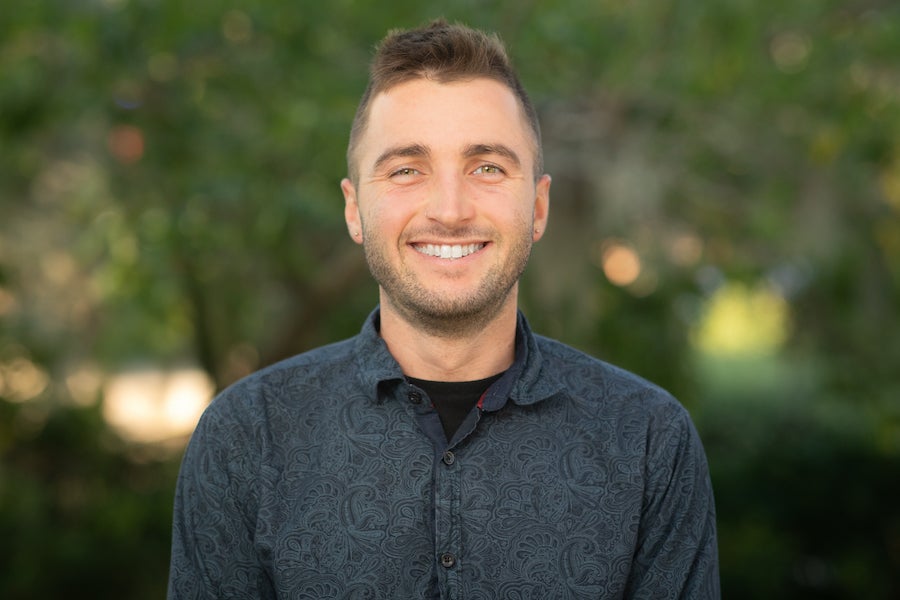
Eli Myron is a first-year doctoral student in biological science through Florida State University’s Department of Biological Science, part of the College of Arts and Sciences. Myron conducts research in the Rassweiler-Lester Lab, led by associate professors of biological science Andrew Rassweiler and Sarah Lester, on how coastal development shapes marine community structure. Additionally, he founded Ocean Scholar, a platform for ocean career development, and has worked as both a biologist and contract manager for the Florida Fish and Wildlife Conservation Commission.
Tell us about your background, where you’re from and what brought you to FSU.
I’m from Jacksonville, Florida and came to FSU in 2016 to study biology with a focus in marine science. After graduating with dual bachelor’s degrees in biological science and environment and society, I spent a year in Honduras working as a biologist and social media coordinator at the Whale Shark and Oceanic Research Center. In 2022, I returned to Tallahassee as a biologist with the Florida Fish and Wildlife Conservation Commission’s Artificial Reef Program. I returned to FSU in 2025 to pursue a doctorate under the mentorship of my adviser Andrew Rassweiler and study how coastal development influences marine communities.
What inspired you to pursue degrees in biological science?
I’ve always loved animals and being outdoors. That led me to study biology and ecology as an undergraduate. While completing my honors thesis on artificial reefs, I became fascinated by the patterns I uncovered through research. After graduation, I explored marine science and realized I wanted research at the core of my work, which led me to pursue a doctorate.
What aspects of your studies do you find most rewarding?
Working in conservation biology allows me to connect science to communities and ecosystems. One of the most rewarding aspects of my work is identifying ecological challenges and collaborating with communities to create solutions that benefit the environment and the people depending on it. I enjoy learning what groups value, developing solutions that meet those needs, and seeing results in action.
Break down your areas of research for us.
My research focuses on the role of structure in marine ecosystems and how it shapes biological communities. In tropical marine systems, the structure of the seafloor plays an important role in determining which species are found there.
However, humans are changing the seafloor’s structure by adding man-made features such as oil rigs, jetties and artificial reefs, while natural structures, like coral reefs, are being degraded by coral stress and destructive fishing practices. I study how these changes affect marine ecosystems and how the results inform resource management and conservation strategies.
What do you want the public to know about the importance of your research?
Our coastlines are changing rapidly, and human activities are reshaping marine ecosystems in ways we don’t fully understand. My research helps fill these gaps by studying how structural changes influence marine communities to support conservation decisions and help protect ecosystems and people who rely on them.
Tell us about your work with the Florida Fish and Wildlife Conservation Commission.
From late 2022 to mid-2025, I worked in the Division of Marine Fisheries Management under the Artificial Reef Program, serving as both a biologist and contract manager with a focus on the Florida Panhandle. I collaborated with cities, counties, and nonprofits to design artificial reefs that met program goals and regulatory requirements. I also surveyed reef sites and monitored deployed reefs using data collection methods such as scuba diving, side-scan sonar and photo and video surveys.
Tell us about earning a Fulbright Fellowship.
During my junior year at FSU, I began preparing an application for a Fulbright Scholar Award to gain research experience in the Philippines. In May 2020, I received the award, which was an honor and a confidence boost.
However, the COVID-19 pandemic caused significant delays. After graduation, I took a temporary job while waiting for updates but eventually decided to move to Utila, Honduras, to complete scuba training and pursue long-term work in marine conservation. When I received a job offer at the Whale Shark and Oceanic Research Center, I chose to withdraw from the Fulbright program due to uncertainty.
Although disappointing, the experience allowed me to slow down, grow professionally and reconsider my career path. I plan to reapply to Fulbright to complete part of my doctoral research abroad.
Are there any faculty or staff who have helped or inspired you?
I wouldn’t be where I am today without the support of many at FSU. As an undergraduate, FSU Coastal and Marine Laboratory research faculty Sandra Brooke played a pivotal role in launching my career in marine science. Chris Peters, FSUCML diving safety officer, helped build my confidence and skills as a diver. Jesse Wieland, former associate director of FSU’s Office of National Fellowships, was essential in helping me secure grants like the Fulbright. As a graduate student, lab leaders Rassweiler and Lester have been incredibly supportive and inspiring and I look forward to working with them throughout my Ph.D.
What on-campus resources have helped you achieve success?
ONF has been the most impactful resource in my academic journey. I worked with ONF staff during my undergraduate career and secured multiple funding opportunities, including the 2020 Fulbright, a 2024 Fulbright semifinalist distinction, and a 2025 National Science Foundation Graduate Research Fellowship Program honorable mention.
The FSU Career Center was also helpful in my undergraduate career, helping me build my résumé and connecting me with an FSUCML internship.
What advice do you have for fellow students? For undergrads?
It’s okay to not have everything figured out. There’s a lot of pressure to know your “dream job” and have a career plan, but changing directions is normal and often beneficial. Your journey is your strength.
I recommend planning your weeks to maintain a work-life balance. Student life can be demanding, but scheduling both work and rest can make a difference. Take care of yourself, lean on your support system, and remember you’re not alone.