
Student Spotlight: Rachel Flemming
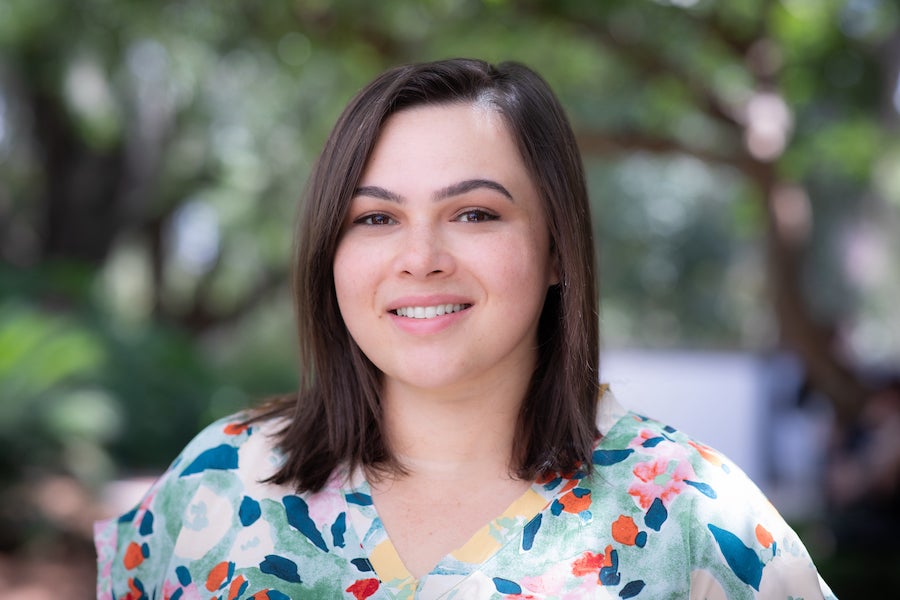
Rachel Flemming is a Florida State University doctoral candidate pursuing a Ph.D. in Hispanic linguistics through the Department of Modern Languages and Linguistics, part of the College of Arts and Sciences, with plans to graduate in Fall 2026. She is already a two-time FSU alumna, having earned a master’s in Hispanic linguistics in 2018 and a bachelor’s with a double major in Spanish and English from the Department of English in 2013. Flemming has earned FSU academic awards including the 2020 Outstanding Teaching Assistant Award, second place in the 2022 Three Minute Thesis Competition, and the 2025 Best Organized Op-Ed in the Graduate Student Op-Ed Competition. She also served as a course-level coordinator for her department and worked with administration to prepare calendars and assessments while overseeing other teaching assistants.
Tell us a little about your background.
I’m a Tallahassee native. After earning my master’s degree, I stayed at FSU for my doctorate because I was drawn to the department’s research program.
What inspired you to pursue a doctorate in Hispanic linguistics?
During my undergraduate years when I double-majored in English and Spanish, I was introduced to linguistics and became very interested in language learning. I wanted to learn more about how the mind conceptualizes language and how we can make classroom-based language learning more efficient.
Can you break down your areas of research?
My research centers around adult second language education. Different teaching methods and models tell us how language learning works, specifically in terms of the cognitive processing of language. I examine how the mind responds during language learning and what occurs internally as it happens.
Tell us about your role as a course instructor for the Department of Modern Languages and Linguistics.
I’ve taught Spanish 1 through Spanish 4, as well as an applied linguistics course, which covered topics such as neurolinguistics, psycholinguistics, animal communication and child language learning. I started teaching as part of the master’s degree program, and it’s become something that I’m very passionate about. I consistently keep up with the latest research in my field to create the best possible learning environments for my students.
What’s something people don’t know about studying a foreign language?
There’s a difference between how language exists in our minds and how our minds store and process this language. Many curricula enforce memorizing grammar rules, which doesn’t always translate into a real-time conversation. We call it metalinguistic information — knowing about the rules and structure of a language rather than the ability to use it in a conversation. To acquire fluency, we must use language in a meaningful way such as conversation or active listening. Knowing the rules may have its place, but it’s not the same as being able to speak and understand the language.
What aspects of teaching do you find most rewarding?
Seeing students’ progress over time is extremely rewarding. It’s incredible to watch someone who began with no conversational ability be able to converse, read and write in a new language. Students in FSU language programs generally have three hours of class per week for three semesters, which is not very much. It’s impressive to see how much they accomplish with the exposure they have.
What are some current goals or projects that you’re working on?
My dissertation project, which I’ll be presenting and defending in Fall 2026, compares two different teaching methodologies. In input-based learning, students learn through listening and reading, and in output-based learning, students learn through speaking and writing. I’m using multiple evaluation methods to measure the effectiveness of each approach, including a self-paced reading task that assesses learners’ sensitivity to grammatical mistakes.
For example, in English, we add an “s” to verbs in sentences like “he walks to the store.” If I say, “Every day he walks to the store,” that sounds perfectly fine. However, if I said, “Every day he walk to the store,” most people would immediately recognize that something sounds wrong. This reaction occurs because the grammar has been internalized and stored in our mental system for language. If people are sensitive to these mistakes during testing, it suggests they’ve acquired the grammar. If they don’t notice a difference, it suggests they may not have acquired that grammar form yet.
Are there any faculty or staff who have helped or inspired you?
Michael Leeser, my major professor and coordinator of the Spanish program, has been especially influential in my development. When I began my master’s in 2016, he played a central role in my training as an instructor. He taught me effective language teaching practices, particularly task-based language learning and how to design classes that are engaging and meaningful for students.
He’s also been instrumental in my research, helping me design projects and develop their theoretical foundations, and he’s been a personal inspiration, supporting not only my academic growth but my development as a person. He gave me valuable advice about managing stress, navigating challenges, and approaching problems with curiosity and openness.
Following graduation, what are your plans?
I would love to teach Spanish, linguistics, and courses related to language acquisition. Ideally, I will continue conducting research alongside teaching and work toward a tenured position that allows me to do both.
In future research, I hope to study additional teaching methods, explore new ways of evaluating language learners, and continue examining the cognitive side of language acquisition. I’m also very interested in curriculum design and would enjoy developing language programs that reflect what we know about language learning while also meeting the realities of the classroom.
What advice do you have for undergraduate students?
The best advice I can give is to stay curious. It’s easy to focus narrowly on career goals, but a liberal arts education is about growing as a person. You’re not just developing expertise; you’re learning to think across disciplines and engage meaningfully with the world. Even frustrating moments can offer valuable lessons. Course requirements may feel limiting at times but approaching them with curiosity can make your FSU experience far richer and more meaningful.