
Faculty Spotlight: Suzanne Sinke
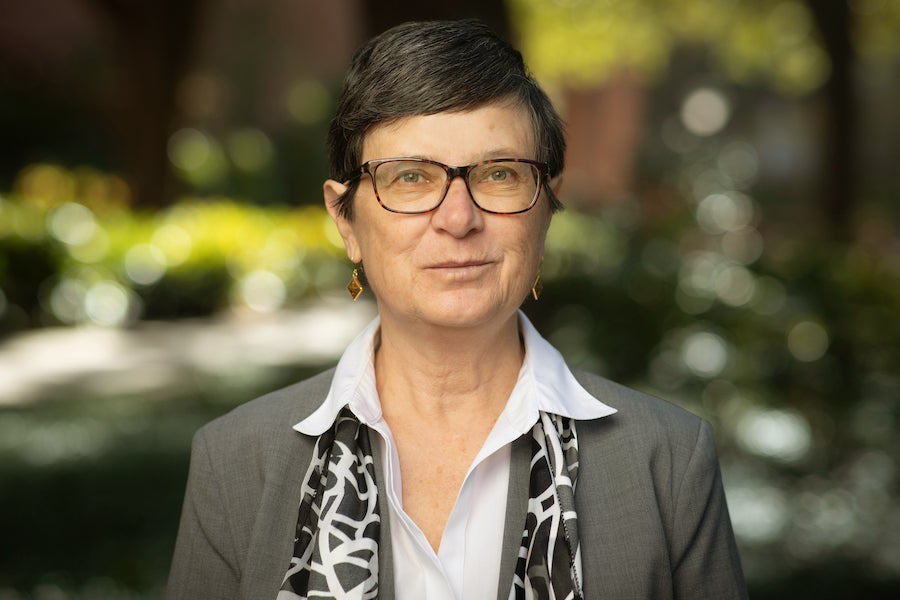
Suzanne Sinke is a professor in the Department of History, part of the Florida State University College of Arts and Sciences. Sinke joined FSU’s faculty in 2002 and has earned two Fulbright Distinguished Awards in Teaching, published a book and many articles, and, since 2018, served as editor for the Journal of American Ethnic History. In addition to her work as a professor, Sinke previously held the position of associate chair and director of graduate studies for the history department for 10 years.
Tell us about your background, where you are from and what brought you to FSU.
When I was growing up in the Midwest, I always knew I wanted to teach history. After receiving my master’s degree in history from Kent State University, Ohio, I earned a doctoral degree in history from the University of Minnesota, in Minneapolis. Then I taught at Clemson University in South Carolina for nearly 10 years until I got the offer to work at FSU, a position that has allowed me to engage with advanced graduate students and teach a wider range of classes.
Can you break down your areas of research for us?
My research falls broadly into two subjects: the history of international migration and the history of gender in the U.S. In recent years, I have focused much of my research and publications on the relationship of marriage to migration and on letters and other means of communication among migrants.
The current doctoral students I am advising are studying the history of Nigerian immigrant Pentecostalism, Dutch American religion during World War I, and the eugenics movement across the 20th century. I have supervised three doctoral students specifically interested in Dutch American history, along with several others who researched international migration or gender, covering topics ranging from the adoption of children from China to changing policies regarding gender in the U.S. military.
Describe your experiences as associate chair and director of graduate studies with the Department of History.
As associate chair and director for graduate studies, I sought to ensure that all our graduate students had funding, received formal training in fields that could lead to employment, and could complete the program on time. Helping students negotiate the professionalization process of graduate school gave me joy. I also handled a wide variety of tasks, from setting up recruitment events to implementing processes to help students achieve success in the program.
Tell us about your involvement in the Social Science History Association, a coalition of scholarly communities interested in social life and theory.
I have been active in the Social Science History Association since graduate school, and I previously served as a migration network chair and program co-chair. This association connects me with other historians, sociologists, anthropologists, and demographers who also study international migration. These connections have been especially rewarding and generative when I’ve dabbled in using quantitative sources in my research.
Describe your time as the editor for the Journal of American Ethnic History.
I am now in my 10th and final year as editor of the Journal of American Ethnic History, the leading academic publication related to international migration and the ethnic groups it engenders for North America. The journal appears quarterly, which means regular deadlines and coordination. I put lots of energy into selecting the right people to evaluate manuscripts for our double-blind review process. I have relished the ability to introduce scholars to the process of publication. In the last two years, I have also begun training my graduate students as editorial assistants so they can learn how journal publications function.
Tell us about your work with College Board, a nonprofit organization that connects students to college success, which manages the SAT and the Advanced Placement program.
The College Board asked me to become a consultant in 2008 and then co-chair of its U.S. history curriculum development and assessment committee from 2010 to 2012. During my time on the committee, I sought to shift the focus of the AP U.S. history exam away from simple memorization to make it more comparable to college courses.
Tell us about the teaching awards you have earned.
The Fulbright Scholar Program honored me twice with opportunities to teach and build academic and personal networks at other institutions, first in Tampere, Finland, and second in Salzburg, Austria. After my time in Austria, I coordinated with the Institute on World War II and the Human Experience to host a conference with a focus on Austrian sources.
Additionally, in 2025, the Organization of American Historians presented me with a summer teaching award at the University of Augsburg, where I taught a history class around the question: Is the U.S. a nation of immigrants?
Tell us about your experiences as president of the Association for the Advancement of Dutch and American Studies.
For a number of years, I worked on Dutch American history, including authoring the book, “Dutch Immigrant Women in the United States, 1880-1920.” That trajectory connected me to the Association for the Advancement of Dutch American Studies and then led to my election as association president.
Established in 1980, the association encourages research and interest in the history, life, and culture of the Dutch in North America. As president, I organized international conferences, wrote regular updates, and worked with both academic and armchair historians in the group.
What exciting projects are you working toward?
Currently, I am working with the correspondence of a family of refugees from Nazi Germany who scattered to many countries, hiding struggles from one another as they wrote: dealing with polio, marital abuse and mental instability. I have an upcoming paper exploring emotions within this context of this psychological turmoil.
If your students only learned one thing from you, what would you hope it to be?
I would hope students leave my classes knowing that we cannot understand the present without history, and that this understanding includes history’s influence on their own lives.