
Student Spotlight: Savoya Simone Joyner
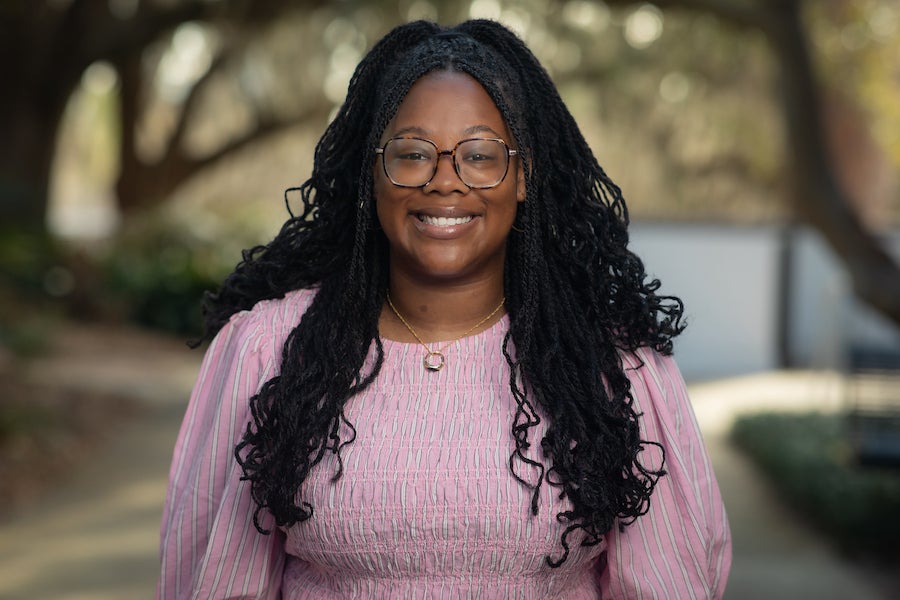
Savoya Simone Joyner is a fifth-year doctoral student in Florida State University’s Program in Neuroscience, an interdisciplinary program with the Department of Biological Science and Department of Psychology, both in the College of Arts and Sciences, and FSU’s College of Medicine. Her research examines sex differences in the brain and immune system that contribute to obesity development, and she’s currently investigating how estrogen protects against diet-induced obesity. Joyner is a McKnight Doctoral Fellow and a recipient of the National Institutes of Health T32 Chemosensory Training Program Dean’s Scholarship. She recently won Best Explanation of a Complicated Subject in FSU’s Graduate Student Op-Ed Competition, hosted by the Office of Graduate Fellowships and Awards, and expects to graduate in Fall 2026.
Tell us about your background.
I’m from Raleigh, North Carolina. In 2021, I earned my bachelor’s in biomedical sciences from North Carolina Central University, a historically Black university in Durham. During my senior year, I worked in a neuroscience-adjacent lab and met biological and biomedical sciences professor Gregory Cole, who completed his doctoral training in neuroscience at FSU, and he encouraged me to apply here. He explained that FSU’s neuroscience doctoral program offers early hands-on experience, strong mentorship, institutional training grants such as the NIH T32, and interdisciplinary research opportunities that allow rotations across departments. When I was admitted, Black faculty and students reached out to offer their support, helping me feel reassured about starting my doctoral program as a first-generation college graduate.
What inspired you to pursue a doctoral degree in neuroscience?
My curiosity about how the brain integrates internal and external signals to shape behavior inspired my studies. As an undergraduate, I focused on biological science and chemistry, which helped me build a foundation in molecular and physiological mechanisms. Later, I became interested in how these processes influence behavior in controlled rodent models and how environmental factors like diet affect energy balance and disease risk. Over time, I realized that neuroscience often overlooks the role of hormones and fats in shaping neurobiology. That realization shifted my research interests toward understanding behavioral change through neural, hormonal and immune interactions. Pursuing a doctorate in neuroscience allows me to investigate these connections and bridge the studies of behavior, metabolism and neuroendocrinology.
Break down your research.
My research focuses on understanding why females are often more protected against obesity and how the hormone estrogen contributes to that protection. I study how estrogen influences brain systems that regulate hunger and fullness, particularly during exposure to high-fat diets. I also examine how these diets trigger inflammation in key brain regions that control energy balance and whether estrogen helps prevent it. My goal is to better understand how hormonal changes influence obesity risk and inform more personalized strategies to prevent metabolic disease.
What aspects of your studies have been most rewarding?
I really enjoy scientific communication, presenting research and mentoring students. I also value the collaborations that come from discussing my research. What I enjoy most is that my career path allows me to keep learning and growing.
What do you want the public to understand about the importance of your research?
Examining hormones and their roles in regulating the body is important. What we eat affects the brain, and my research explores gut-brain communication to better understand how nutrient-rich diets influence health and how to help underserved communities access these diets.
Tell us about your experiences as a NIH T32 CTP Dean’s Scholarship recipient and a McKnight Fellow.
As part of the scholarship, we help create tutorials introducing different research areas to scientists outside our field and strengthen our publication workflow. We also deliver three-minute presentations to job candidates and visiting faculty, and we present at the biennial CTP retreat at Wakulla Springs to faculty and students in our department. As a McKnight Fellow, I’ve gained a strong sense of community with other Black and Latin scholars. The fellowship has given me confidence and a deeper sense of purpose in my academic journey.
Tell us about your essay, “The Key to Solving Sex Differences in Obesity Lies in Women’s Brains — If We Choose to See It.”
In this essay, I argue that sex differences in obesity are not solely driven by lifestyle or behavior — they’re rooted in the brain, particularly in how hormones like estrogen regulate appetite, energy balance and inflammation. I highlight evidence indicating that premenopausal females are relatively protected against obesity. The essay emphasizes that understanding these mechanisms is critical to developing effective, sex-specific prevention and treatment strategies. It calls for greater attention to women’s biology in obesity research rather than relying on male-centered models. I want the public to understand that hormones play a far more significant role in health than many people realize.
What projects are you currently working on?
I’m currently evaluating a preclinical rodent model of diet-induced obesity to explore how estrogen influences appetite, food preferences and weight gain. I’m also analyzing how high-fat diets trigger inflammation in brain regions that regulate hunger and metabolism and whether estrogen can reduce it. These projects help us better understand how hormonal changes may influence obesity risk in women.
Are there faculty or mentors who have influenced your academic journey?
I’m grateful to my dissertation committee and my primary adviser, neuroscience program director and professor of psychology Lisa Eckel, for their guidance and support. They consistently treated me as a scientist and encouraged my growth. I’m also thankful for mentors beyond FSU who challenged me to pursue goals that once felt out of reach and helped build the confidence I carry today.
What are you most looking forward to after graduation?
While I’ll miss the community I built here, I’m looking forward to stepping into the next phase of my scientific career with greater independence. I’m excited to deepen my research on sex differences in neuroimmunology, expand my technical expertise, and begin carving out my own niche in the field. After graduation, I want to pursue a general postdoctoral fellowship to study sex differences in immune function.