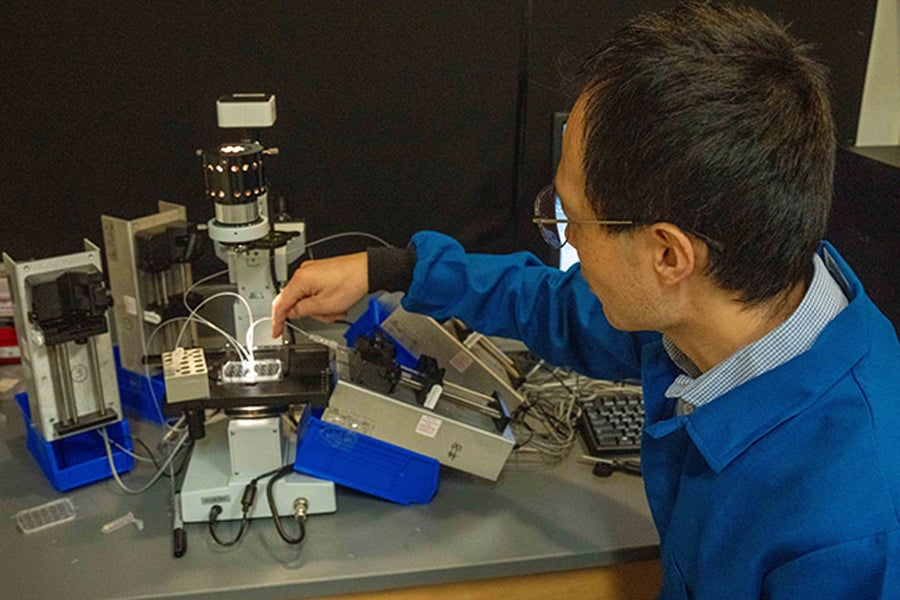
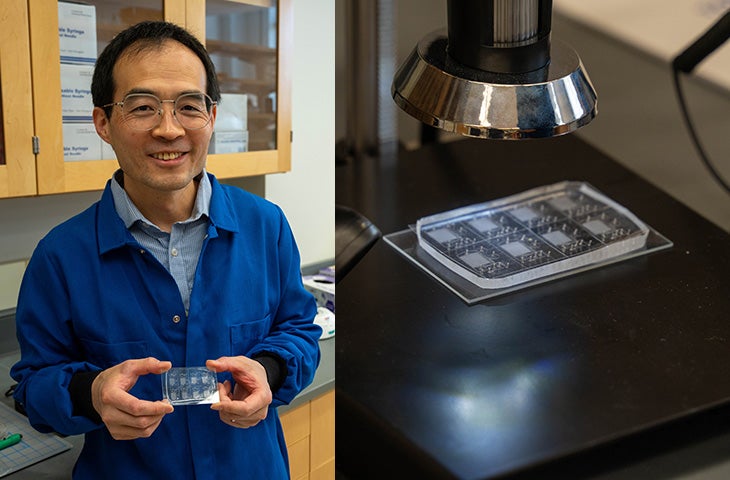
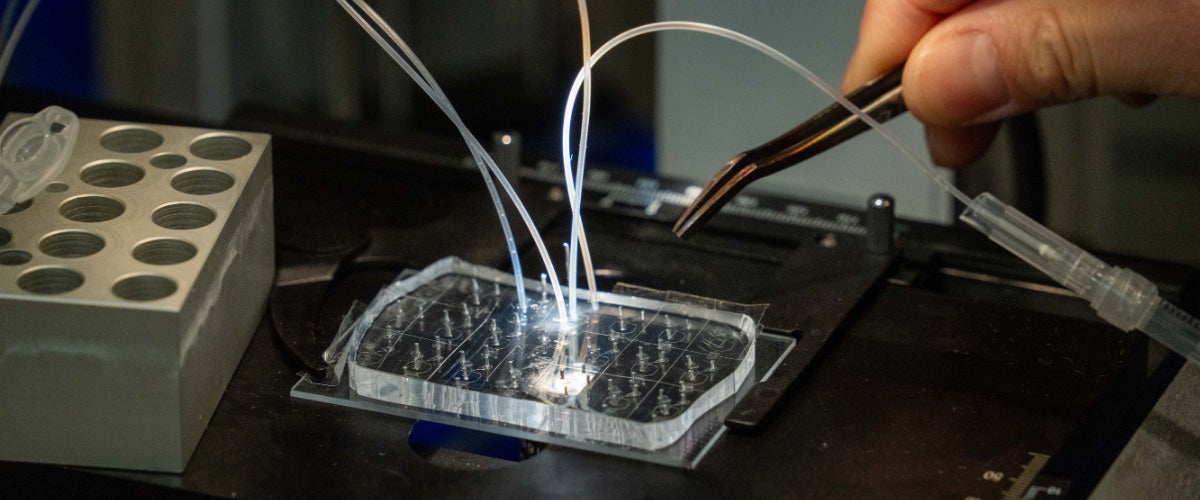
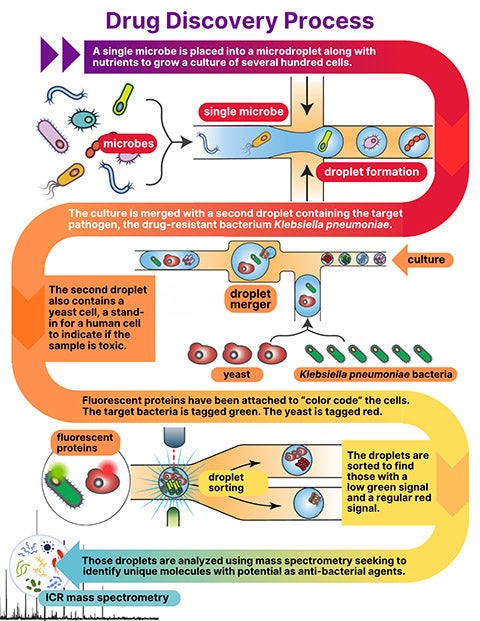
Li specializes in droplet microfluidics, manipulating tiny drops of fluid about the width of a human hair through troughs etched on a silicone disc to rapidly conduct chemical screening. His microfluidics system will quickly process tens of thousands of droplets at a time.
“Typically, when we search for new compounds from nature, it’s a rather arduous process working with individually isolated microbes, but with the speed of microfluidics and the analytical power of the Ion Cyclotron Resonance Facility, we can sample all of the microbes from a variety of environments all at once. It’s a very exciting collaboration,” said Edward Kalkreuter, an assistant professor in the Department of Chemistry and Biochemistry.
Inside the droplets, soil microbial cells will be combined with a common antibiotic-resistant bacterium called Klebsiella pneumoniae and a fluorescent color-coded tag to allow for rapid sorting.
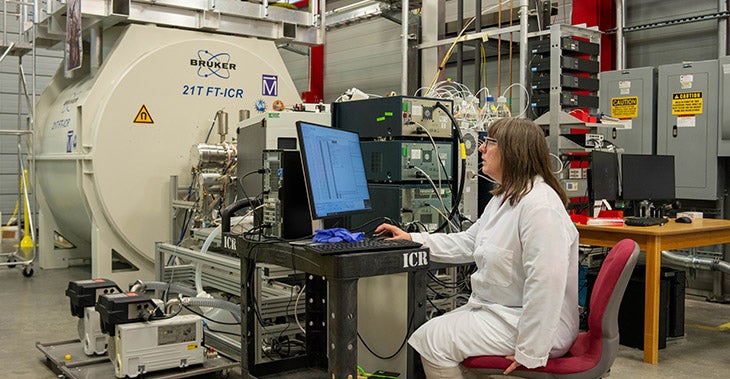
Then the MagLab’s Ion Cyclotron Resonance Facility, or ICR, will identify bioactive molecules from the soil microbes.
“You might have a soil sample and it kills the Klebsiella, but you don’t know what those molecules are. So that’s where we come in,” said ICR Director Kicki Håkansson.
The lab’s powerful ICR mass spectrometers will analyze the droplets that show antimicrobial activity to determine which molecules are responsible for the antibacterial properties. The precision analysis will also be crucial for making sure the discovery is indeed new.
“We’re looking for signals that have not been discovered before. We don’t want to rediscover penicillin,” Li said. “To do that, we annotate the molecular composition of each signal and compare it against databases of known compounds.”
Taking on that data analysis challenge will be the team’s fifth member, Ryan Rodgers, a researcher at the ICR.
International collaboration
The researchers will also share data and ideas with 21 other research groups around the world as part of an international drug discovery consortium with additional funding provided by the Gates Foundation and the Wellcome Trust. This coordinated investment and collaborative effort will accelerate the search for new medications that are crucial to addressing this growing crisis.
“This new approach allows us to look very thoroughly at compounds that haven’t been looked at,” Håkansson said. “And if we find something, this could be transformative, which is what’s really exciting.”