
Student Spotlight: Rimil Guha Roy
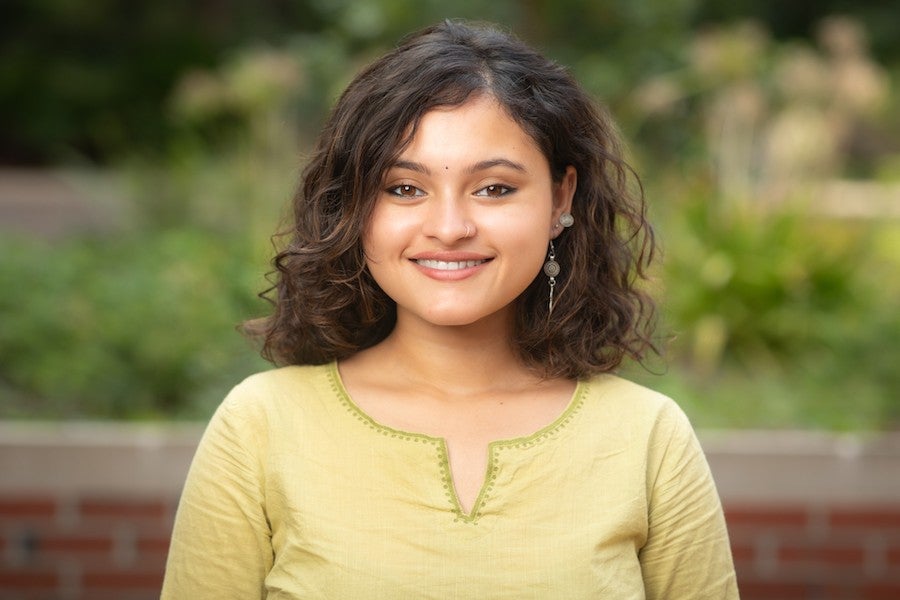
Rimil Guha Roy is a third-year doctoral candidate in Florida State University’s Program in Neuroscience, an interdisciplinary program with participation from the Department of Biological Science and Department of Psychology, both part of the College of Arts and Sciences, and FSU’s College of Medicine. She currently works in the Debi Fadool Laboratory researching the effects of the weight-loss drug semaglutide and studying the relationship between the brain and the metabolic system. In the FSU Graduate School’s 2025 Op-Ed Competition, Roy received an honorable mention award for “Best Explanation of a Complicated Subject.”
Tell us about your background, where you’re from and what brought you to FSU.
I’m from the eastern part of India where I spent my whole life until 2023, when I moved to the U.S. In 2018, I earned my bachelor’s in microbiology from Scottish Church College in Kolkata and my master’s in biochemistry and molecular biology in 2020 from Pondicherry University in Puducherry, both in India. I looked into doctorate programs at FSU because I had a few friends who were students here and loved it. When I first spoke to biological science professor Debi Fadool about her laboratory, it clicked that this was where I was meant to be.
What inspired you to pursue a degree in neuroscience?
Neuroscience wasn’t my background. I shifted from microbiology to biochemistry before I finally realized my passion for neuroscience. I worked at the National Brain Research Centre in India for about two and a half years operating an MRI machine and taking brain scans to gain more research experience. I realized that I'm very interested in how neurons function at a cellular and molecular level, so I applied to doctoral labs doing neuroscience research.
Can you break down your areas of research for us? What’s the goal of your research?
I study the olfactory system, which is responsible for our sense of smell, and its link to metabolism. How we smell and sense things around us influences physiological processes in the body, and yet, our sense of smell is the most mysterious of all the sensory systems.
My research focuses on a drug called semaglutide, which is sold under the brand names Wegovy and Ozempic. Most have heard of these medications as treatments for diabetes and weight loss, but they’re also being used to treat psychiatric issues like addiction and PTSD. I use patch clamp recordings, a technique that measures electrical currents in cell membranes like neurons, to see how semaglutide influences the way neurons communicate, especially in the brain’s olfactory bulb.
We’ve seen the way semaglutide affects how attracted people are to food, so I eventually want to investigate how semaglutide injections’ influence on smell could affect other ways we perceive the world.
What’s your role in the Debi Fadool Laboratory? What does a typical day in the lab look like?
A typical day in the lab depends on what experiments I'm running. Some days, I'm sorting data and trying to analyze it. If I'm running experiments, I have a longer day ahead of me as patch clamping is a very laborious technique and takes a lot of preparation. On those days, I make sure to take breaks before I come back and restart my work.
I love the flexibility of being a doctoral candidate because I have the freedom to work in the laboratory when I want.
What aspect of your area of study do you find most rewarding?
I find it super exciting that I’m getting to see neurons firing in real time. There’s so much coordination and synchronicity that goes on in the brain, like with all the neurons that have to fire together just to make someone think or speak.
I’m also excited to be involved in learning about varied types of research experiments and philosophies. When I speak with my peers, I find it fascinating to hear their perspectives on science. Their collective excitement reminds me that there’s a new discovery every day, no matter how small it is.
How did it feel to receive an honorable mention for “Best Explanation of a Complicated Subject” at the Op-Ed Competition for your paper, “The Taste of Joy: Are GLP-1 anti-obesity drugs altering what we like to eat?”
It was a great validation to receive this honor. In India, I wrote articles for the lab I was working in and developed a love for scientific writing. However, this was quite a different writing experience because I had to go on social media to read people’s opinions on Ozempic, which I really enjoyed. I look forward to writing about something new next year.
Following graduation, what are your plans? Even though you might miss FSU, what are you looking forward to once you graduate?
I’m looking into postdoctoral positions where I can pursue research regarding how perceptions change when someone has a mental health disorder. I want to understand how someone who is depressed might perceive the world differently than someone without depression. With all the new techniques developed in neuroscience, I want to explore the link between mental health and perception and how it may link to olfaction.
What advice do you have for fellow students? What advice do you have for undergraduates?
Being in the same boat as my fellow doctoral students, I know things get crazy sometimes. We try to define success as this upward trajectory, but one of the biggest things that research has taught me is that success is not linear. Failing one day doesn’t mean that you’re on a downward trajectory forever.
As for undergraduate students, I interact with them all the time as a teaching assistant, and I know a lot of them are incredibly stressed. It's important to have fun studying. No one should give up on having fun, no matter who you are or what you want to do. Another thing is to stay curious. If you want to get into research, don’t be shy — ask questions and be curious.