

Cyber Service

National scholarship program supports tomorrow’s experts studying today at FSU

Thu, 01/15/26
Cyber service graphic.

While warfighters in the United States armed forces complete basic training to prepare for real-world combat, a different kind of training is preparing another group of warriors to defend the country. But their battlefields aren’t abroad; they’re all around us, in cyberspace, and some of them are training right here at Florida State University.

Nearly 30 years ago, in 1998, then-President Bill Clinton signed Presidential Directive 63, requiring the Executive Branch to assess the cyber vulnerabilities of the nation’s critical infrastructures including information and communication, banking and finance, energy, transportation, water supply, emergency services and public health. The directive also called for the creation of the National Plan for Information Systems Protection, NPISP, designed to shield America from cyber disruptions.

Today, despite some highly publicized tech-sector layoffs, the field of cybersecurity continues to flourish. According to Bureau of Labor Statistics estimates, employment for information security analysts is projected to grow 29 percent from 2024 to 2034, and computer occupations overall by 9 percent, both far outpacing the projected national job growth rate of 3 percent.

“We have a severe shortage in the cybersecurity workforce, especially in the government sector,” explained An-I Andy Wang, Mainline Information Systems Endowed Professor in the FSU Department of Computer Science. “We need these cyber warriors to defend our national cyber infrastructure.”

Since it began at FSU, the SFS program has been renewed many times and has supported 119 graduate and undergraduate students studying cybersecurity with a 92 percent placement rate in federal government agencies. Our graduates are highly sought after.

— An-I Andy Wang, Mainline Information Systems Endowed Professor, FSU Department of Computer Science

As a result of NPISP, the CyberCorps Scholarship for Service program, or SFS, was established in 2000. The program, cosponsored by the National Science Foundation and Department of Homeland Security, addresses the continued and growing demand for highly qualified cybersecurity experts by providing scholarships to outstanding computer science students with an interest in cybersecurity. In exchange for scholarships, students work in federal government after graduation for a period equivalent to the length of their study.

In 2002, the National Security Agency designated FSU as a Center of Academic Excellence in Information Assurance Education in Cyber Defense and Research, an honor granted to institutions that meet rigorous cybersecurity education standards. The following year, FSU was awarded its first SFS grant.

“Since it began at FSU, the SFS program has been renewed many times and has supported 119 graduate and undergraduate students studying cybersecurity with a 92 percent placement rate in federal government agencies,” said Wang, the principal investigator for the grant. “Our graduates are highly sought after.”

In 2022, FSU received renewed NSF funding to support 32 SFS Scholars through 2028. The scholarships are merit-based, and recipients pursue degrees in computer science, cybersecurity, cyber criminology, and computer and network administration.

Computer science professors Mike Burmester, Xiuwen Liu, and David Whalley are co-investigators for the SFS grant, overseeing student recruitment, retention, professional development and evaluation.

“The program provides a very financially lucrative scholarship,” said Whalley, Distinguished Research Professor and E.P. Miles Professor of Computer Science. “Students receive a nine-month scholarship that spans the fall and spring semesters. The stipend is $27,000 for undergraduates, $37,000 for graduate students, and covers tuition and all other education-related fees.”

Xiuwen Liu, Mike Burmester, An-I Andy Wang and David Whalley.
Clockwise from top left: Xiuwen Liu, Mike Burmester, An-I Andy Wang and David Whalley. Photo by Devin Bittner.

Scholarship recipients also take a trip to Washington, D.C. each January to attend the national SFS job fair, an opportunity to meet face-to-face with federal agencies and test-drive different career avenues that align with their specific areas of interest.

“As part of the grant, we have the funds to fly the students there and take care of their expenses,” Whalley said. “They attend the job fair at least twice — the first time to arrange for online interviews for a required summer internship and the second to arrange for on-site interviews for their employment after graduation.”

Elijah Lieu, a graduate student and SFS Scholar majoring in cybersecurity, first learned about the scholarship in 2024 while earning his bachelor’s in computer science at FSU and applied after attending an information session hosted by Wang.

“SFS enabled me to start a master’s program, which I previously hadn't considered for financial reasons,” Lieu said. “When I met more of the cohort, there was an incredible amount of talent there, and everybody was so driven, hardworking and smart. I knew I wanted to be a part of this group.”

The scholarship, Lieu added, has provided him the flexibility to focus solely on school and earning the best grades possible. For his required internship, he accepted an opportunity to work in security analysis for Oak Ridge National Laboratory in Tennessee.

“‘Required’ is a funny word for the internship because you end up doing exactly what you want to do,” said Lieu, who hopes to work at a national lab following graduation. “I’ve learned so much through that internship. What I’ve seen with some of the alumni is that they’re able to leverage that SFS recognition after graduation — even at my internship, half of the team was from SFS, and the other half had worked there before SFS’s inception. It’s a national recognition, and it’s wonderful to have.”

SFS enabled me to start a master’s program, which I previously hadn't considered for financial reasons. When I met more of the cohort, there was an incredible amount of talent there, and everybody was so driven, hardworking and smart. I knew I wanted to be a part of this group.

— Elijah Lieu, Scholarship for Service Scholar

Graduates of the SFS program are able to fulfill their post-graduation service requirement with any federal cybersecurity job.

“Our graduates go on to become cybersecurity investigators for federal agencies such as the FBI, CIA, NSA, Department of Defense, Department of Energy, and more, to defend the cyber infrastructure of this nation,” Wang said.

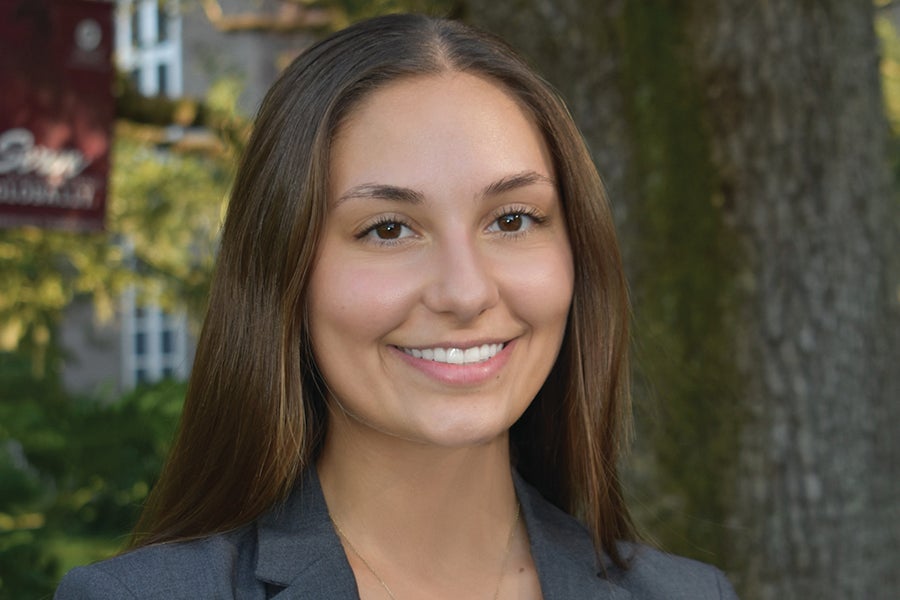
Program alumna Emma Baudo was referred for the scholarship by a professor in a computer security fundamentals course while she was an undergraduate studying cyber criminology.

Emma Baudo, SFS program alumna.
Emma Baudo. Courtesy photo.

“I was always interested in working for the federal government,” said Baudo, who graduated  in 2024 with a master’s in cybersecurity. “One of the biggest reasons I applied for the SFS program was because it allowed me to continue my education, and the financial assistance allowed me to graduate with no student debt.”

Baudo now works full-time in cybersecurity for the federal government, but like many of her fellow alumni, specific details of her role are classified. As she takes on her next challenge, she’s thankful for her SFS experience.

“The SFS program allowed me not only to work for the federal government post-graduation, which is what I was planning on doing anyway, but it assisted in tuition aid as well as stipend aid,” Baudo said. “Working for the government post-graduation is a great start to any career, whether you’re in computer science, cyber- security, engineering, math, or any other field because it provides so many resources — the sky is the limit.”

I was always interested in working for the federal government. One of the biggest reasons I applied for the SFS program was because it allowed me to continue my education, and the financial assistance allowed me to graduate with no student debt.

— Emma Baudo, Scholarship for Service program alumna

FSU is on track to apply for a renewal of the SFS grant program and continue supporting the next generation of cybersecurity specialists. To learn more about the Scholarship for Service Program at FSU, visit sait.fsu.edu.

Capture the Flag

FSU has been a pioneer in educating capable cybersecurity scholars for more than 20 years, but technical coursework alone cannot keep pace with the speed of change in cybersecurity. Recognizing this reality and to better meet the nation's needs for national security in the digital realm, FSU faculty in 2018 launched a competitive “Capture the Flag” program designed to provide students with real-world offensive and defensive cyber experience.

“Through these competitions — where teams solve reverse engineering, cryptography, binary exploitation, web security, and other advanced challenges under time pressure — students gain the skills and instincts that cybersecurity careers demand,” Xiuwen Liu said. “A unique component of our program is we have developed a dedicated CTF course to maintain a pipeline of talent and allow our team to build on the accumulated experience and knowledge over the years."

A number of FSU’s SFS Scholars are also members of the FSU Cybersecurity Club, a student organization formed in 2013. The club, which is among the top 10 for CTF in the U.S., participates regularly in international competitions, teaming up against other universities, clubs, and professionals to crack codes and score points by solving real-world cyber challenges that include locating vulnerabilities in computer systems. Competitors range from high school students to experts 30 years into their cybersecurity careers.

“It's really wonderful because a lot of the challenges that we see are quite useful, either for the type of cybersecurity infrastructure that I'm researching or some of the information technology infrastructure that other students are focusing on in the major,” Elijah Lieu said.