

Material Mysteries

FSU alumnus-turned-faculty Zhengguang Lu investigates new states of matter to drive powerful quantum computing

Thu, 01/15/26
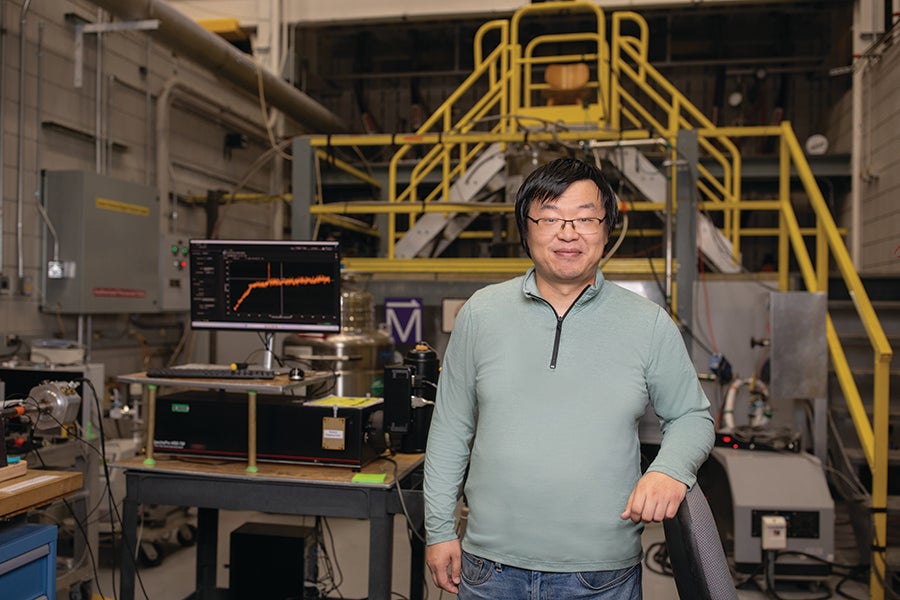
FSU alumnus-turned-faculty Zhengguang Lu.
Zhengguang Lu. Photo by Devin Bittner.

Take a look at the tip of your pencil. That humble lead is composed of thousands of layers of graphene — a material that holds incredible potential for creating stronger, more efficient electronics within laptops and in quantum applications including medicine, environmental science, national security and more.

As an assistant professor of physics at his alma mater, Florida State University, Zhengguang Lu pushes the limits of this common material by probing and transforming the naturally occurring sheets of carbon atoms to power innovative electronic and quantum technologies.

“I’m also affiliated with the FSU-headquartered National High Magnetic Field Laboratory, and my research demonstrates that there’s much more to learn about the simplest of materials,” Lu said. “Fundamental research is essential because while some of the applications aren’t immediately recognized, these discoveries have long-lasting effects on the field and in their applications, just like when the field-effect transistor was invented 80 years ago. It was a great discovery then, but no one could have imagined its applications today.”

Condensed-matter physics, the foundation of Lu’s research, investigates how new properties and phases of matter arise from interactions among elementary particles like electrons. When molecules interact under certain circumstances, like extremely high pressures or low temperatures, they can exhibit emergent behaviors and properties that create entirely new forms of matter.

For example, understanding how electrons behave in semiconductors enabled the development of the transistor, essential to the microprocessors that power modern electronic devices from smartphones to supercomputers.

“Zhengguang has a really creative physics mind, and what makes him a top experimental researcher of his generation in condensed-matter physics is his ability to translate brilliant physics ideas into practical experiments in the laboratory,” said Peng Xiong, professor of physics and an expert in the field of mesoscopic electronic phenomena in quantum materials. “His ability to make the impossible happen in the lab sets him apart.”
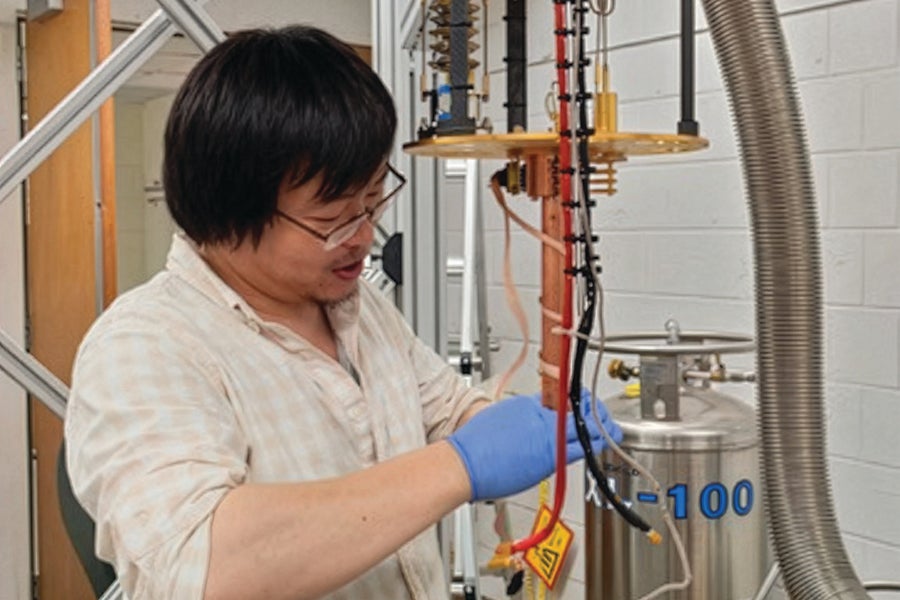
Zhengguang Lu sets up an experiment at the National High Magnetic Field Laboratory.
Zhengguang Lu sets up an experiment at the National High Magnetic Field Laboratory during his doctoral study. Courtesy photo.

Lu earned his bachelor’s in physics from Nankai University in Tianjin, China, in 2012. His school wasn’t far from Beijing, home to the Institute of Physics of the Chinese Academies of Sciences. There, Lu learned about modern condensed-matter physics at the Quantum Transport Lab, run by FSU alumnus Yongqing Li at the time, and became fascinated by experiments during the facility’s open houses.

“The scientific demonstrations were so cool, and I wanted to understand why they were so cool,” Lu said. “The principal investigator of the lab was one of Peng Xiong’s early students, which is how I met Peng. They both encouraged me to pursue my doctorate at FSU, and it was one of the only places I applied — this is where I wanted to be.”

During Lu’s graduate study at FSU and the National MagLab under research professor Dmitry Smirnov, he focused on magneto-optics in low-dimensional quantum materials. He received his doctorate in 2020 before taking a postdoctoral position at the Massachusetts Institute of Technology, where he participated in the first discovery of unusual electrical properties in graphene in 2023. After returning to FSU in 2024, he won the First Year Assistant Professor Award. For Lu, the choice to return to Tallahassee to continue cutting-edge quantum research after completing his postdoctoral appointment was obvious.

“It felt like coming home again,” he said. “I love the friendly, collaborative environment in my department, and the support I’ve received from the dean, the college, and FSU has been constant. Physics is a process of finding and discovering beautiful things, and I’m lucky to continue this work here.”

One year after joining FSU’s faculty, Lu was awarded the 2025 William L. McMillan Award from the University of Illinois, one of the most prestigious honors for early career researchers in the field. The award recognized Lu’s joint discovery of the fractional anomalous quantum Hall effect in multilayer graphene materials, a breakthrough demonstrating that electrons appear to split into fractions of themselves under certain conditions that can lead to future electronic and quantum applications.

His groundbreaking research, which is also aligned with the FSU Initiative in Quantum Science and Engineering, is only part of the legacy Lu has started at the university.

“He’s made an impressive impact through the inspiration and self-confidence he’s given to our graduate students,” Xiong said. “I’ve witnessed firsthand the changes in the students’ expectations and the confidence he’s given them. The forefront research he’s conducting at FSU and his everyday presence in laboratories brings excitement to both his students and other groups, including my own.”

McKenzie Harris is a two-time FSU alumna who earned a master’s degree from the College of Communication and Information in 2022 and a bachelor’s degree from the Department of English in 2020.