

Light Work

Chemistry alumna Alexandra Barth breaks scientific barriers by designing the next generation of energy-harvesting molecules

Thu, 01/15/26
Alexandra Barth, chemistry alumna.
Alexandra Barth. Photo courtesy California Institute of Technology.

The solar energy hitting Earth’s surface in one hour is powerful enough to fuel the global energy grid for an entire year. The problem, however, lies in our limited ability to capture and harvest this energy.

Photochemists like Alexandra Barth, a Florida State University Department of Chemistry and Biochemistry alumna, push past such scientific barriers by designing brand-new molecules that can efficiently harness light energy, leading to enhancements in fuels, industrial feedstocks and even medicine.

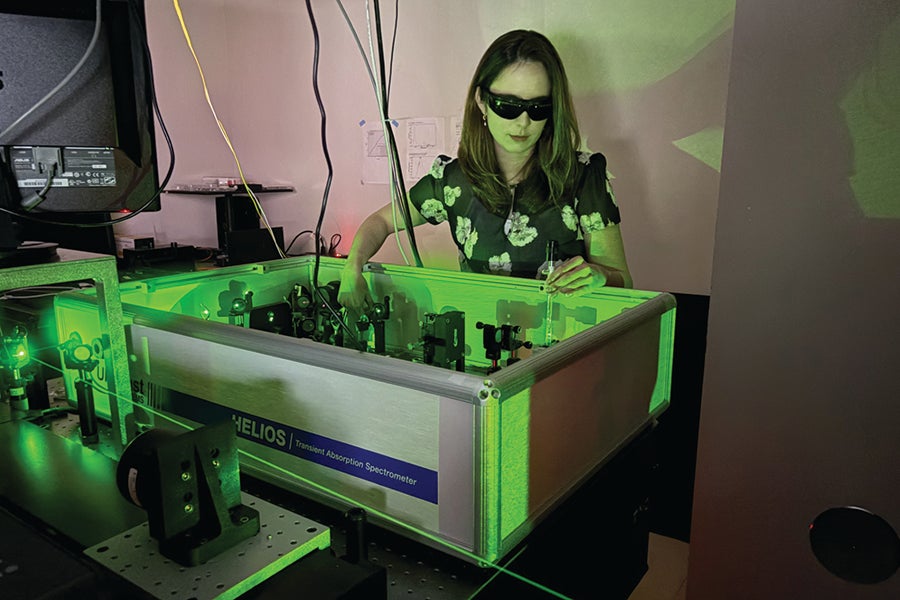
“When I mention my job, people often reminisce about how difficult they found chemistry courses,” Barth said. “Even without a technical background, people can understand that laser-based instruments are captivating and powerful. These tools, which allow me to understand chemical events occurring faster than I can blink, unlock new means of energy harvesting.”

As a postdoctoral researcher at North Carolina State University, Barth combines ultrafast spectroscopy — a technique that leverages lasers to measure and characterize molecules — with molecular design, or the intentional creation of new molecules. This approach seeks to identify ways scientists may have synthetic control over molecular properties, such as light-reactive charge localization, that are critical for discovering the next generation of energy materials.

“Chemists have recently recognized the power and potential of harnessing light energy for selective, unprecedented transformations,” Barth said. “Examples of these advancements include carbon dioxide reduction by turning greenhouse gas emissions into small-molecule fuels and creating more effective medicines through targeting bond construction to access complex molecules.”
Barth’s research also has applications in spintronics, or spin electronics — an emerging physics field that can increase processing capabilities while keeping the size of electronic devices small. Her graduate research explored ways to keep electrons in a polarized state for extended periods of time to create spin memory, a key component for efficient data storage in computers.

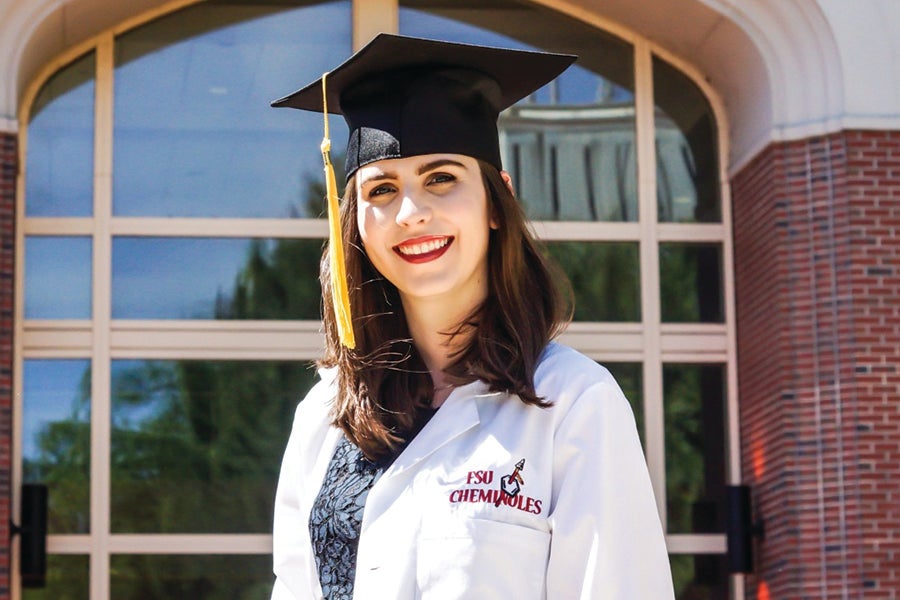
From the top: Alexandra Barth uses laser-based instruments to measure and characterize molecules. Photo by Sarah Arteta. Barth at graduation. Photo by Scotty Pham. Barth at the National MagLab. Courtesy photo.


“Alex has made significant contributions toward understanding the electronic structures of inorganic complexes,” said Felix Castellano, NCSU professor of chemistry and Barth’s postdoctoral mentor. “She brings significant energy to the Castellano Research Group in addition to being a capable and strong leader, which will serve her well in an independent faculty career.”

Barth began her NCSU postdoctoral appointment in 2023 shortly after earning her doctorate in chemistry from the California Institute of Technology. According to Barth, who graduated from FSU in 2017 with a bachelor’s in chemistry, her time in Tallahassee as a University Honors Program student set her up for success as an early career academic.

“At FSU, Alex demonstrated an amazing curiosity that manifested itself in substantive research, establishing herself as a phenomenal young scholar poised to have an impactful research career,” said Craig Filar, associate dean of FSU’s Honors, Scholars and Fellows, director of FSU’s Office of National Fellowships, and faculty director of the university’s Presidential Scholars Program. “The national recognition of Alex’s work and her continued efforts to mentor young women in chemistry illustrate her intelligence and depth of character. She’s a phenomenal representation of what an undergraduate can accomplish at FSU.”

In Summer 2025, Barth was among 35 early career scientists worldwide selected for the CAS Future Leaders Program, a leadership program hosted by the Chemical Abstracts Service division of the American Chemical Society. This initiative equips doctoral students and postdoctoral scholars with leadership training and networking opportunities.

As part of the program’s 15th cohort, Barth traveled to CAS headquarters in Columbus, Ohio. She also delivered a research presentation on molecular design strategies to enhance visible light absorption in long-lived, earth-abundant emitters at the ACS Fall 2025 conference in Washington, D.C., continuing a decade-long relationship with ACS that first began during her role as founding president of the ACS Student Chapter at FSU in 2015.

“Research is built for collaboration, and the CAS Future Leaders Program has easily been a career highlight thus far,” Barth said. “This program featured education in mentoring, problem-solving, storytelling and personal branding. After a decade of conducting research, it’s easy to get caught up in the details and forget the bigger picture; science only works if we can find ways to work together, discover new properties and materials, and share our findings with the public.”