
FSU chemist lands international fellowship to advance quantum materials
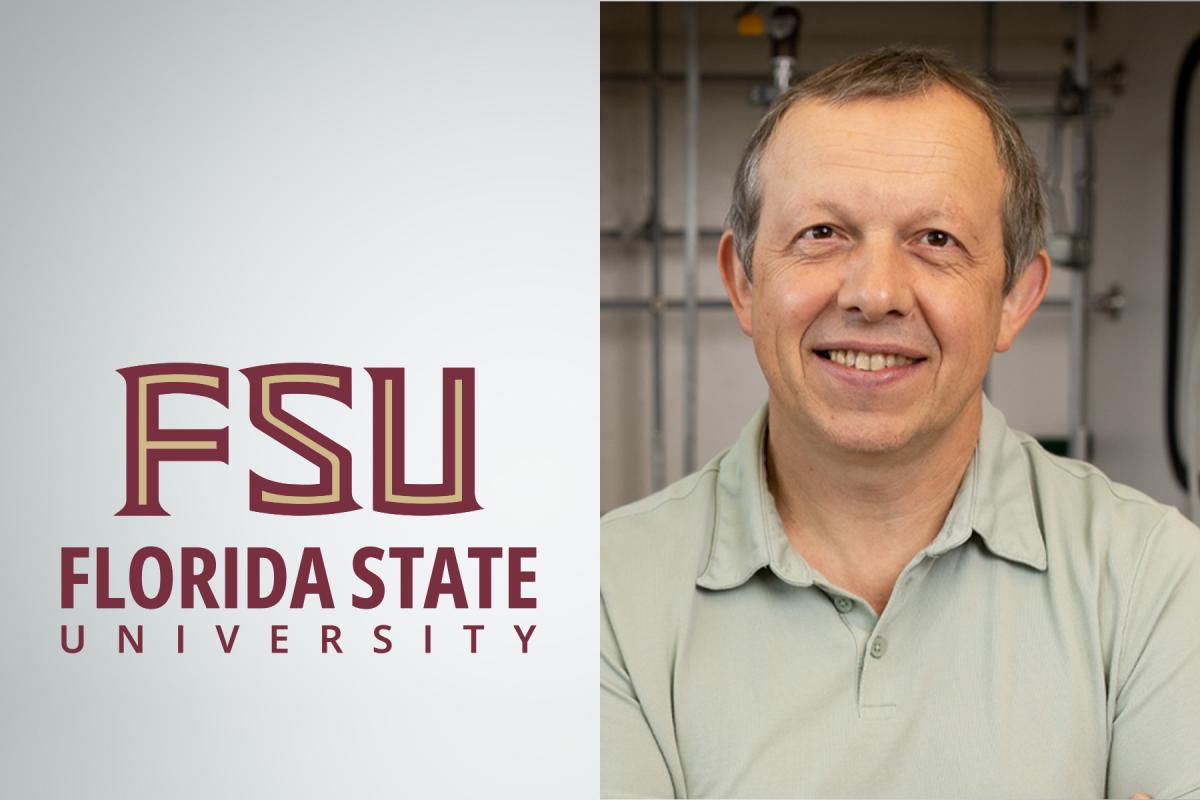
A Florida State University researcher has been awarded an international fellowship to develop new materials that contain quantum bits — the elementary units of quantum technologies — with eventual applications ranging from health care to cybersecurity.
Professor of Chemistry and Biochemistry Michael Shatruk has earned a 2025 Novo Nordisk Fellowship. Through 752,000 Danish kroner in funding, or about $117,000, the fellowship will allow Shatruk to study quantum molecule-based materials using advanced equipment housed at the Technical University of Denmark in Copenhagen through early May.
“Quantum technologies are poised to revolutionize many areas, including computing, drug development and medical sensing,” Shatruk said. “This fellowship will allow me to carry out research on quantum materials with extensive use of electron-diffraction crystallography, a rare and cutting-edge method for determining the crystal structures of sub-micron particles, which are less than one-thousandth of a millimeter in size.”
Based in Denmark, Novo Nordisk is a global pharmaceutical company specializing in medical treatments for serious chronic diseases. As the producer of half of the world’s insulin, Novo Nordisk is a global leader in diabetes care and notable for developing insulin pens as well as GLP-1 weight loss medications such as Ozempic and Wegovy. Novo Nordisk is also Denmark’s largest private sponsor of fundamental research and supports a wide array of work across scientific disciplines, including Shatruk’s discovery of new quantum materials.
“Dr. Shatruk’s research is highly innovative and rich with transformative insights and effective realizations,” said Wei Yang, chair of the Department of Chemistry and Biochemistry. “In the past decade, scholar development has been a major departmental focus, and Dr. Shatruk’s fellowship, which centers on improving quantum science and technology, is a testimony to FSU’s synergistic efforts.”
“Quantum” refers to the smallest possible unit of a material and is often associated with quantum computing, which can perform large tasks faster and more efficiently than classical computing through cutting-edge processing chips. The average laptop or phone has plenty of computing power for everyday use like internet surfing and building spreadsheets, for example.
However, industries involving artificial intelligence, health care, and scientific research often need to process large quantities of data to explore multiple possibilities at once — quantum computing’s specialty. Quantum chips can “think” more complexly than typical computers as a result of qubits, or atomic-sized particles engineered for their unique ability to represent multiple values simultaneously.
“While in Denmark, I plan to work on the systems that create two-dimensional arrays of qubits, which are the building blocks of chips used in quantum devices,” Shatruk said. “The focus of my project is to study molecular spin qubits placed in the nodes of metal-organic frameworks, or MOFs, to increase computing stability and power. The discovery of MOFs was recognized with the 2025 Nobel Prize in Chemistry, so it is fun to work in this field immediately after it received such great recognition.”
MOFs are crystalline structures that are built from metallic ions connected by organic molecules to form a porous material that is readily customizable for specific tasks, including the slow, controlled release of drugs in the body. By integrating MOFs in quantum chips, Shatruk aims to target stability issues in current quantum technology. Most MOFs are smaller than one micron, while a single strand of human hair is about 70 microns in diameter. “Large” MOF crystals are still under one millimeter in size.
“Unfortunately, it is difficult to grow large MOF crystals, so many of them cannot be studied using traditional single-crystal X-ray crystallography methods,” Shatruk said. “The electron-diffraction crystallography machinery in Denmark will help determine the atomic structures of MOFs, even if large crystals cannot be grown, because it enables crystal structure determination on sub-micron particles.”
In 2023, Shatruk became the founding director of the FSU Initiative in Quantum Science and Engineering. With an initial investment of more than $20 million from FSU over three years, the initiative aims to accelerate the discovery of novel quantum phenomena that can impact the design of quantum-related systems.
Visit the FSU Department of Chemistry and Biochemistry website to learn more about Shatruk’s work and research. Visit quantum.fsu.edu to learn more about the FSU Initiative in Quantum Science.