
Two Florida State University history graduates win statewide awards in historic preservation
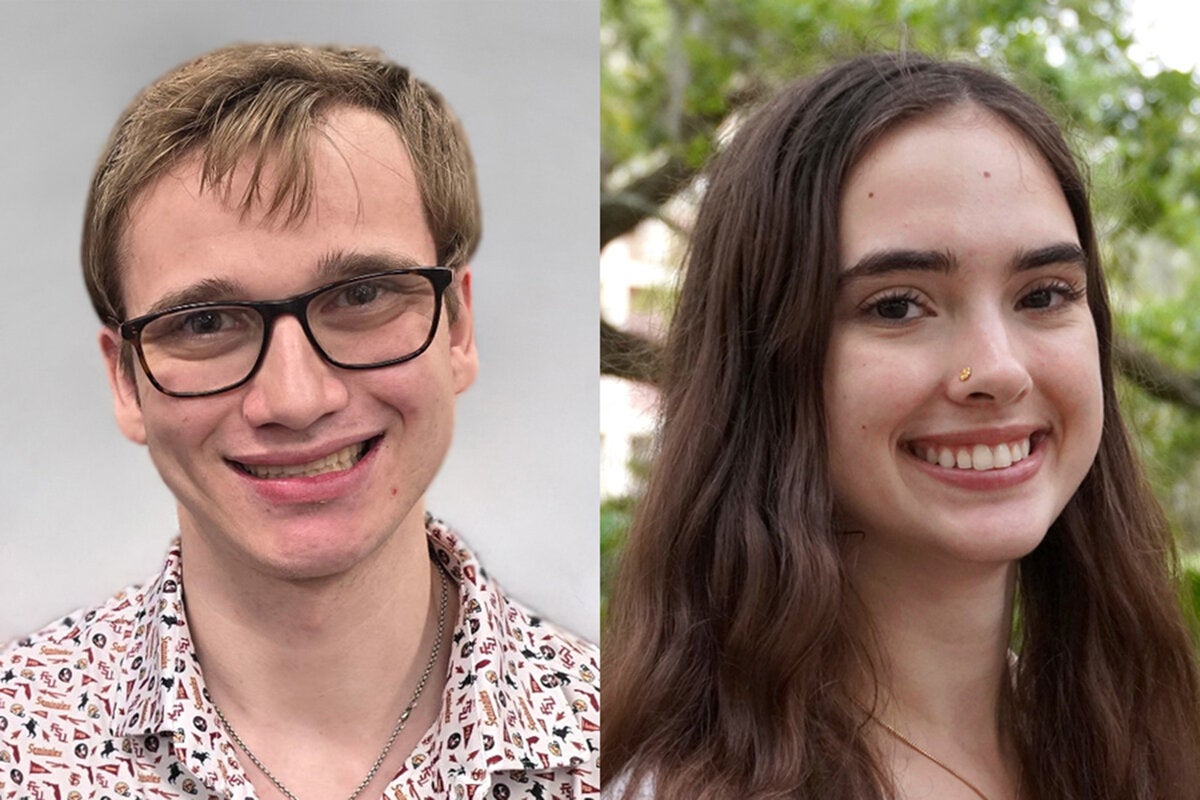
Two Florida State University students from the Department of History have earned prestigious awards for their work in the identification, protection and rehabilitation of historic sites around the state of Florida.
Chase Panish and Flora Domitrovic, both Spring 2026 graduates, have won the Historic Preservation Scholar Award from the Florida Trust for Historic Preservation, a statewide award recognizing outstanding scholarship in the field.
The Florida Trust for Historic Preservation is a statewide non-profit founded in 1978 with the goal of promoting the preservation and sharing of Florida’s heritage. The awards were first presented in 2024, and many of the recipients have hailed from FSU.
“Flora and Chase are gifted preservationists who excel at archival research to create research projects that benefit their communities,” said Kathleen Powers Conti, an assistant professor of history at FSU who nominated the students for this award. “Two of our students receiving this prestigious, statewide award showcases the important, community-engaged work that the Department of History does every day.”
“Flora and Chase are gifted preservationists who excel at archival research to create research projects that benefit their communities. Two of our students receiving this prestigious, statewide award showcases the important, community-engaged work that the Department of History does every day.”
— Kathleen Powers Conti, assistant professor of history at FSU
Panish was honored with the Historic Preservation Scholar Award for his work nominating Tallahassee’s Union Bank to the National Register of Historic Places (NRHP). When the NRHP — the official list of the U.S.’s historically significant places — was created in 1966, there was a rush to build out the list. The Union Bank was originally listed in 1971, but like many of the original listings, the existing nomination was quite short and had substantial gaps. Panish authored an updated nomination for the Union Bank, the state’s oldest surviving bank building, to include more substantive discussions about its history and architectural significance.
A NRHP nomination requires months of archival research, interviews and site visits to create a detailed description of a site’s long history and architectural significance. Panish worked closely with the Florida Department of State’s Division of Historical Resources to develop the appropriate documentation to renominate the bank with a testament of its full history including its time as a plantation owner’s bank and, later, a branch of the Freedman’s Savings and Trust Company, a Congress-chartered bank serving formerly enslaved people.
“Don’t look past a small building. Every patch of dirt has a history if you look far enough,” Panish said. “Just follow your interests because you never know where they may lead.”
Prior to graduating this spring with a master’s in history with a major in public history, Panish interned at Heritage Village, a public museum featuring a collection of a historic structures in Pinellas County, Fla., during which he created several precise, digital, architectural drawings to help the museum complete its catalog of these structures.
Panish also used specialized software to design and build 3D virtual models of the structures to create an opportunity for people with disabilities who may not be able to fully access these sites a chance to experience them. As an advocate for accessibility in preservation, Panish was selected by the National Council on Public History to partake in the Accessibility Working Group beginning in Jan. 2025, a team dedicated to making public history more inclusive and accessible for people with disabilities.
“I’m disabled but there are not a lot of disabled people in the preservation realm,” Panish said. “I’m grateful for the research and to have received this honor so that I can represent the small amount of disabled people in my field.”
After graduation, Panish plans to continue his involvement in cultural resource management as an architectural historian, documenting and evaluating historic sites for preservation.
Domitrovic earned the Historic Preservation Scholar Award for her Honors in the Major project, “Early Computers as a Tool for Ecologically Conscious City Planning.” Her research examined how urban planners in the 1970s encouraged more environmentally conscious planning, in line with new environmental regulations of the time, through the integration of computers into urban planning systems.
With support from an IDEA Grant from FSU’s Center for Undergraduate Research and Academic Engagement, Domitrovic visited the Library of Congress’ History of Computer Cartography and Geographic Information Sciences Archive during the summer of 2025 to examine primary sources related to the integration of these systems.
“We can see the similarities between how people grappled with automation in the integration of computers into the city-planning in the 1970s and the emergence of AI today,” said Domitrovic. “We can also see the link between environmental conservation and historic preservation, and the early efforts to try to protect them both.”
Domitrovic earned her bachelor’s degree in history from FSU this spring, and during her time in the department, she completed internships at the Port Authority of New York and New Jersey. She also worked with the Florida Resources and Environmental Analysis Center, starting with her experience in the Undergraduate Research Opportunity Program. Domitrovic also drafted a nomination to put Tallahassee’s Coca-Cola Bottling Plant, built in 1940, on the National Register of Historic Places.
In Fall 2026, she will join the University of Pennsylvania’s Stuart Weitzman School of Design to purse a master’s in city planning.
To learn more about historic preservation and the research conducted in the FSU Department of History, visit history.fsu.edu.