
Cascading Effects

Oceanographer Olivia Mason analyzes how marine disturbances affect microscopic organisms in waters around the world

Thu, 01/15/26
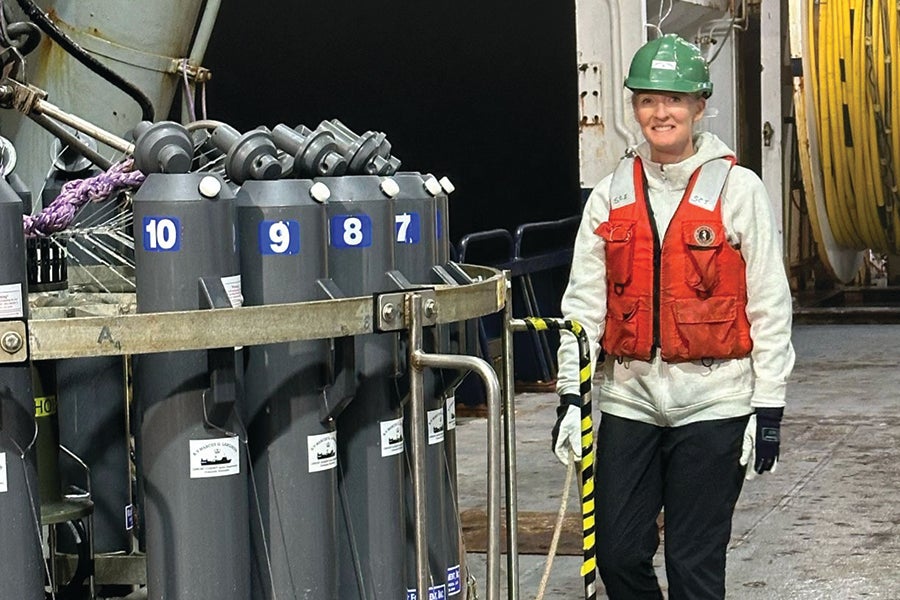
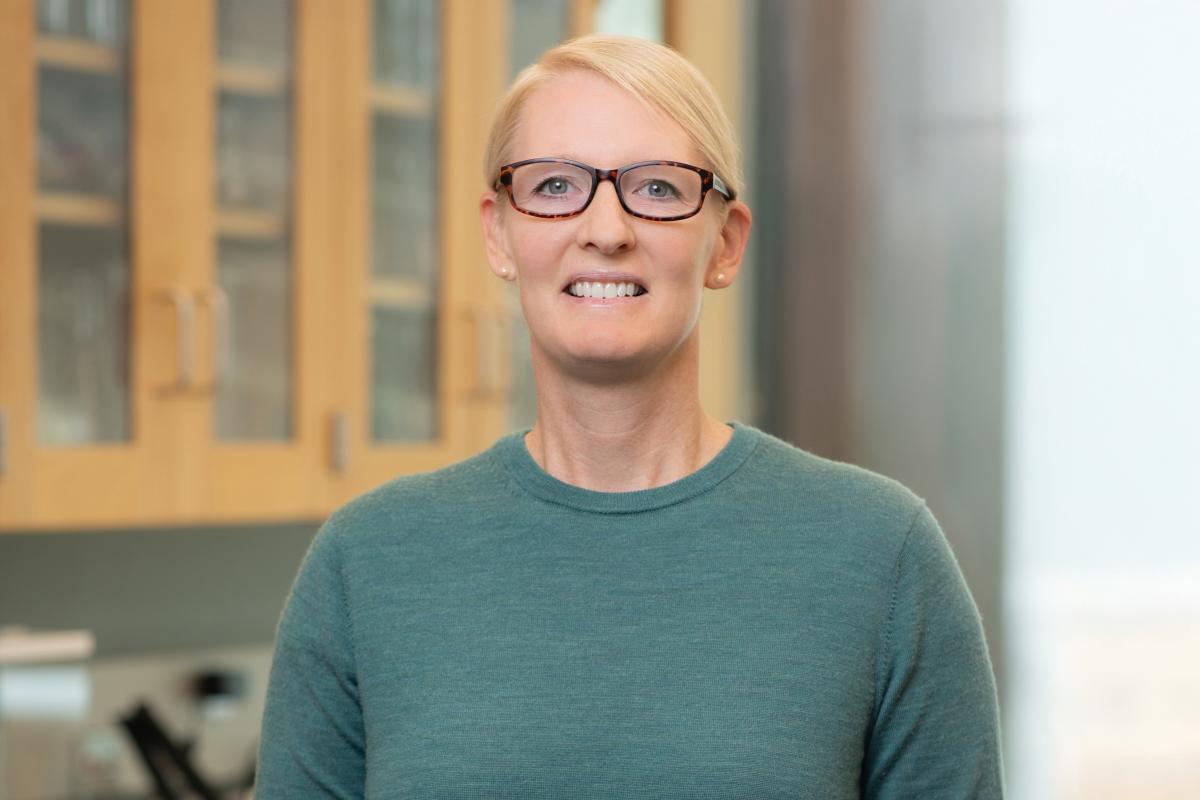
Oceanographer Olivia Mason.
Olivia Mason. Photo by Devin Bittner.

An underwater wellhead pipe leaks. Millions of gallons of oil gush onto the ocean floor. While the full consequences of this large spill won’t be seen for years, beneath the water’s surface, an important part of the area’s marine ecosystem is already changing because of microbes. These tiny living organisms, ranging in size from invisible to the naked eye to the width of a nickel, possess the ability to consume contaminants produced by the leak, meaning they literally eat oil.

Aboard a research vessel on the surface, Olivia Mason, then a postdoctoral researcher, collects samples from the water column to study the microbial response to the spill. Her research on these samples will go on to provide critical insights about the event that broaden our understanding of long-term impacts to ocean health and productivity.

“Discovering new information about microbes, which are difficult to grow in the lab due to their physiology, is thrilling,” Mason said. “My efforts increased our understanding of changes in microbial communities during major events like the 2010 Deepwater Horizon oil spill, allowing us to better predict the microbial response during subsequent ecosystem disturbances.”

Today, as a professor in Florida State University’s Department of Earth, Ocean and Atmospheric Science, Mason researches how microbes react to disruptions in the marine environment, including oil spills and areas with decreasing oxygen concentrations known as oxygen minimum zones, or OMZs.

Marine microbes — such as bacteria and archaea — are known as ecosystem engineers because they're involved in nearly all marine biogeochemical cycles, making them crucial to ecosystem function. As microbes change due to disturbances in their environment, their role in the ecosystem is affected, which can produce cascading effects on marine health and the food chain.

“With factors like rising ocean temperatures, OMZs are expanding exponentially,” said Mason, who holds a bachelor’s in natural resource conservation from the University of Massachusetts Amherst and a master’s in environmental science from Portland State University, Oregon. “My research allows us to understand how microbes respond to ecosystem perturbations like OMZs so we can understand the full effects these changes have on the ecosystem.”

As part of her doctoral study at Oregon State University, Mason spent two months on the International Ocean Drilling Program research vessel sourcing microbes from the deepest crust sampled at that point — 4,564 feet down in the Atlantic Ocean.
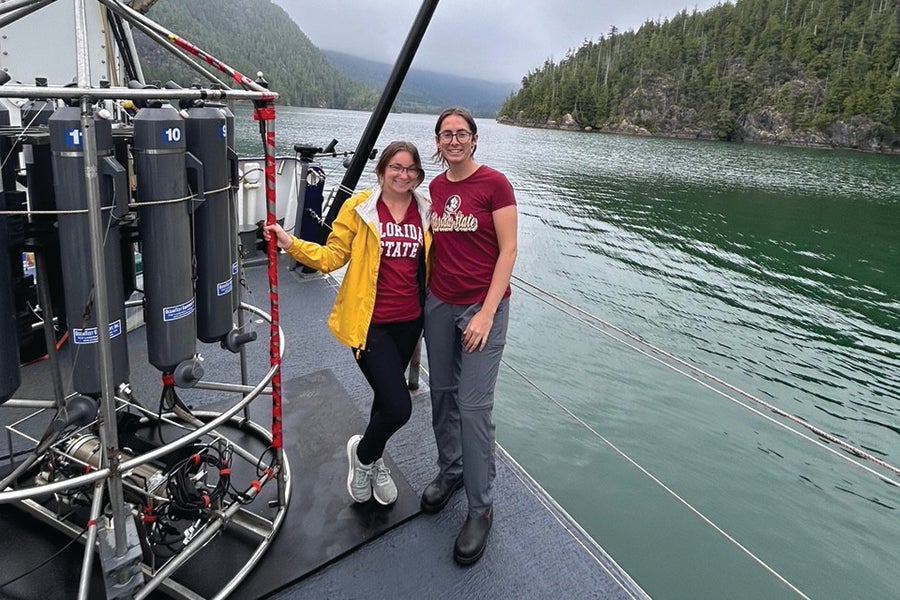
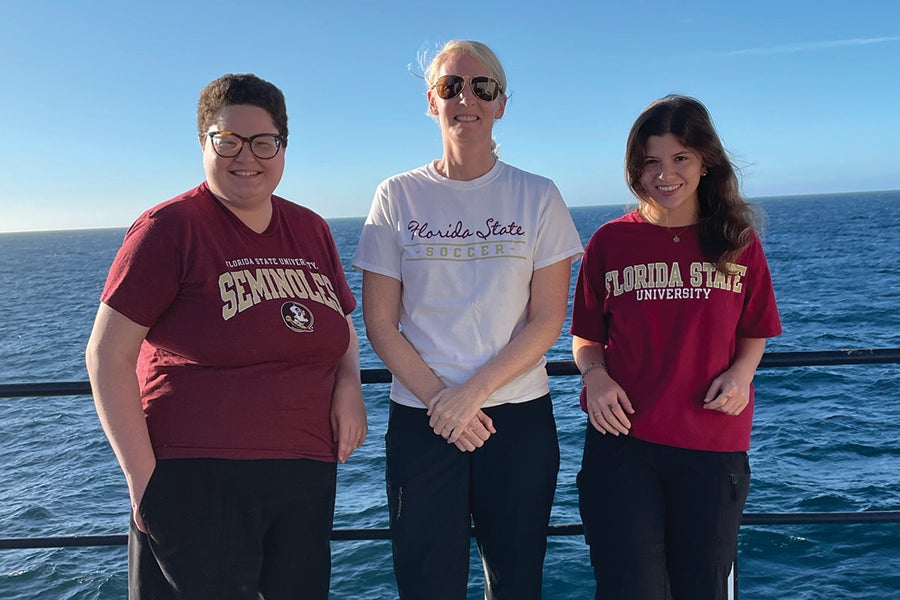
From top: Mason Lab graduate students Emily Guidry and Alexa Crossen on the R/V Rachel Carson in Tofino Inlet, British Columbia. Graduate student Paige Payne, Olivia Mason, and graduate student Kaitlin Dombroski on the R/V Marcus G. Langseth off the coast of Namibia, Africa. Olivia Mason on the R/V Marcus G. Langseth off the coast of Namibia, Africa. Courtesy photos.

After earning her doctorate in biological oceanography in 2008, Mason took a role as a postdoctoral researcher at the Lawrence-Berkeley National Laboratory in California, which allowed her to travel to the Gulf to sample water from the Deepwater Horizon spill.

Using a combination of state-of-the-art sequencing technologies, Mason and the team found that microbes called Oceanospirillales were consuming hydrocarbons produced by the oil spill, reflected by changes in their gene expression. Her research marked an advancement in complementary methodologies previously unused simultaneously in this field.

“Our work culminated in a seminal paper,” Mason said. “It was the first time microbial ecology research combined multiple sequencing techniques to answer how microbes respond to an ecosystem perturbation, and utilizing these methodologies in microbial oceanography has been my biggest contribution to the field to date.”

Mason joined FSU’s faculty two years later and, since then, has led the Mason Laboratory in its worldwide investigation of microbes. Recently, she and her graduate students traveled to the eastern Tropical Atlantic, off Africa’s west coast, to study the northern Benguela Upwelling System where high nitrous oxide fluxes have been observed. The team has also collected OMZ samples in Saanich Inlet, British Columbia and off the coast of Louisiana.

Beyond her work in the classroom and lab, Mason has since 2023 directed FSU’s Women in Math, Science and Engineering academic living-learning community, which is committed to the academic and career development of women in the sciences and growing the STEM workforce. WIMSE students live in the same residence hall, attend weekly colloquia that teach foundational academic and career knowledge, and participate in laboratory research experiences.

“Undergraduate research is key to success in STEM disciplines,” Mason said. “WIMSE students are among the best and brightest, and it’s rewarding to advise them as they build their STEM careers.”

Mason is known to the scientific community as a stalwart in her field, and at FSU, she’s regarded as a leader whose scientific contributions and academic involvement enrich the experiences of those around her.

“I knew Olivia from her reputation as a researcher, but upon meeting, I was struck by her confidence and leadership abilities,” said Mike Stukel, EOAS department chair and professor. “Her clear scientific vision, pioneering efforts in microbial omics methodology, and influence in the department make her a valuable part of FSU.”

Devin Bittner is a two-time FSU alumna who earned a Master of Business Administration in 2022 and a bachelor’s in digital media production in 2019.