
You’re probably familiar with how growth rings in trees capture the passage of time on land, but what catalogs the history of our oceans? For marine scientists, it’s growth bands within coral skeletons. These rings chronicle a coral’s age, and the skeleton’s chemistry functions as an environmental journal, logging evidence of unusual temperature events and other oceanic conditions occurring over the coral’s lifespan.
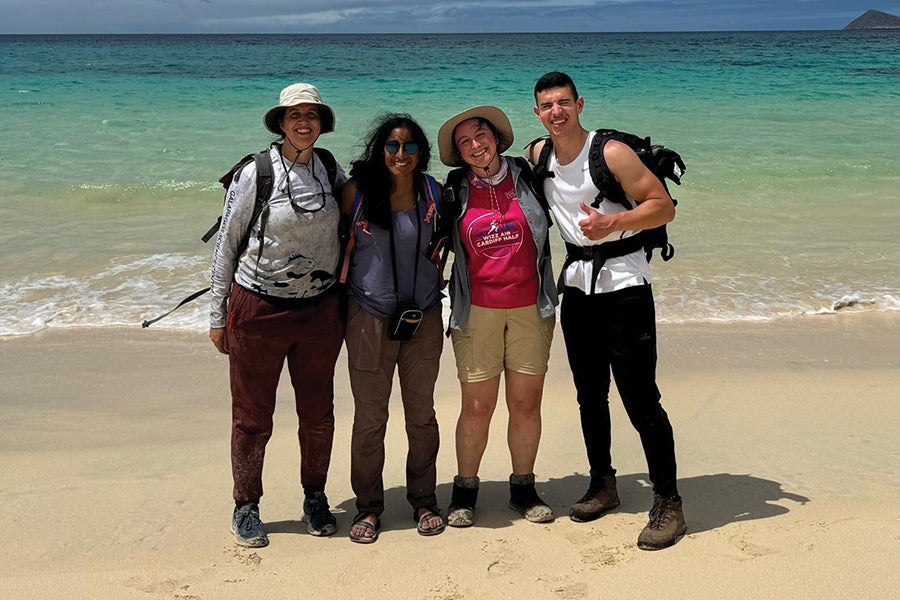
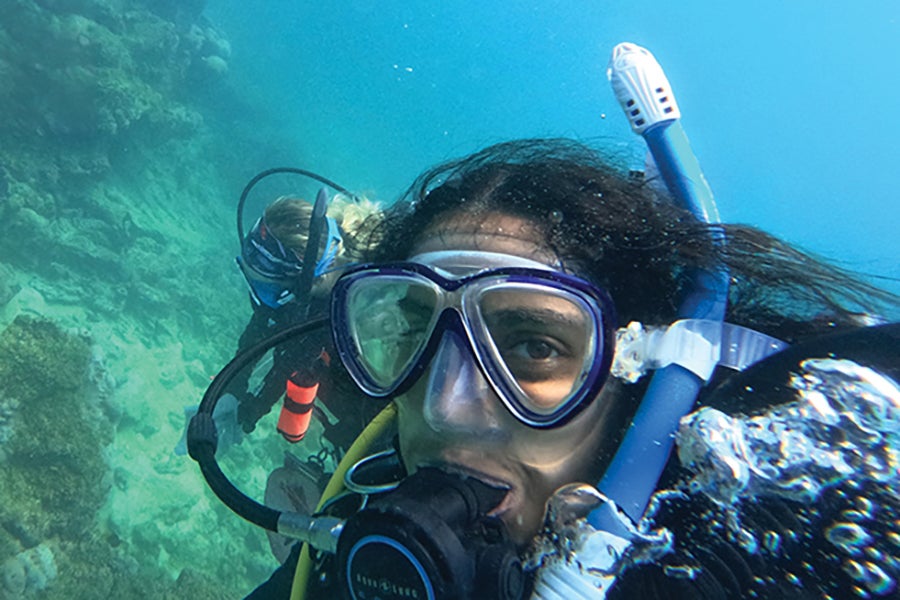
Neda Mobasher is intimately familiar with the hidden histories corals can reveal. Peering through her diving mask, she collects coral samples from remote islands off the coast of Ecuador and due south of Hawaii, locations separated by nearly 5,000 miles of Pacific Ocean. Once back at Florida State University, she’ll analyze the samples’ chemical fingerprints to reconstruct thousands of years of climate history.
“As corals take in seawater, the water’s environmental properties become part of their skeletal chemistry, which we then extract from both sub-fossil and living corals,” said Mobasher, a first-year doctoral student in chemical oceanography. “Because these corals record sea-surface temperature variability at monthly resolution, we can use them to reconstruct changes in the El Niño-Southern Oscillation over time.”
Mobasher uses coral samples from the Galápagos Islands and Kiritimati, also known as Christmas Island, to reconstruct the El Niño-Southern Oscillation, or ENSO, a recurring climate pattern in the tropical Pacific. ENSO’s warm phase is called El Niño and the cold phase La Niña. This pattern of oceanic warming and cooling directly influences global weather. In the southern U.S., El Niño typically brings colder, rainier conditions and fewer Atlantic hurricanes: La Niña’s impacts are opposite.
Research suggests human activity has contributed to ENSO’s intensification since the mid-20th century, but it’s difficult to pinpoint how and to what extent because precise ocean-atmosphere measurements only date back to the satellite era’s start in the mid-1960s. Mobasher’s work helps fill millennia-sized gaps in sea-surface temperature estimates from the tropical Pacific Ocean to guide future predictions, ultimately supporting accurate natural disaster forecasting and climate projections.
“Reliable data only goes back so far, but corals are one of the highest-resolution archives for reconstructing oceanic conditions and historical changes in climate prior to the instrumental era,” Mobasher said. “This not only helps us understand our environment’s response to changes that occurred hundreds to thousands of years in the past, but it also enables us to make inferences for how Earth will handle present and future conditions.”