

Limitless Learning
English alumna Christine Fox’s passion for education aims to make knowledge accessible to all
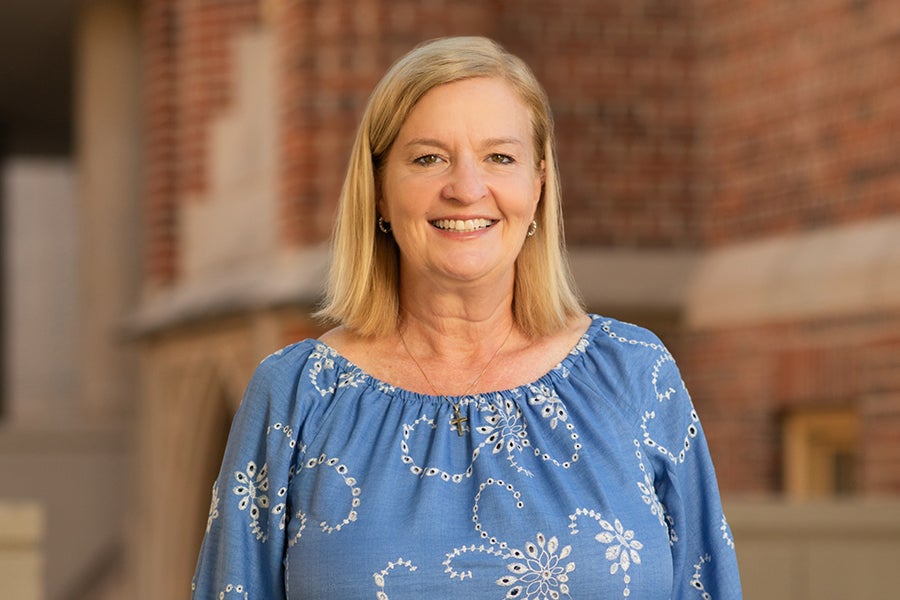
If you’ve accidentally picked up your friend’s iPhone thinking it’s yours, you were probably surprised by how different the display looks from your own device. When we adjust font size, screen brightness, or other settings to customize our digital experience, we’re interacting with accessibility features that enhance our abilities to read, learn and communicate.
Florida State University Department of English alumna Christine Fox believes that the accessibility concepts and tools that strengthen all users’ digital experiences should be applied to educational design, meeting individual needs and supporting a variety of learning styles.
Fox is the chief growth and innovation officer for the nonprofit Center for Applied Special Technology, which leverages scientific research and the universal design for learning, or UDL, framework to facilitate accessible and adaptable educational design. UDL provides flexibility and choice in how students of all ages engage with learning, all the way from pre-K through high school to postsecondary study and those in professional workforce development.
“UDL is a framework to support education systems that fosters inclusion from the start, giving learners and teachers agency to address learner variability, or students’ unique learning styles,” said Fox, who earned her bachelor’s in English literature from FSU's College of Arts and Sciences in 1993. “CAST’s tagline is ‘Until learning has no limits.’ Our research investigates how and why UDL works for all students and how the quality of implementation drives education change in an ever-changing world.”
This emphasis on the power of giving students choice in their preferred learning experiences supports all learners, including multilingual students and those with disabilities. It also helps educators pave multiple paths to knowledge and understanding, a mission that aligns with Fox’s lifelong commitment to ensuring inclusive education, something that dates back to her early adulthood.
The West Palm Beach, Florida native’s desire to help others flourished as an undergraduate at FSU, where her on- and off-campus involvements — such as tutoring incarcerated individuals at the Federal Correctional Institution in Tallahassee and participating in the national service fraternity Alpha Phi Omega — expanded her interests and connections.
“Volunteering allows you to meet different people and build relationships and a foundation for your career,” Fox said. “Today, I send my daughters, both undergraduates at FSU, interesting opportunities I find on social media in hopes they will do the same.”
After earning her degree in 1993, Fox spent a year volunteering with Salesian Missions as a youth center coordinator in Mexico organizing after-school programs. She then returned to South Florida to pursue graduate studies at Florida International University. In 1996, Fox earned her master’s in teaching English to speakers of other languages and began her teaching career at an elementary school in Belle Glade. The experience shaped her understanding that assorted pedagogical approaches are essential when supporting a classroom of learners with different needs.
“Working at the first bilingual school in Palm Beach County, I quickly discovered learner variability because my students came from a variety of cultural, linguistic and economic backgrounds,” Fox said.
After a few years, she wanted to drive change on a larger scale. Fox became a coordinator of English for speakers of other languages in Lake Worth, Florida, and a reading curriculum coach for New York and New Jersey inner-city schools. In 2004, she transitioned into a research and professional learning space for state and district education leaders, supporting policy and practices to implement digital learning.
Drawn to CAST’s commitment to building comprehensive and thoughtful educational design, Fox joined the nonprofit as a co-project director for a federal grant in 2022 after having served on CAST’s advisory boards.
“Christine’s a leader who can identify and bring growth opportunities to CAST,” said Lindsay Jones, the organization’s chief executive officer. “Moreover, she’s built a strong professional network of connections that help us expand our reach and turn opportunities into reality. Christine’s deep experience in our field and network are helping us expand adoption of UDL and build a solid future for inclusive education.”
Through her work, Fox aims to drive institutional change and encourage greater learning accessibility for all.
“When you learn to read, research, and write about literature — skills I developed at FSU — you can transfer those communication skills to any topic,” Fox said. “Now, with CAST, I’m working to make sure that each learner has every opportunity possible in our education systems.”
Christine Watson is an FSU alumna who earned a bachelor’s degree in literature, media, and culture with a double major in international affairs in 2019.
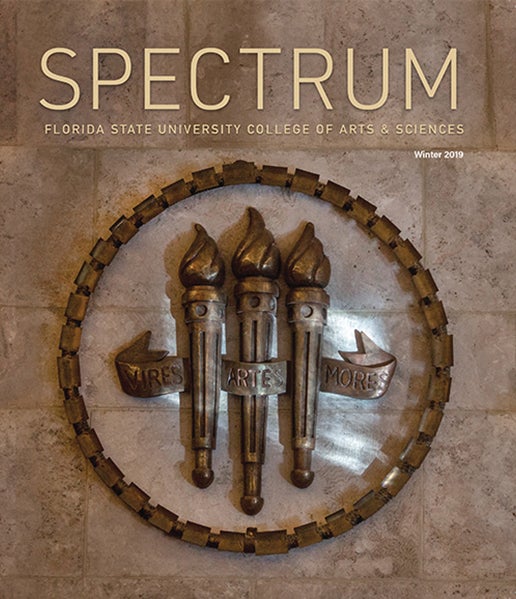
While at FSU, Christine Fox was one of four students to win a 1993 contest allowing them to name a forthcoming publication that would become the official alumni magazine of the FSU College of Arts and Sciences. Across the Spectrum was published in various forms for more than two decades before taking on its present shape and title in 2019.