

Classroom to Clinical Impact
Statistics professor Debajyoti Sinha prepares students to solve real-world health challenges through research and teaching
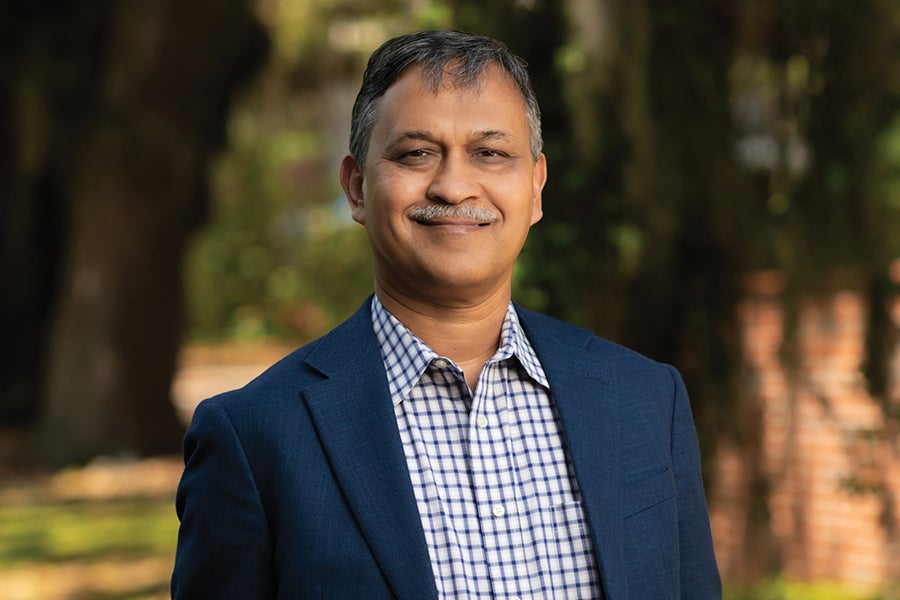
When Debajyoti Sinha first arrived as a new faculty member at Florida State University’s Department of Statistics in 2007, he saw more than a strong department; he saw an opportunity to make a lasting impact through statistical research in medicine.
Nearly two decades later, Sinha has done exactly that — he’s helped establish a nationally-recognized graduate biostatistics program that prepares students to tackle challenges in medicine and public health.
“In today’s world, with so much information coming at us, it’s essential to gather evidence, quantify it and explain it clearly, and that’s where statistics plays a big role,” said Sinha, who has spent more than 30 years researching complex public health problems, especially cancer survival.
At its core, biostatistics is a quantitative science of gathering and evaluating evidence to interpret data from biomedical studies and experiments, such as national and state cancer registries. Biostatisticians like Sinha use data to understand disease, evaluate treatments and guide decision-making.
“I’ve always been interested in problems that affect human life and society,” he said. “In medicine, statistics helps scientists design clinical research studies, collect and manage data, and use that evidence to understand how treatments work, how diseases spread, and how findings apply to different populations.”
Sinha positions his students for success by grounding his courses in current medical and public health challenges, such as disease modeling, identifying populations susceptible to specific diseases, or identifying vulnerabilities in health-care systems. Many of his students secure internships and careers in the pharmaceutical field through industry connections and research experience developed via FSU faculty collaborations with drug companies.
“I emphasize how to give relevant answers to practical problems and how to persevere toward the best solution,” he said. “These skills are broadly applicable, whether students go on to work in pharmaceutical companies, high-tech industries or even start their own ventures.”
Before joining FSU’s faculty, Sinha earned his doctoral degree in statistics from the University of Rochester, New York, in 1993 and held several leadership roles in academia, including serving as director for the Division of Biostatistics at the Medical University of South Carolina in Charleston. Until 2007, he also served as interim director of the biostatistics core at MUSC’s Hollings Cancer Center.
"This endowed chair is an incredible privilege. The funding gives me the freedom, motivation, and responsibility to make an impact by supporting students, developing meaningful research, and focusing on the most important problems. One of the biggest advantages is being able to go to conferences, meet people, and interact with leading innovators and policy makers. It also allows me to support student research, which is where I see the real success."
— Debajyoti Sinha
In 2007, Sinha accepted a position as the FSU Ron and Carolyn Hobbs Endowed Chair in Statistics, which supports his work on survival analysis, Bayesian biostatistics, and modeling health data for cancer outcomes.
“This endowed chair is an incredible privilege,” Sinha said. “The funding gives me the freedom, motivation, and responsibility to make an impact by supporting students, developing meaningful research, and focusing on the most important problems. One of the biggest advantages is being able to go to conferences, meet people, and interact with leading innovators and policy makers. It also allows me to support student research, which is where I see the real success.”
Sinha holds memberships in several professional statistics organizations, including the American Statistical Association, the Institute of Mathematical Statistics, the Royal Statistical Society, and the Society for Bayesian Statistical Science, and he’s an elected fellow of the International Society for Bayesian Analysis. Previously, he served on the regional advisory board for the International Biometric Society and as vice president for the South Carolina chapter of ASA.
“Dr. Sinha’s influence extends far beyond his own work — he’s a researcher who’s driven to find solutions to health-related problems we may all someday face,” said Eric Chicken, Department of Statistics chair. “His students are well-trained and well-placed in industry and academia.”
Sinha’s dedication and engagement also shape the culture of the statistics department, where he serves as the director of the biostatistics program and co-director of the Biostatistics, Informatics, and Research Design program at FSU. Over the past two decades, the biostatistics program has grown from two or three faculty members to nearly a dozen, evolving into a collaborative group committed to cutting-edge research with real-world impact.
“Evaluating evidence and managing uncertainty is how we make better decisions and understand what direction research should take,” Sinha said. “For me, the motivation will always be to solve problems that have significant implications in human life and society.”
Rahaf Alshinhab is an FSU student pursuing dual degrees in marketing and accounting with minors in professional communication and computer science and a leadership studies certificate. She is set to graduate in May 2027.