
Student Spotlight: Jaylynn Brunelli
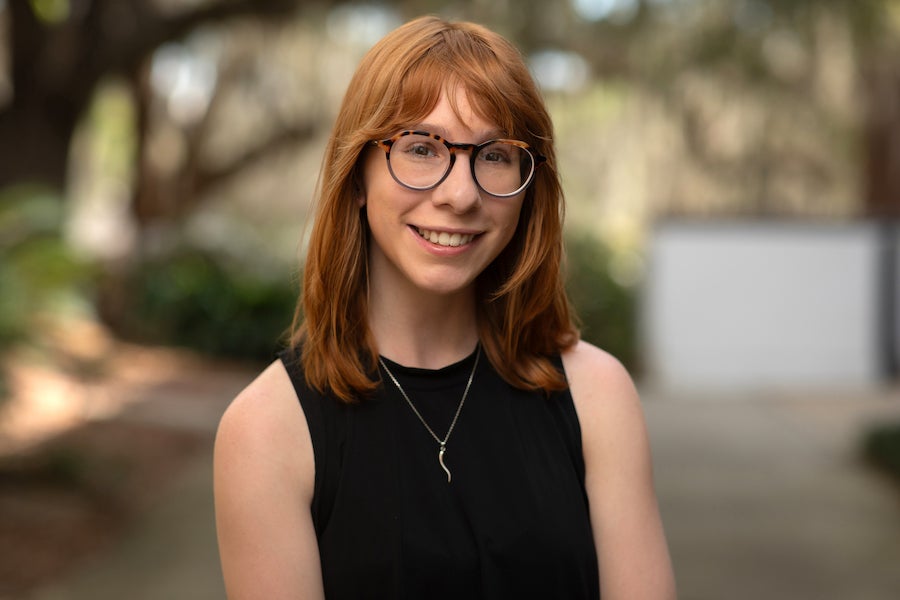
Jaylynn Brunelli is a senior at Florida State University pursuing a bachelor’s degree in meteorology through the Department of Earth, Ocean and Atmospheric Science, part of the College of Arts and Sciences. Brunelli is a science communication intern at the FSU Wakulla Springs Lab, a state-funded collaborative project designed to educate the public and conserve the springs supported by the FSU Coastal and Marine Laboratory and the FSU College of Communication and Information. In 2025, Brunelli presented the honors thesis, “Effects of Stratospheric Aerosol Injection on Global Climate Distribution,” at the American Meteorological Society Annual Meeting, and is expected to graduate in Spring 2026.
Tell us about your background, where you’re from, and what brought you to FSU.
I’m originally from Schenectady, New York, and after living in many places along the East Coast, my family settled in Bradford, Pennsylvania. I chose to attend FSU mainly because of its prestigious reputation in meteorology, but the beautiful campus and vibrant culture are also great bonuses.
What inspired you to pursue meteorology?
My interest in meteorology developed from a fascination with our planet’s changing climate. I became interested in climate change in middle school after having the opportunity to travel to Fairbanks, Alaska. Seeing the state’s beauty, along with the locals’ environmental concerns, allowed me to truly see the impacts and potential consequences of climate change for the first time. I ultimately decided to pursue meteorology as a gateway into climate science because of the vital role the atmosphere plays in understanding Earth’s climate.
Tell us about your work as a communication intern at the FSU Wakulla Springs Lab.
I’ve been a science communication intern at the FSU Wakulla Springs Lab for nearly two years and was one of its original founding members. I work with environmental scientists, geologists, and communicators to create social media posts that explain scientific concepts related to Wakulla Springs, such as water quality issues caused by nitrate pollution and the effects of sea-level rise, while also raising awareness of the challenges the springs face and the importance of protecting them.
Besides writing and designing these posts, I also give tours and explain how water in Tallahassee reaches the springs and vice versa. These tours are important because they raise awareness about how everyday pollution affects our drinking water and provide ways for students and Tallahassee residents to get involved in protecting Leon County’s waterways.
Tell us about your honors thesis.
My thesis examines the dispersion of highly reflective particles, known as aerosols, in the upper atmosphere to reflect sunlight back into space and cool the planet. This approach is called stratospheric aerosol injection, or SAI, and is a proposed climate intervention that could help reduce the impacts of global warming.
In my thesis, I evaluate the effectiveness of SAI using a climate classification system that divides the world into different climate zones. Using global climate models, I analyze how these zones shift over time under various emission scenarios. I base this on predictions of future human greenhouse gas releases to evaluate how effectively SAI performs relative to increasing or decreasing emissions.
What do you want the public to know about the importance of your research?
Climate intervention or geoengineering often carries a somewhat negative connotation, especially in today’s social and political climate. Ultimately, I want the public to understand that this research is about exploring options as we face continued warming. Eventually, someone – whether it’s a government, private corporation or other group – will decide on climate intervention, and we want to be as prepared as possible when that happens.
Therefore, researching and understanding the consequences and benefits of geoengineering is crucial, as it prevents blind decisions. If we pursue climate intervention in the future, we will have the necessary knowledge and understanding of how human-made and natural processes influence our planet.
How has your time at FSU prepared you for professional success?
Participating in programs such as the Center for Undergraduate Research and Academic Engagement Undergraduate Research Opportunity Program and Honors in the Major, through FSU’s Honors Program, has immensely prepared me for professional success. These are the perfect opportunities for students who want to pursue research-related careers, as they provide the resources, skill development, and experience necessary to do so.
What’s your best memory from your time at FSU?
I had the opportunity to attend a workshop and conference on climate intervention in Helsinki, Finland, in October 2025. I met many fascinating people from social and physical science backgrounds from around the world. It was an incredible learning experience for me and something I never imagined I’d be able to participate in during my college years.
What faculty or staff members inspired you?
I’m inspired by Michael Diamond, my research adviser and an assistant professor in the Department of Earth, Ocean and Atmospheric Science, who has been an incredibly supportive mentor. I’m also inspired by my former professor and current adviser at the Wakulla Springs Lab, CCI research faculty Kellie Keys, whose passion for her work has had a lasting impact on me.
Tell us about some upcoming projects or goals you’re working toward.
Recently, I’ve been working on a manuscript based on the research from my thesis. My adviser and I plan to submit it for publication, which is very exciting and rewarding, since few undergraduates have the chance to publish research so early in their scientific careers.
What are your plans following graduation?
After graduation, I’m pursuing a doctorate in atmospheric science at Indiana University Bloomington. I plan to continue conducting climate change research, specifically on climate intervention, land-atmosphere interactions, and how biosphere processes influence regional climate. Although I’m committing to five more years of school and work, I’m very excited about this next chapter in my academic journey.