
Faculty Spotlight: Bhargav Karamched
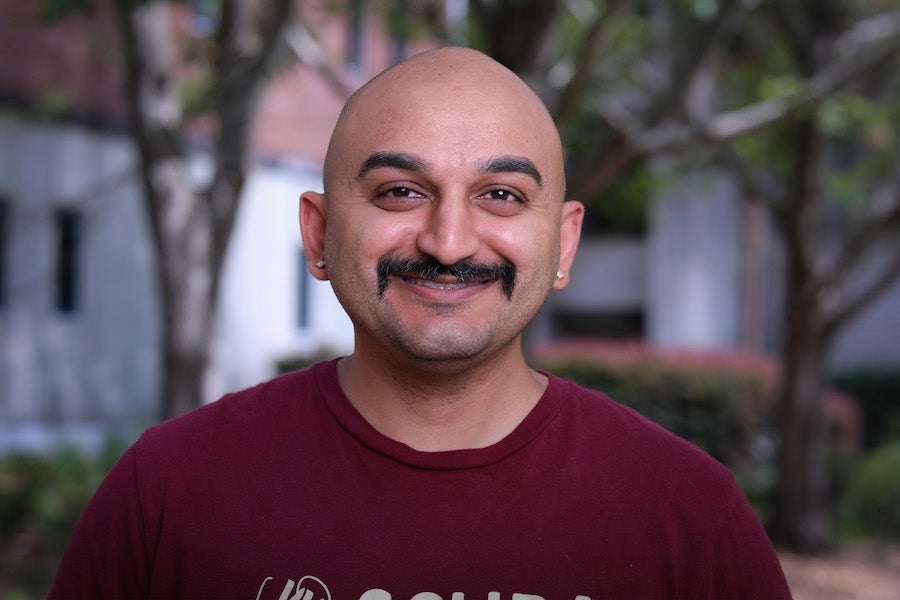
Bhargav Karamched is an assistant professor in FSU’s Department of Mathematics and is affiliated with FSU’s Institute of Molecular Biophysics, both part of the College of Arts and Sciences. Karamched earned dual bachelor's degrees in mathematics and biochemistry from the University of Oklahoma in Norman in 2012 before earning his doctorate in mathematical biology from the University of Utah in Salt Lake City in 2017. Currently, Karamched’s research focuses on understanding the molecular basis for neurodegenerative diseases and the behavior of genes through mathematical models.
Tell us a little about your background, where you’re from and what brought you to FSU.
I grew up in Oklahoma and always enjoyed the sciences. During my undergraduate studies, I learned about biomathematics programs and considered several options before I decided to attend the University of Utah for my doctoral degree.
After graduating, I worked in Texas as a postdoctoral fellow for a collaboration between the University of Houston mathematics department and the Rice University bioengineering department in which I developed mathematical models for a synthetic biology lab. In 2020, I started applying for new positions and was drawn to the interdisciplinary nature of FSU.
Can you break down your areas of research for us?
My research involves applying dynamical systems, mathematical frameworks for understanding how things evolve over time, on a variety of projects. One area I’m interested in is trying to understand the molecular basis for neurodegenerative diseases like Alzheimer’s and Parkinson’s diseases through mathematical models. I also describe the behavior of genes in terms of feedback loops, a process in which a system’s output then amplifies or inhibits the system’s input, continually influencing the system.
In addition, I’m working on modeling for olfactory coding, or how we smell things, and how people with diabetes can optimally consume food to maintain their glucose levels in range for a maximum period of time.
Tell me a bit about the interdisciplinary nature of your research.
Biology is becoming more quantitative, and oftentimes biologists have lots of data from which a mathematician or statistician can derive patterns. I try to look for motifs in the biological data that are common at all scales to develop minimal models, which describe not only a very specific occurrence but also point to patterns that lie at the heart of biology.
What makes you passionate about your research topics?
As a researcher, I have this desire to solve the puzzle, answer the question, delve deeply into questions and be comfortable with uncertainty. Math is very concrete; biology is the opposite of that because out-of-the-ordinary events happen all the time. Working toward understanding biology through mathematics allows us to see a plethora of problems to address and situations that we can analyze.
Tell us about your experiences as a postdoctoral fellow at Rice University and the University of Houston.
I worked on two projects as a postdoctoral fellow, one of which analyzed populations of E. coli in rectangular microfluidic traps. The BioDesign Lab at Rice University noticed E. coli cells orient in the same way every time, despite how they are put into the trap. I developed a mathematical model to explain why these patterns were emerging. Broadly speaking, the cells would align because it was the most efficient use of energy.
I also worked on research related to decision-making in groups of people. One groundbreaking insight we found was that groups whose members possessed a variety of decision-making styles made better decisions faster than groups of people who made decisions similarly.
Tell me about your involvement with FSU’s Institute of Molecular Biophysics.
IMB is a great environment to be in. We have professors from biology, chemistry, and mathematics all in one building. It's a very easy place to have interdisciplinary conversations that lead to collaborations.
What do you want the public to know about the importance of your research?
It’s important that people recognize the benefit of embracing mathematics in other fields to understand incredibly complicated things. I hope people who read my work can see that if you’re willing to understand math, you can access a new outlook on biological systems, financial systems and more.
What’s your best memory so far from working at FSU?
I really enjoy the friendships and collaborations I’ve developed with other FSU professors. The math department has been incredibly supportive. My office is next door to my good friend, professor of mathematics and the director of the FSU biomathematics program, Richard Bertram. We keep our doors open to chat and collaborate, which has been one of my favorite parts of working here.
Another favorite memory is playing ping-pong with other IMB members in the lab’s basement. Sometimes when we’re stuck on a problem, we take a quick ping-pong break and revisit the issue with a fresh mind. Besides being fun, it’s also quite helpful.
Do you have any exciting upcoming projects or goals you’re working toward?
Recently, biomathematics doctoral student Chris Ryzowicz and I discovered that you can generate oscillations in the variables of systems –– repetitive displacements that return to equilibrium — with positive feedback. Typically, oscillations are assumed to be caused by delayed negative feedback. Right now, we have a theoretical model to explain this, and we’re trying to ground it in physical processes.
A simplified example of this is a microphone and a speaker. If someone says something into a microphone, sound comes out of a speaker, which can be picked up by the mic again, creating a pulsing noise or oscillation.
If your students only learned one thing from you (of course, hopefully they learn much more than that), what would you hope it to be?
I think, in today's world, people are uncomfortable with not knowing things. It’s beneficial to embrace uncertainty and continue pursuing something even if it’s difficult to learn or understand. If my students can leave FSU with that mindset, I think they'll be set up for success in whatever their career may be.