

War Stories

History doctoral candidate Brian Davis Jr. explores the intersections of the Black freedom movement and Black military experiences

Wed, 06/17/26
Brian Davis Jr.
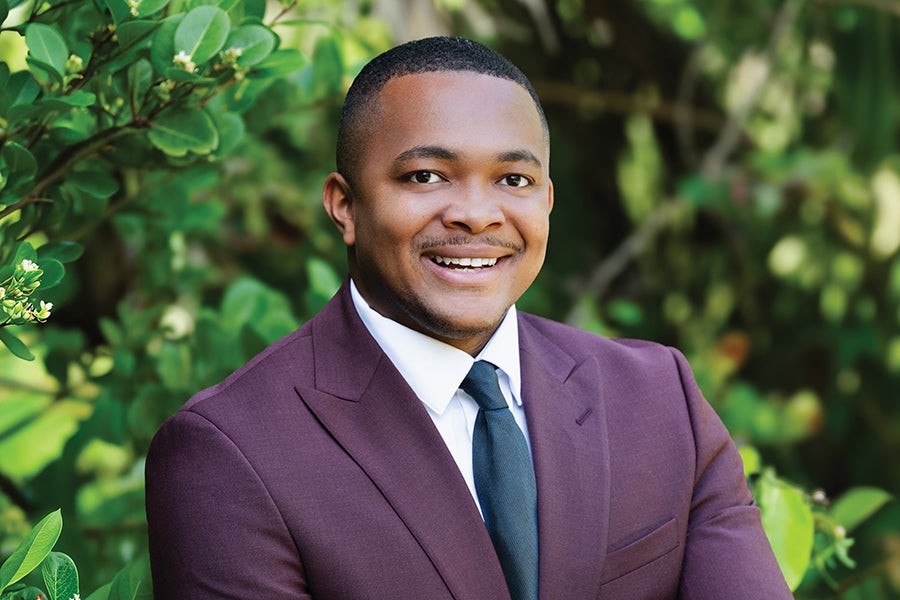
Brian Davis Jr. Photo by Frank Leon, Glass & Pen Studios.

Brian Davis Jr. is doing one of his favorite things: combing through mementos from his uncle’s time serving in the U.S. Marine Corps during the Vietnam War. There’s his uniform, the Purple Heart he was awarded for being wounded in action, and the copy of his original enlistment contract. 

The personal experiences of his family members affected by war have been a fascination for Davis since childhood. Now, as a Florida State University history doctoral candidate, his research centers on war and society, focusing on the people, memories, and artifacts that inform our understanding of conflict.

“Wars don’t just affect soldiers; they transform entire societies, affecting civilians on the homefront and many other aspects of daily life,” Davis said. “Wars have created new opportunities to challenge racial or gender hierarchies, as illustrated during World War II when women assumed roles traditionally held by men. These shifts not only altered daily life but also helped shape broader political, social, and economic developments in the United States, highlighting the role of ordinary people in driving historical change.”

Davis, a first-generation college student, earned his bachelor’s in history from Winston-Salem State University in North Carolina in 2019 and a master’s in history from FSU in 2022. He studies Black military service during the Cold War, from the end of WWII and through the dissolution of the Soviet Union in 1991, and he focuses on the intersections of the struggle for racial equality and military experiences.
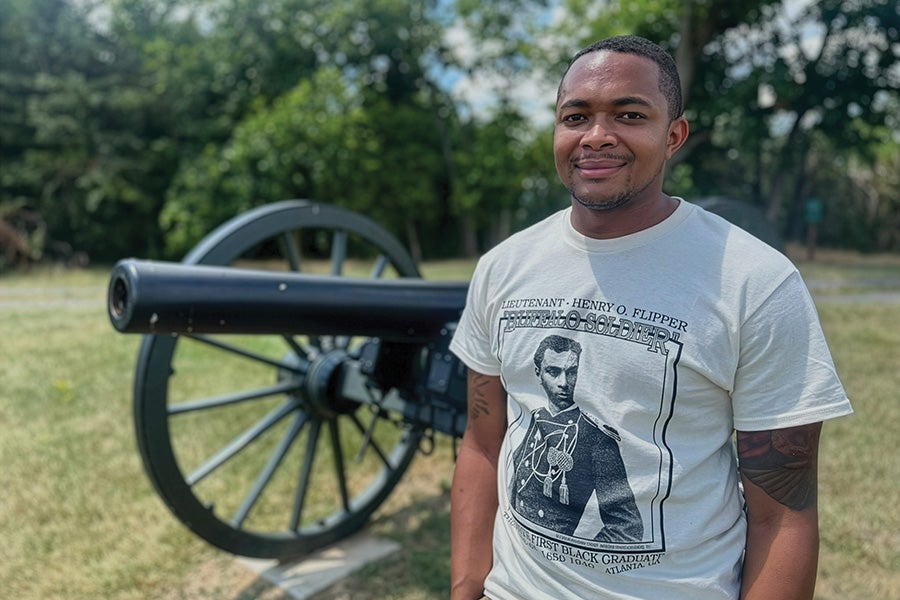
Brian Davis Jr. visits battlefields.
Brian Davis Jr. visits battlefields and views historic military artifacts during his 2024 Society for Military History Summer Seminar Fellowship in Lexington, Virginia. Courtesy photo.

“Growing up around Black military veterans has inspired and driven my research,” said Davis, who plans to graduate in December. “Despite scholarship on Black military history being limited, Black men and women have served in the U.S. military in every major conflict since the American Revolution. Although wars often result in shifts in strategic thinking and military policies, the lived experiences are just as critical to interpreting and understanding historical development.”

For his research, Davis has received multiple academic awards, including a 2024 McKnight Dissertation Fellowship, which helped support his travels to the Library of Congress in Washington, D.C., where he analyzed NAACP records for his dissertation.

“Working with archival materials in the Library of Congress is very different from using any digital archive,” Davis said. “You notice the person’s handwriting, feel the paper they wrote on, and it’s truly a personal connection, especially when going through documents like letters.”

The month-long research experience was also supported by the Department of History’s 2024 Martin-Vegue Dissertation Fellowship. In the same year, Davis was awarded the Gerald R. Ford Presidential Foundation Research Travel Grant, through which he explored government documents at the Gerald R. Ford Presidential Library in Ann Arbor, Michigan.

Also in 2024, Davis earned a Society for Military History Summer Seminar Fellowship that allowed him to attend a three-week program in Lexington, Virginia. During the program, visiting scholars and Virginia Military Institute faculty guided fellowship recipients in refining their approaches to teaching military history.

“Brian is probably the most tenacious graduate student I’ve worked with,” said Paul Renfro, associate professor of history and Davis’ co-doctoral adviser. “He’s an indefatigable researcher, and he’s spent countless hours refining his arguments. Brian’s scholarship marries African American history, military history, and civil rights history in thoughtful and innovative ways, and it’ll make meaningful contributions to each field.”

Davis’ tenacity is key to the career he has carved out today: Before completing his undergraduate degree, he stepped away from college for financial and other personal reasons after burning the candle at both ends. After working for three years, Davis bumped into a professor who convinced him it was time to come back. This unconventional path, as he calls it, is a core part of Davis’ drive to further his own and others’ education through research and mentorship. 

“I care about what tools and skills my students take with them, and I want to help them achieve their goals,” said Davis, who teaches a course at FSU on the history of the United States since 1877. “History is something I’ve always loved. For some, it can feel like you’re just memorizing facts, but history isn’t just about that. History is about sharing, interpreting, analyzing, and understanding the experiences of those who lived it to help us reconstruct the historical narratives.”

Bella Bozied is a two-time FSU alumna who earned a master’s degree in integrated marketing management communication with certificates in project management and multicultural marketing communication in 2026 and a bachelor’s degree in information, communication and technology with a dual major in editing, writing and media in 2024.