

When most Americans think about the birth of the nation, they envision the founding fathers, bewigged heads clustered over documents like the Declaration of Independence and the Constitution. Things are murkier when they attempt to conjure images of the founding mothers.
Many aren’t aware of the crucial work these women, the wives and daughters of the United States’ first politicians, were doing in the background. They organized and presided over social engagements that influenced political majorities and built partisanship, paving the way for modern democracy.
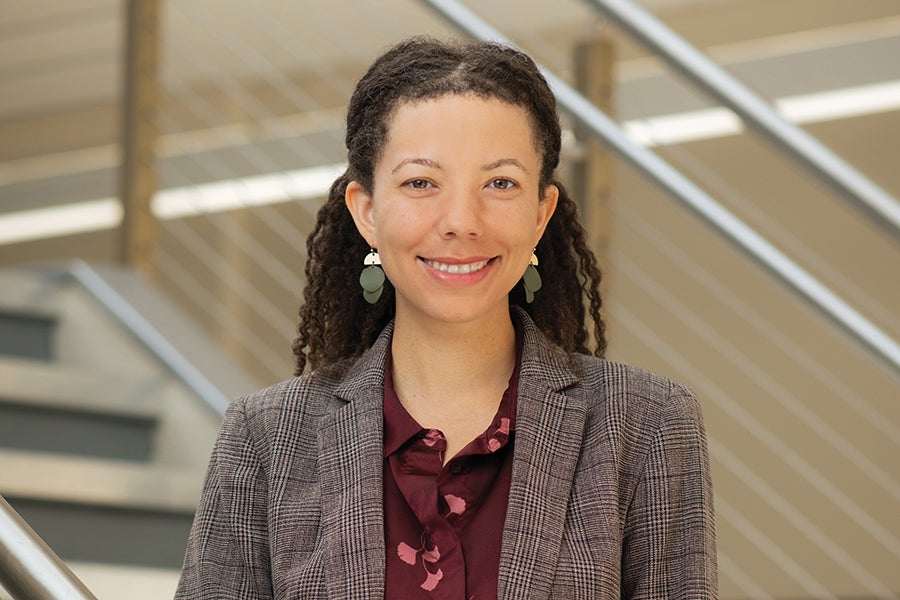
As an expert in women’s impacts on early American life, Florida State University assistant professor of history Mercedes Haigler sheds light on the backdrop against which some of the American republic’s most notable moments unfolded.
“The experience on the ground during the American Revolution is crucial to my research,” Haigler said. “Early America was more than men in wigs waxing poetic about the Declaration. Those without direct political power had visions of what the United States could be, and they were fighting for their own reasons. From women to Native Americans, African Americans and even loyalists, my research focuses on how these conflicting ideas of America influenced the major events we remember.”
Haigler, who earned a bachelor’s in history from Alice Lloyd College in Kentucky in 2019 before earning her master’s and doctorate in history from the University of Virginia in 2021 and 2025, respectively, became fascinated with historical documents related to late-1700s partisan caucusing activities while conducting research as a graduate student.
Though she was familiar with early America’s opposition to a two-party system, these documents showed that elite women legitimized partisanship through social gatherings, allowing it to function quietly for many years before the method became a formal feature of the political process under Andrew Jackson’s presidency from 1829 to 1837.
"My tour of campus was wonderful ... and the graduate students and faculty were encouraging and supportive. My mom earned her master’s degree from FSU, so accepting this offer was a full-circle moment for our family. It was a perfect fit."
— Mercedes Haigler
“While women were not officially citizens in early America, the wives and daughters of politicians used the public sphere to exert influence via partisanship,” Haigler said. “The two-party system is deeply ingrained into our idea of American politics today, but back then, there was a prevalent fear that whichever party was not in power was dangerous. By hosting dinners, teas, and salons, women circumvented the suspicion of an anti-partisan political culture and helped create a space where partisans could caucus effectively and ultimately obtain consensus in Congress.”
While writing her dissertation in 2022, Haigler was named a fellow of the University of Virginia’s Jefferson Scholars Foundation, where she split time between writing and creating a permanent exhibit at James Monroe’s Highland home in Charlottesville, Virginia. She then completed a summer of research at the International Center of Jefferson Studies before moving to Philadelphia in 2024 for a year-long fellowship at the McNeil Center for Early American Studies at the University of Pennsylvania.
Haigler was invited for an FSU faculty interview during her time as a McNeil fellow, and she looked forward to escaping the cold and returning to her birthplace of sunny North Florida. Upon arriving, she was surprised to be greeted by the historic Tallahassee snowfall of January 2025.
“My tour of campus was wonderful, albeit cold, and the graduate students and faculty were encouraging and supportive,” Haigler said. “My mom earned her master’s degree from FSU, so accepting this offer was a full-circle moment for our family. It was a perfect fit.”
Since joining FSU’s faculty in Fall 2025, Haigler has provided a unique perspective on the roles of different groups vying for power in early America to students across the university.
“Professor Haigler’s work on the sociopolitical history of the Early Republic builds a bridge in our department between faculty working on vast early America to those studying the Civil War,” said Department of History chair Jennifer Koslow. “With just one academic year under her belt, she’s already a popular instructor who excels at piquing students’ interest.”
Currently, Haigler teaches two courses on revolutionary America and contested visions of the early American republic, and she’s developing a graduate seminar on women in politics in early America to highlight their oft-overlooked roles in the country’s history.
“Because I look different from the men who founded the country, it was hard to see myself represented in the narrative of American history,” Haigler said. “Now, one of my goals is to show students that no matter their background, their ancestors are part of this story.”
Devin Bittner is a two-time FSU alumna who earned a Master of Business Administration in 2022 and a bachelor’s in digital media production in 2019.