

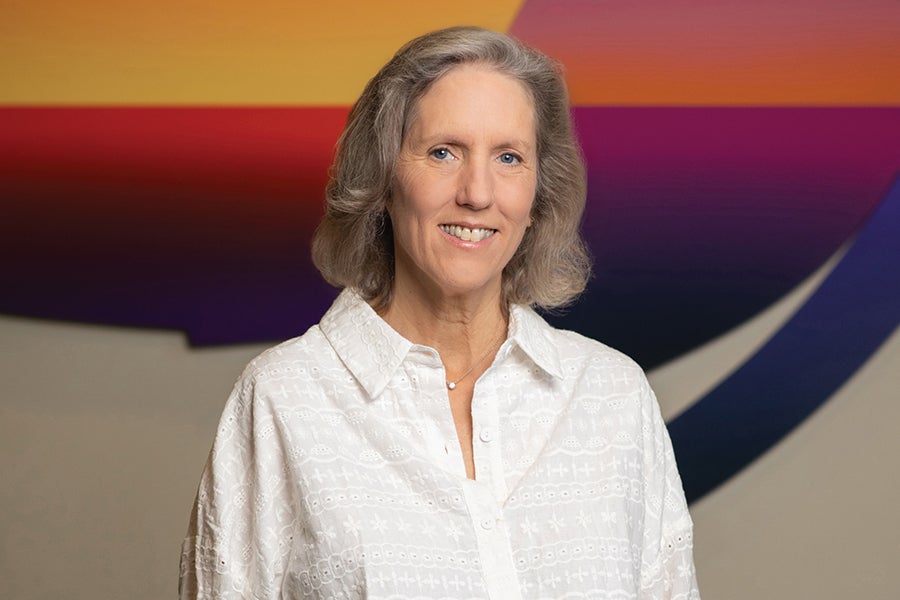
The year was 1984; Prince had just released “Purple Rain,” and the Apple Macintosh promised that the computing power of a room-sized mainframe could sit on your desk. It was also the year Linda Rinaman crossed Florida State University’s stage to accept her bachelor’s in psychology.
Rinaman, now a Distinguished Research Professor in FSU’s Program in Neuroscience, carved her own path to a career in neuroscience — a major that didn’t yet exist at FSU — by adding minors in biological science and statistics to her psychology major while gaining hands-on lab experience. When Rinaman returned to her alma mater as faculty more than three decades later in 2017, FSU was poised to become the first public university in Florida to offer an undergraduate neuroscience degree program.
“It was a big deal to pack up my home and lab at the University of Pittsburgh, and FSU’s Program in Neuroscience made the move worth it,” Rinaman said. “Now, I recruit faculty as part of the job-search committee, and I’m able to honestly and enthusiastically tell them that this is one of the best places to develop a research program.”
FSU’s Program in Neuroscience is a unique, interdisciplinary collaboration among the Departments of Biological Science, Psychology and Mathematics — all housed in the College of Arts and Sciences — as well as the College of Medicine and National Science Foundation-funded, FSU-headquartered National High Magnetic Field Laboratory.
"Her technical and conceptual breadth is outstanding. Then there’s the issue of rigor; a growing amount of biomedical research lacks it, the National Institutes of Health crave it, and Linda’s experimental work epitomizes it."
— Alan Spector, FSU Distinguished Research Professor
“Pharmaceutical companies latched on to the idea that if you activate that GLP-1 system, it reduces food intake,” Rinaman said. “Our research showed that activation also causes stress, so companies worked to develop new drugs that yielded food suppressant effects without the anxiety.”
Researchers remain stumped by how these medications can decrease food intake without triggering anxious side effects, a mystery that the Rinaman Lab is working to understand. Additionally, Rinaman’s latest research project explores early-life nutrition’s role in the functioning of adult GLP-1 systems.
“The nutritional environment in utero has a large effect on brain development,” Rinaman said. “My lab is investigating the neurological mechanisms behind GLP-1 system variations caused by developmental events or exposures, such as the kind of food your mother ate when she was pregnant and what you eat during infancy, whether through nursing, formula or toddler foods. We hope this provides better nutrition information for pregnant mothers and their children.”