
Student Spotlight: Claudia Urday
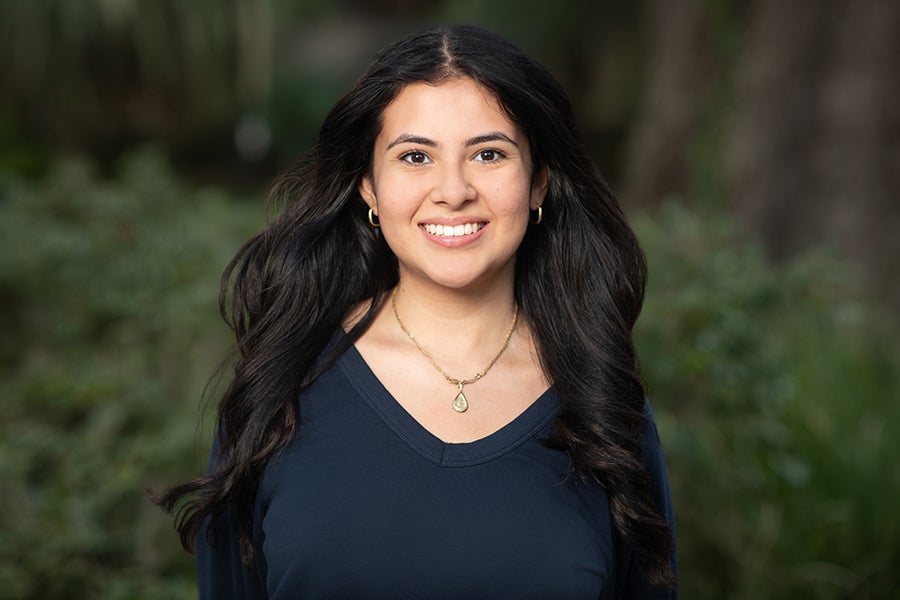
Claudia Urday is a Florida State University senior pursuing dual degrees in literature, media, and culture through the Department of English and religion through the Department of Religion, both within the College of Arts and Sciences. She is also pursuing a minor in anthropology through the Department of Anthropology and a minor in law and philosophy through the Department of Philosophy. Expected to graduate in May 2027, Urday is interested in the intersections of law, social justice, and cultural identity, with plans to pursue a career in immigration and human rights law. She currently interns at FSU’s Center for the Advancement of Human Rights and works as a desk assistant for University Housing. During the 2025-26 academic year, she served as deputy solicitor general for the FSU Student Government Association. Her commitment to advocacy also extends beyond FSU — in Summer 2026, Urday participated in the FSU DC Study Away Program and worked with the International Rescue Committee, a global humanitarian aid organization, as a refugee walk-in services intern. In this role, she conducted client intakes and connected individuals of varying humanitarian statuses with employment, public health benefits, medical assistance and other services.
Tell us a little about your background, where you’re from and what brought you to FSU.
I’m originally from Miami, Florida, and my interest in FSU grew after touring campus. My tour guide was an English major on the pre-law track, and hearing about her experiences and pre-law connections showed me how much FSU had to offer.
What inspired you to pursue dual degrees in literature, media, and culture as well as religion?
I wanted to prepare for law school while staying true to my interests. I’ve always enjoyed literature, particularly studying culture and its representation, so FSU’s literature, media and culture program felt like a natural fit.
My religion courses further developed my analytical skills and ultimately inspired me to pursue the subject as a second degree.
How do your minors in anthropology and law contribute to your academic and career goals?
My majors and minors strengthen my reasoning while exposing me to different perspectives. Anthropology especially challenges me with scientific and evolutionary concepts outside my humanities background, pushing me to apply what I know in new ways.
What do you want the public to know about the importance of your work and areas of study?
Humanities degrees are sometimes seen as impractical, but the critical thinking and analytical skills they develop are valuable in almost any field, especially with the growth of artificial intelligence. Humanities perspectives can help us evaluate AI-generated information, recognize potential biases, and consider the ethical implications of these technologies and their uses.
My studies also examine racism, discrimination, and how those systems influence everyday life. Understanding the systems and cultures around us is essential to advocacy and knowing our rights.
What aspect of your areas of study do you find most rewarding?
I enjoy seeing a tangible impact from what I’ve learned. During my IRC internship, I applied concepts like trauma-informed care while working with people in distress. Seeing clients receive the support they needed was incredibly fulfilling.
Tell us about your internship with the IRC through the FSU DC Study Away Program, part of FSU’s Career Center. What did your role entail, and what was this experience like?
I worked in refugee walk-in services and was often one of the first people potential clients met. I conducted roughly 21 intakes, learning to understand each person’s circumstances and help them navigate an unfamiliar system.
The FSU DC Study Away Program also exposed me to new fields and perspectives through my cohort’s different internships and provided networking and professional development opportunities throughout the Washington, D.C. area.
What on-campus resources have helped you achieve success?
FSU’s cultural communities have been especially important to me. I’ve been involved with Hispanic/Latinx Student Union affiliate organizations and am an active member of the broader HLSU community. I’ve also been involved in multicultural Greek life through my sorority, Lambda Theta Alpha.
Coming from Miami, I was initially unsure how I would adjust to Tallahassee’s cultural differences. Finding these communities gave me a sense of belonging while providing networking and professional development opportunities.
What are some current goals or projects that you’re working on?
One of my goals is to continue developing projects from my classes and internships rather than leaving them behind once they’re completed.
During my IRC internship, I researched Cuban migration policies and their effects on the experiences of Cuban immigrants. I’d like to continue following changes in migration policy and expand my research to other populations, especially as immigration remains a prevalent topic.
Are there any faculty or staff who have helped or inspired you?
One of the biggest benefits of studying the humanities at FSU is building close relationships with professors. Professor of English Christopher Okonkwo and in the religion department professor Adam Gaiser and teaching faculty member John Cole have been especially influential. They genuinely want to see their students succeed. They’ve supported me through challenges, encouraged my work, and reminded me of my potential. Having professors who see me as a person has meant a lot to me.
Following your graduation, what are your plans? Even though you might miss FSU, what are you looking forward to once you graduate?
For the first time, my post-graduation plans are up in the air, and I’m excited about that. I came to FSU planning to graduate in three years and go directly to law school, but I’ve realized I don’t need everything figured out immediately.
I’m considering taking a gap year to prepare for law school and the LSAT. I’d like to work with the IRC again, but I’m also considering working with the Peace Corps. I also hope to travel before eventually practicing law related to refugees, human rights or immigration.
I’m looking forward to growing professionally and personally, discovering what kind of professional I want to be, and finding ways to pursue meaningful work while still prioritizing myself.