
FSU-led team wins 2026 ACM Gordon Bell Prize for Climate Modelling
A team of researchers with faculty and alumni from Florida State University’s Department of Mathematics and Department of Scientific Computing has received one of the most prestigious honors in high performance computing for developing an artificial intelligence-powered system designed to improve weather forecasting and climate predictions.
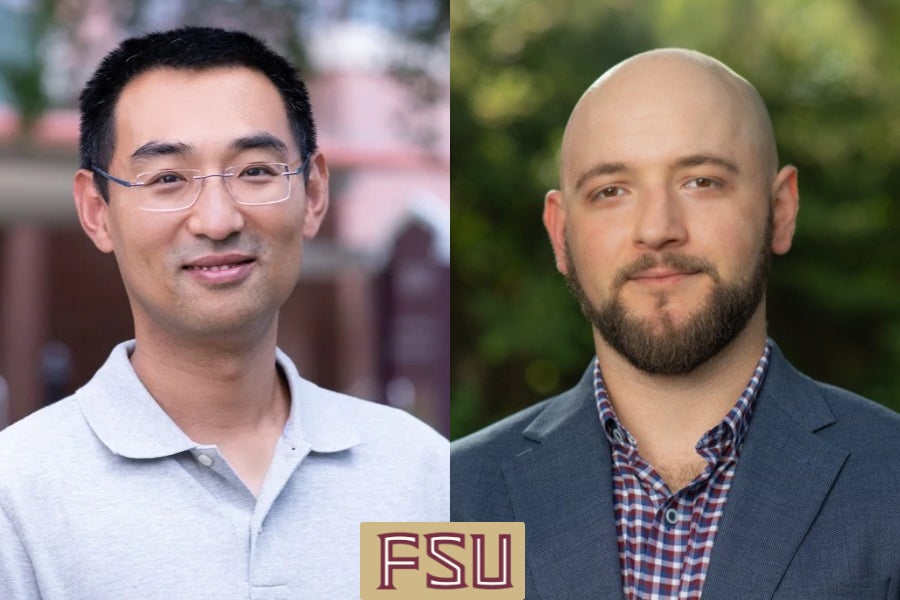
The research group, led by FSU scientific computing alumnus and Oak Ridge National Laboratory (ORNL) distinguished staff scientist Guannan Zhang, has earned the 2026 Gordon Bell Prize for Climate Modelling for the project, “Global Attention with Linear Complexity for Exascale Generative Data Assimilation in Earth System Prediction.” FSU faculty participants include Feng Bao, the Granville L. Larimore Endowed Professor of Mathematics, who contributed the generative data assimilation methodology developed by his research group, and Assistant Professor of Scientific Computing Hristo Chipilski, who offered his expertise in numerical weather prediction and atmospheric dynamics.
The award is presented by the Association for Computing Machinery, the world’s largest educational and scientific computing society.
“Winning the prestigious Gordon Bell Prize for their impressive accomplishments is stunning news and cause for celebration,” said College of Arts and Sciences Dean Sam Huckaba. “These researchers have managed to stand out in a fiercely competitive pool of nominees. While high-performance computing has been a staple at FSU for many years, being part of this prize-winning team takes us to a new level. I’m pleased to provide my heartiest congratulations to the entire team.”
The prize was awarded Nov. 19 at ACM’s International Conference for High Performance Computing, Networking, Storage, and Analysis in Chicago, Illinois. The Gordon Bell Prize was established in 1987 and is often called the “Nobel Prize of supercomputing.” The Gordon Bell Prize for Climate Modelling, introduced in 2023, recognizes advances in computing systems that address complex climate challenges. The awards honor the late Gordon Bell, a pioneer of the minicomputer and personal computing revolution.
“This prize recognizes more than just high-performance computing and the use of supercomputers,” Bao said. “It also acknowledges the algorithms and tools that make it possible to use that computing power to tackle some of the most challenging real-world problems.”
In addition to Zhang, four other FSU alumni contributed to the work. Isaac Lyngaas, a 2018 scientific computing doctoral graduate; Siming Liang, who earned his doctorate in mathematics in 2025 under Bao’s mentorship; and Dan Lu, a 2013 scientific computing doctoral graduate, are all current ORNL researchers who collaborated on the project. Zezhong Zhang, an assistant professor of mathematics and statistics at Auburn University who earned his doctorate in mathematics at FSU in 2023 under Bao’s guidance, is the second author.
Predicting weather and understanding long-term climate patterns requires scientists to account for incomplete observations and uncertainty. This project builds on generative data assimilation, a method that combines observational data with computer models to produce more accurate predictions of the atmosphere’s current and future conditions.
“As AI becomes more widely used, we need ways to assess when its predictions deserve our confidence,” Chipilski said. “In scientific applications, an incorrect prediction can affect decisions about infrastructure, natural resources and public safety. Knowing the uncertainty helps people interpret a prediction and decide whether they need more information before acting.”
Data assimilation addresses these challenges by incorporating available observations into computer models, allowing researchers to regularly update their understanding of Earth’s changing systems.
“Our model can forecast weather and hurricanes, but it can also continuously incorporate new data to adjust and improve its predictions as conditions change,” Bao said. “Unlike models that generate forecasts after training, ours updates its predictions as new observations become available.”
To make this process more efficient at an unprecedented scale, researchers developed Spatiotemporal Transformer for Observation-informed Reconstruction and Modeling, or STORM, a generative AI framework that combines information across time and space. STORM uses a new data assimilation approach that incorporates historical information and current observations in a single model, reducing computational demands while allowing researchers to work with larger datasets and account for greater uncertainty.
“We’re focused on developing a high-performance computing system that implements generative data assimilation methodology at an unprecedented scale,” Bao said. “Our mathematical innovations and AI-based methodologies can be translated into large-scale computational applications on some of the world’s most powerful supercomputers.”
The team demonstrated STORM on Frontier, a supercomputer at ORNL, showing how their work could help scientists generate more detailed representations of Earth’s systems, improve understanding of extreme weather events, and better assess long-term climate patterns.
Additional collaborators include researchers from ORNL, Colorado State University and Advanced Micro Devices Inc., a semiconductor manufacturing company.
“This has tremendous potential to address some of the most complex challenges we face today and ultimately improve people’s lives,” Bao said. “That’s what makes this work so special.”
To learn about research conducted in FSU’s Department of Scientific Computing, visit sc.fsu.edu. For more on research conducted in FSU’s Department of Mathematics, visit mathematics.fsu.edu.