
Faculty Spotlight: Herschel Chawdhry
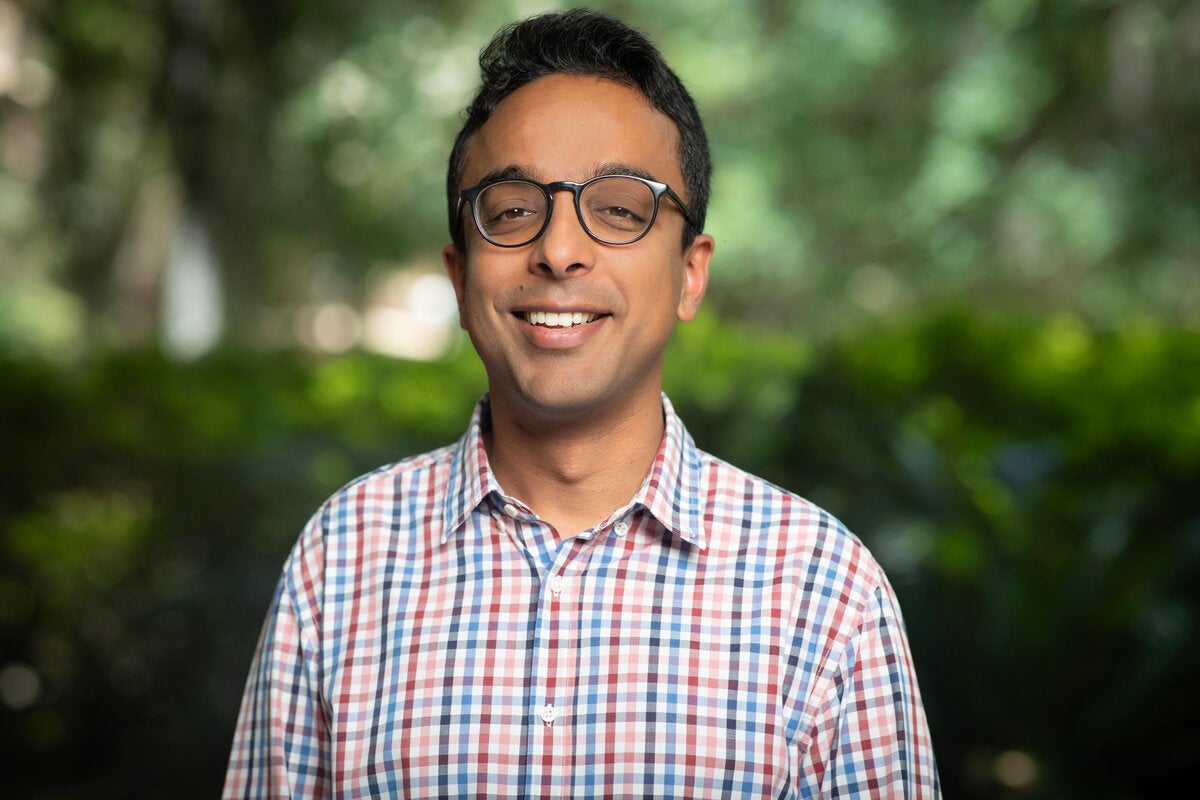
Herschel Chawdhry is a level I research faculty member in Florida State University’s Department of Physics, part of the College of Arts and Sciences. His research is at the intersection of two fields: high-energy physics, which studies the fundamental particles constituting matter and the forces governing their behavior, and quantum computing, which seeks to use quantum physics to perform faster information processing. He was recently awarded a $755,000 grant alongside physics professor Fernando Febres Cordero and Robert O. Lawton Distinguished Professor Laura Reina as part of a $7 million U.S. Department of Energy Quantum Technology Outposts initiative to enable scientific breakthroughs using quantum technology. After Chawdhry earned his doctorate in high-energy physics from the University of Cambridge in England in 2020, he researched particle physics theory as a postdoctoral researcher at the University of Oxford in England for three years before coming to FSU in 2023. In 2026, he was promoted from postdoctoral researcher to research faculty.
Tell us about your background and what brought you to FSU.
I grew up in England and Italy, studied physics at university, and did my doctorate in high-energy physics. I came to FSU because it has one of the top research groups in the U.S. for my research topic.
What inspired you to choose your field?
Particle physics is exciting because it studies the smallest and most fundamental building blocks of our world. Asking what everything is made of may seem like a simple question but answering it requires huge and exciting experiments — including the biggest machines in the world — to probe nature at the shortest distances and study the fundamental forces that determine the behavior of the most basic particles that make up everything we see around us.
Break down your areas of research for us.
I specialize in making high-precision predictions about what happens inside high-energy particle colliders, like the Large Hadron Collider — the world’s largest and most powerful particle accelerator — located at CERN, the European Organization for Nuclear Research near Geneva, Switzerland. By comparing these predictions with precise measurements from the LHC, we can better understand the properties of fundamental particles, and perhaps even spot the first signs of new particles awaiting discovery.
In recent years, I’ve also begun exploring ways to use quantum computers to improve the speed or precision of these predictions. Quantum computers are emerging machines designed to exploit the fundamental laws of quantum mechanics to perform certain calculations much faster than even the largest supercomputers. An important part of my research is to understand which parts of a high-precision calculation could be the most amenable to quantum computing and how best to design quantum algorithms to implement these in practice.
Tell us how researching theoretical particle physics led you to quantum information.
Back when I was in England, a colleague and I began a side project to explore potential ways to use an (entirely hypothetical!) quantum computer to calculate predictions at high-energy particle colliders. The inherently quantum-mechanical character of these calculations could make them a natural fit for quantum computers.
At the time, we validated our quantum algorithms by performing simulations on ordinary classical computers, but I never would’ve dreamed that just two years later we would be running tests and demonstrations on a real quantum computer! This came about thanks to Oak Ridge National Laboratory, which has unique access to several of the most powerful quantum computers in the world: a year after I arrived at FSU, I successfully applied for a substantial time allocation on these quantum computers, and this unparalleled access has really been pivotal for my research.
What do you want the public to know about the importance of your research?
It’s an exciting time for research in the twin fields of high-energy physics and quantum computing. The LHC is getting a big upgrade to make measurements with a higher precision than ever before, and quantum computers are quickly advancing in capability. Indeed, the U.S. intends to build a scientifically useful, error-corrected quantum computer by 2028, and several other countries have similar plans over the next few years, which makes now the perfect time to develop the quantum algorithms and scientific techniques to ensure that we are best positioned to get the full benefit of these unique machines as they emerge.
Tell us about being a co-PI on the DOE grant with professors Fernando Febres Cordero and Laura Reina.
Starting in July 2026, the grant provides $755,000 across three years, and I’m delighted as it’s my first major research grant. Building a brand-new line of research has been exciting yet daunting, so I’m grateful to the DOE and its panel of expert reviewers for their vote of confidence in my research plans. I’m also very grateful to Fernando and Laura for encouraging me to apply for the grant in the first place and for their invaluable refinements to help the grant proposal shine.
What’s your best memory so far at FSU?
Several of us in FSU’s High-Energy Physics group recently visited FSU’s Special Collections and Archives to see the archived documents of Paul Dirac, a Nobel Laureate in physics who moved to FSU from the University of Cambridge in 1972. It’s a fascinating collection with unique items ranging from amusing secondary-school report cards to formerly top-secret World War II correspondence and even Dirac’s original handwritten doctoral thesis, “Quantum Mechanics,” which went on to become the foundation for the fields of particle physics and quantum computing.
Who are your role models? Are there certain people who’ve influenced you most in your life and career?
I’ve been fortunate to have extremely bright, wise, and inspiring advisers throughout my research career, including Cambridge physics professor Alex Mitov, Oxford physics professor Fabrizio Caola, and FSU physics professors Fernando Febres Cordero and Laura Reina. I’m grateful for all their advice, support and encouragement, and I hope in time to offer the same to my own students or postdocs.