
Professor of Geology and Environmental Science Yang Wang and geology doctoral student Chance Hannold are coauthors of a new study that challenges the long-held belief that North and South American mammals did not mix until the continents joined through an isthmus, a narrow strip that connects two larger land masses. Instead, the researchers found evidence of some North American animals clustering in present-day southern Mexico before opportunities arose to move further south beginning about 7 million years ago.
This research was published Thursday in the journal Science.
“Fossils, as well as ancient sediments and soils, provide valuable archives of past life and environmental conditions,” said Wang, who is also a faculty affiliate of the National Science Foundation-funded, FSU-headquartered National High Magnetic Field Laboratory. “By studying these natural archives, we can better understand how mammalian communities responded to past environmental changes and the processes that gave rise to present-day biodiversity patterns. This knowledge, in turn, can help us better anticipate the potential impacts of future environmental perturbations on the biosphere.”
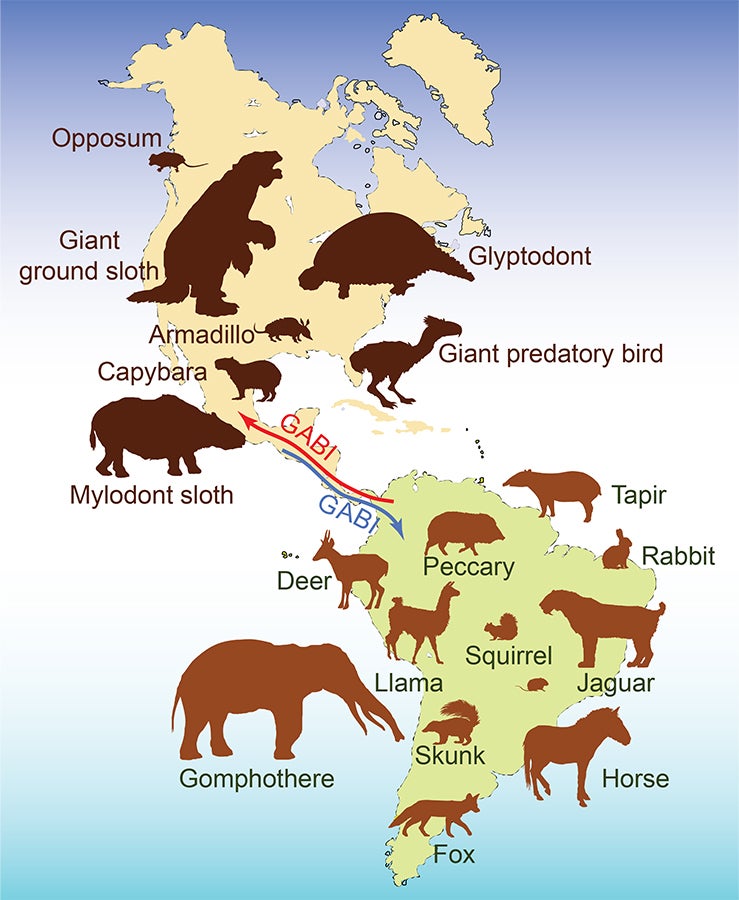
North and South America were once isolated continents home to distinct groups of animals. Until recently, scientists believed those animals moved north and south only after the Isthmus of Panama formed about 3 million years ago. Biologists refer to this as the Great American Biotic Interchange, or GABI.
However, the new research suggests many North American mammals migrated to present-day southern Mexico and remained there in a sort of geographical holding pen until the continents moved just close enough for smaller species, including racoon-like coatis, ringtails and rodents, to travel farther south, likely by island hopping through the Caribbean or rafting on vegetation.