
Student Spotlight: Oriane Yvin
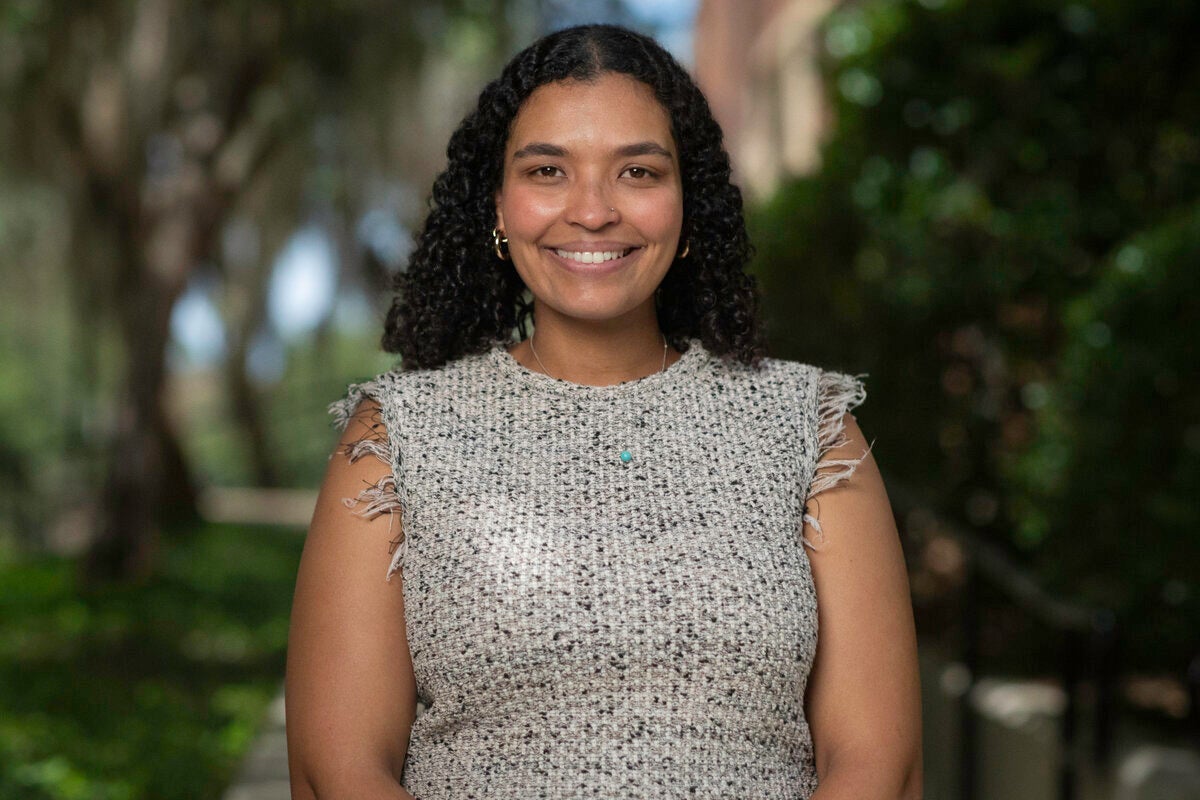
Oriane Yvin is a fourth-year doctoral candidate studying oceanography through the Florida State University Department of Earth, Ocean, and Atmospheric Science, part of the College of Arts and Sciences. Yvin received her bachelor’s degree in 2021 and master’s degree in 2023 in chemistry from the University of Poitiers in Poitiers, France, before coming to FSU in 2023. She currently works in the Spencer Biogeochemistry Laboratory under professor of oceanography Robert Spencer and researches how changing environmental factors like rising temperatures and sea levels, land use, and wildfires affect organic carbon cycling and storage in aquatic ecosystems across North America. In 2023, Yvin earned a McKnight Doctoral Fellowship from the Florida Education Fund.
Tell us about your background and what brought you to FSU.
I was born in the French Alps, but I grew up in Aix-en-Provence, a city in the south of France. I completed my bachelor’s and master’s degrees in analytical chemistry in France.
My path to FSU was unexpected. I met a professor from FSU’s Department of Earth, Ocean, and Atmospheric Science during a hike in the French Alps who encouraged me to email professors in the department after hearing about my interest in environmental science. I reached out to my current adviser, Robert Spencer, and he offered me an internship. I’d never imagined moving to the U.S., but after joining the Spencer Biogeochemistry Laboratory, I felt connected to the research, the lab group, and the questions we work on.
What inspired you to pursue a degree in oceanography?
My interest in environmental science started during my childhood summers in Brittany, a northwestern region in France. I spent a lot of time at an aquarium where I met a research scientist studying lobsters. I was fascinated that someone could build a career studying marine life. She encouraged me and told me that science always needed curious people. That moment helped shape my interest in studying natural systems and the environment.
Can you break down your areas of research for us?
My research focuses on the carbon cycle, specifically how carbon is being transported from land to the ocean through aquatic ecosystems and how environmental changes influence carbon cycling and storage along this aquatic continuum. I compare how dissolved organic matter — a complex mixture of molecules found in water that contain carbon — is cycled and transformed in environments like Florida’s Everglades, the Plum Island estuary in New England, and lagoons along the Beaufort Sea in Alaska.
The goal of my research is to understand what controls carbon stability across seasons and these ecosystems. Carbon stability helps determine whether carbon is released back into the atmosphere as carbon dioxide or stored for longer periods in the environment. I investigate the ways carbon cycling is controlled across these locations.
What do you want the public to know about the importance of your research?
Aquatic ecosystems play an important role in the global carbon cycle. Many of these systems are being affected by environmental changes like increased precipitation, rising temperatures, or wildfires and we still don’t fully understand how these environmental changes will affect them. By studying how carbon is cycled, transformed, and stored in these environments, we can predict how these ecosystems may respond. Even the most remote systems are connected to larger global processes.
Tell us about your research assistantship in the Spencer Biogeochemistry Laboratory.
Through my assistantship, I work on my dissertation research, which includes conducting field sampling, lab work, and data analysis and writing manuscripts. I mentor student members of FSU’s Women in Math, Science and Engineering living-learning community, or WIMSE, who help me in the laboratory. Some days involve fieldwork or sample extraction while others involve running samples at the National Science Foundation-funded, FSU-headquartered National High Magnetic Field Laboratory, processing data, making figures or writing. One of the main tools I use is Fourier transform ion cyclotron resonance mass spectrometry, an analytical technique that allows us to identify thousands of molecular formulas to better understand how organic matter changes in aquatic systems.
What aspect of your areas of study do you find most rewarding?
I love organizing my data and seeing how everything connects. After the fieldwork, lab work, and data processing, it’s exciting to see a story emerge. I enjoy figuring out what the data’s telling us about carbon dynamics and how different ecosystems respond to environmental change.
What on-campus resources have helped you achieve success?
Being in a doctoral program has a learning curve, and many people and resources have supported me along the way. My adviser, lab group, and department have all helped me grow as a scientist. Classes I’ve taken at FSU have helped me build important skills and think in new ways. I’m also grateful for the McKnight Doctoral Fellowship, which has supported my studies and helped me continue working toward my goals.
What are some current goals or projects that you’re working on?
I’m beginning to research how wildfires and prescribed burns in the Everglades affect the ways that dissolved organic matter is transferred from soils to aquatic networks like rivers and the ocean. My next steps are to organize the data, develop figures, and build a cohesive story around the results.
Are there any faculty or staff who have helped or inspired you?
I’ve received support from many people throughout my studies, especially my adviser, Robert Spencer. His mentorship has helped me grow as a scientist, writer and researcher. I’m grateful for my lab group and the people in the department who have supported and encouraged me.
Following your graduation, what are your plans? Even though you might miss FSU, what are you looking forward to once you graduate?
I enjoy fieldwork and collaborative, project-based work, so I’m exploring environmental science opportunities in academia, national labs, and applied roles which make environmental research more visible and accessible.
A doctoral degree requires a lot of multitasking, problem-solving, communication, and persistence, and I’m excited to carry those skills into the next stage of my career.