
Student Spotlight: Jacob Hair
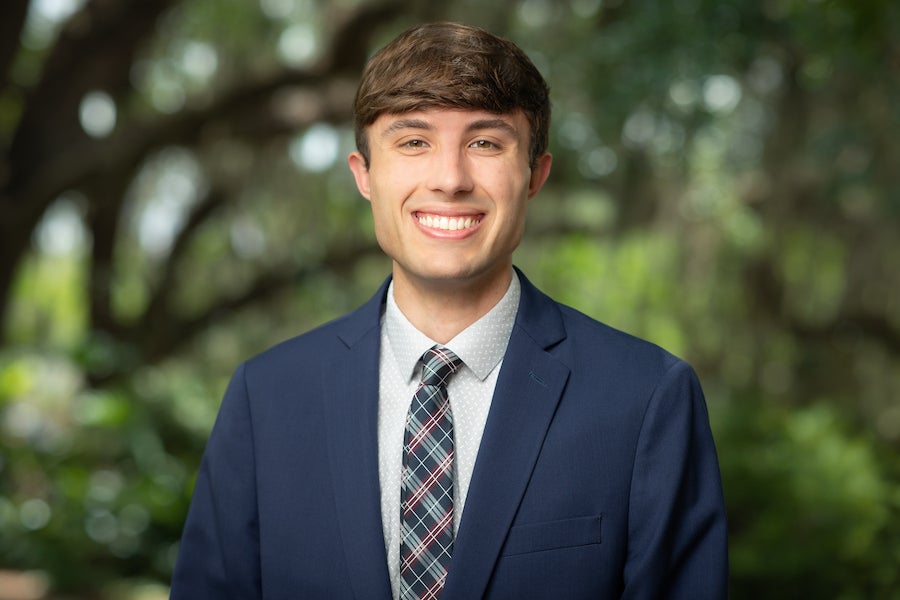
Jacob Hair is a fourth-year doctoral candidate pursuing a Ph.D. in meteorology through the Department of Earth, Ocean, and Atmospheric Science, part of Florida State University’s College of Arts and Sciences. Hair’s research examines how the Gulf Stream — the fast-moving ocean current off the East Coast that transports warm water from the South Atlantic — impacts small-scale weather fronts within bomb cyclones, a rapidly developing low pressure system. Hair also researches the structure of Hurricane Melissa that hit Jamaica in 2025. He holds research assistantships with the Rhys Parfitt Research Group, led by associate professor Rhys Parfitt, and the Hart Lab, led by professor Robert Hart. Previously, Hair earned his bachelor’s in meteorology and atmospheric science from Pennsylvania State University in 2023. In 2022, while pursuing his bachelor’s, Hair worked at the Scripps Institution of Oceanography in San Diego, California, and conducted research for the 45th Weather Squadron at Patrick Space Force Base at Cape Canaveral, Florida.
Tell us a little about your background and what brought you to FSU.
I grew up in Carmichaels, Pennsylvania. After 23 years in the North, it was time to see what the South had to offer. The sunshine and warm weather made it an easy decision to continue my education at FSU.
What inspired you to pursue a degree in meteorology?
I was born with a barometer in my hand. At a young age, I was frightened of the severe storms that would roll off the Ohio Valley into southwest Pennsylvania. That fear turned into a passion around first grade. While my friends were playing video games and watching cartoons, I was glued to The Weather Channel and measuring atmospheric pressure with my trusty barometer. Everyone knew I was destined to be a weather weenie. I would even get called to the principal’s office to tell them whether we should delay or cancel school due to snow. This continued into my undergraduate years at Penn State.
Can you break down your areas of research for us?
Most aspects of meteorology interest me, so I research a blend of topics. Most of my research deals with snowstorms on the East Coast of the U.S., which are commonly referred to as nor’easters, and I especially like to study the strongest of nor’easters — bomb cyclones. I specifically look at how the Gulf Stream influences nor’easters and the atmospheric fronts associated with them.
I’m also doing a case study on Hurricane Melissa, which hit Jamaica in 2025. I’m examining how the computer model forecast compares to the observations of the National Oceanic and Atmospheric Administration’s Hurricane Hunters that flew into the storm with the goal of explaining why the forecast was different than what was actually observed.
Tell us about your work in Parfitt’s research group and the Hart Lab.
I split my time between the two labs, each run by my co-advisers. Most of my days, I’m coding and writing out my results. It’s a lot of hours in the office, so I try to get outside and look at the weather from time to time. The goal of my research is to show that the ocean has a significant role in the development of the weather systems. I love exploring new concepts in meteorology and am always happy to learn.
Tell us about your previous work with the Scripps Institution of Oceanography.
In 2022, I researched observation techniques within atmospheric rivers, or large plumes of precipitation that give the U.S.’s West Coast much of its annual rainfall. I helped with the atmospheric river reconnaissance team by providing input for the hurricane hunters flight tracks into these systems. This opportunity was a wonderful experience that introduced me to day-to-day, independent research.
That same year, I also conducted research for the 45th Weather Squadron at the Patrick Space Force Base in Florida to help make the weather launch criteria rules safer when launching a rocket. There are specific weather requirements that must be met for a safe and successful launch, and I was fortunate enough to help with this project.
What do you want the public to know about the importance of your research?
I want the public to focus on the importance of research in meteorology and atmospheric science as a whole. Weather is a function of our daily lives. Whether it’s as simple as checking the current temperature to decide what to wear, or as important as deciding the evacuation routes to get citizens out of the path of a major hurricane, everyone is influenced by the weather.
It’s more important than ever that research tests the limits of forecast capabilities, models detailed atmospheric processes, promotes the new frontier of forecast communications to the public, broadens our expertise into fields like aviation and space weather, teaches new generations of students to be creative in tackling the challenges that the planet faces, and more.
Meteorology is importantly and uniquely positioned to advance research about the communication of the risks and hazards that people may face.
What on-campus resources have helped you achieve success?
Without the advising and encouragement of faculty and fellow graduate students in my department, I wouldn’t have made it this far.
Are there any faculty or staff who have helped or inspired you?
Jon Nese, associate head of the undergraduate program in meteorology and atmospheric science at Penn State, has inspired me ever since my freshman year. His passion for teaching and sharp communication skills made me fall in love with weather even more.
Following graduation, what are your plans? Even though you might miss FSU, what are you looking forward to once you graduate?
I’ve always been passionate about forecasting and communications. Working in anything that blends those two is right up my alley: national television, a forecast center or even teaching. We’ll see where the journey takes me!
The friends I made along the way always made it worth it. I’ve had a wonderful time at FSU and have no regrets.