
Student Spotlight: Lili Boss
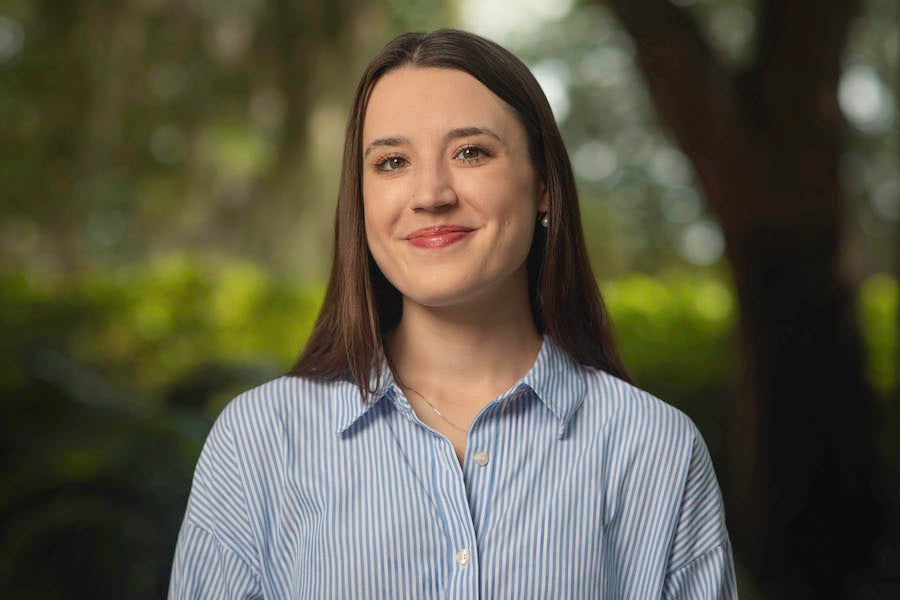
Lili Boss is a third-year doctoral candidate pursuing a Ph.D. in meteorology through the Department of Earth, Ocean, and Atmospheric Science, part of the College of Arts and Sciences. Boss earned her master’s in meteorology from FSU in 2025 and a Bachelor of Science in marine biology and a Bachelor of Arts in physics and operational meteorology from the College of Charleston in South Carolina in 2023. Last year, she also published research in the journal Atmospheric Chemistry and Physics alongside assistant professor Michael Diamond that examined how changes to regulations in shipping emissions from the International Maritime Organization affected cloud properties, such as cloud droplet number concentration.
Tell us a little about your background, where you’re from and what brought you to FSU.
I was born in Zurich, Switzerland, and moved between there and Connecticut a few times when I was younger. I was interested in studying marine biology, which led me to my undergraduate career at the College of Charleston. One of the main topics I was interested in was how climate change impacted marine ecosystems, so I took some classes in the physics department. As I learned more about meteorology, I became fascinated by cloud physics and solar radiation modification as a method of addressing climate change, which led me to apply to FSU to work with assistant professor Michael Diamond.
What inspired you to pursue a degree in meteorology?
I’m passionate about the climate and how climate impacts terrestrial and marine ecosystems, which can impact people and global economies. I decided to pursue my degree in meteorology because I wanted to contribute to a field where I’d have the opportunity to do interdisciplinary research.
Can you break down your areas of research for us?
I’m interested in airborne particles or aerosols from anthropogenic emissions, also known as pollutants, released into the atmosphere due to human activity. Specifically, I research how these aerosols influence cloud properties and the climate.
I’m also interested in how carbon dioxide removal and sunlight reflection technologies, which are both approaches to reduce global temperatures, can be used to address some of the adverse effects of climate change. Moreso, I’m interested in studying how applying these technologies in a way that’s policy-relevant may impact marine and terrestrial ecosystems.
What do you want the public to know about the importance of your research?
Microscopic airborne particles can create cloud droplets when water vapor condenses onto them. In the presence of pollution particles, such as those produced by the exhaust from shipping vessels, cloud droplets will form at smaller sizes. This makes the affected clouds brighter and more effective at reflecting sunlight back into space. Historically, this has led to a cooling that offsets approximately a third of the warming from the greenhouse effect — the process of heat being trapped near the Earth’s surface by greenhouse gases like carbon dioxide, ozone, water vapor and more.
Tell us about your publication, “Conflict-induced ship traffic disruptions constrain cloud sensitivity to stricter marine pollution regulations,” featured in Atmospheric Chemistry and Physics.
In 2020, the International Maritime Organization decreased the allowable sulfur content in marine shipping fuel from 3.5 percent to 0.5 percent. This change in regulation is expected to decrease the size and change the chemical composition of pollution particles released, making aerosols’ impact on clouds harder to detect. In November 2023, the Houthi militia occupying northwestern Yemen attacked merchant vessels and made the ships reroute around the Cape of Good Hope, a rocky point at the southern end of Africa, instead of passing through the Suez Canal, a waterway cutting between Africa and Asia and connecting the Mediterranean Sea to the Red Sea. The increase in traffic created an experiment-within-an-experiment to quantify the effect of the 2020 IMO regulation changes to shipping emissions on cloud properties.
Our study found that the reduction in sulfur emissions from ship pollution led to about a 67-percent reduction in cloud-changing effects from increasing cloud droplet number concentration.
What aspect of your areas of study do you find most rewarding?
I really enjoy relating cloud physics to socioeconomic topics. It’s helped me think critically about the relationship between the choices that humans make and our climate.
What on-campus resources have helped you achieve success?
The main on-campus resource I’ve used are the FSU Libraries. I’ve been able to access a lot of publications that would have been difficult to do so without using libraries.fsu.edu. The libraries also have a lot of interesting events and resources.
What are some current goals or projects that you’re working on?
My current goal is to finish writing and publish the paper from my master’s work, “The Impacts of IMO 2020 on Droplet Number Concentration and Cloud Adjustments in the Southeast Atlantic Shipping Corridor.”
Are there any faculty or staff who have helped or inspired you?
I’ve had a lot of help from many of the faculty members within the department, whether helping me during office hours or meeting with me to discuss study habits for my qualifying exam. Michael Diamond, who is also my major professor, has helped and inspired me the most with my research, encouraging me to build new skills and helping me find ways to navigate my career options once I graduate.
What advice do you have for fellow students? What advice do you have for undergrads?
Don’t compare yourself to everyone else. Instead, measure your progress by the skills you’ve learned and the goals you’ve accomplished. For undergraduate students, my best advice is to be open to as many opportunities as you can. Be kind and build a strong network with your peers and people working in the fields you’re interested in. You never know who you’ll end up working with later in life.