
Faculty Spotlight: Joel M. Smith
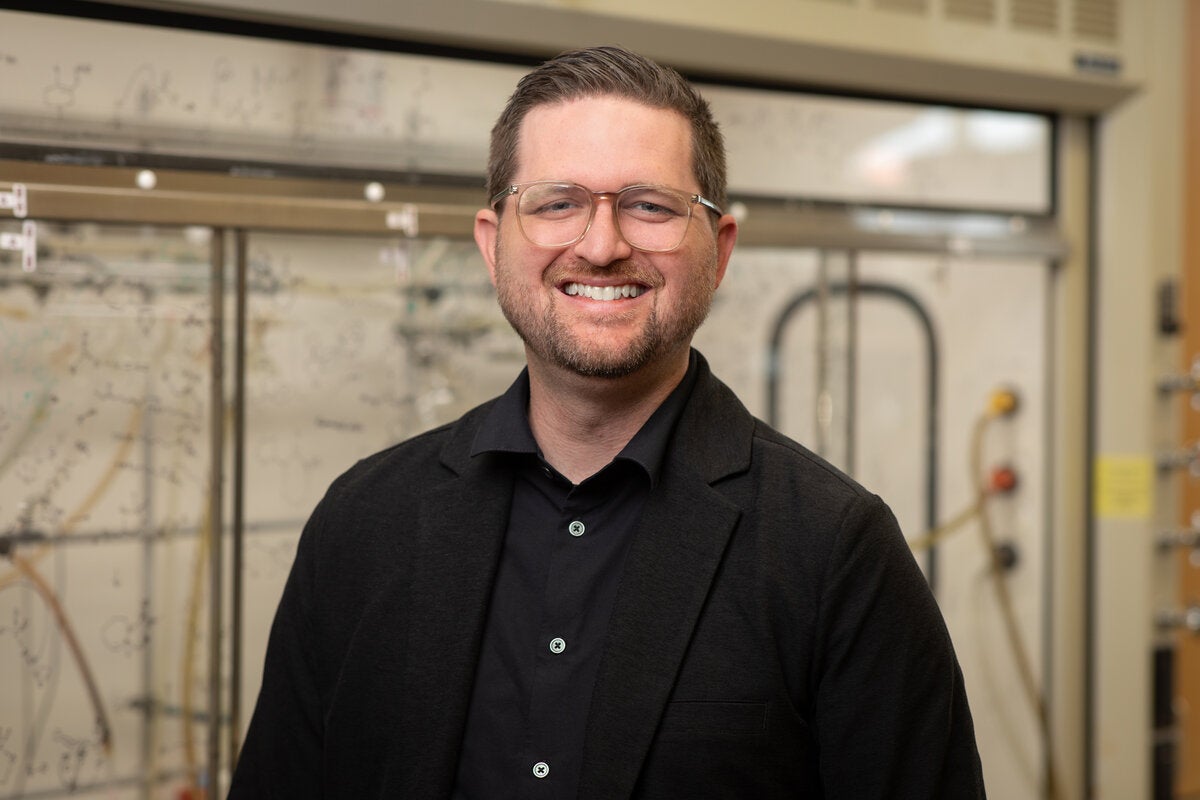
Joel M. Smith is an associate professor in Florida State University’s Department of Chemistry and Biochemistry, part of the College of Arts and Sciences. His research focuses on building complex chemical structures that lay the foundation for the creation of novel drug molecules with pharmaceutical potential. Smith earned his doctorate in organic chemistry from UCLA in 2015 under Neil Garg, the Kenneth N. Trueblood endowed chair in UCLA’s Department of Chemistry and Biochemistry, and completed postdoctoral research at the Scripps Research Institute in La Jolla, California with Phil Baran, Scripps’ Department of Chemistry professor. Smith joined FSU’s faculty in 2018. In February, Smith and his lab earned a Grantee Award from pharmaceutical giant Eli Lilly and Co. to support its research.
Tell us about your background and what brought you to FSU.
I was born and raised in Raleigh, North Carolina and attended Furman University in Greenville, South Carolina, where I received my bachelor's degree in 2010 with double majors in chemistry and music. As an undergraduate I was introduced to the art of synthesizing complex molecules. I was a better chemist than pianist, so I pursued graduate school at UCLA and worked under Neil Garg. I enjoyed having the freedom to ask questions, which led me to academia. When I completed my postdoctoral training, I was given an opportunity to pursue chemistry research at FSU.
What inspired you to choose your field of study?
I loved music, and if I’d pursued it, I might’ve still ended up in academia. During my undergraduate studies, I realized I was more passionate about chemistry than my peers. Music is enjoyable, but my love of chemistry won and has provided abundant opportunity. Being a chemist has become essential to my existence.
What makes you passionate about organic chemistry?
A lot of people that become organic chemists started out wanting to go to medical school, but not me. My father was a physician, and I wasn’t interested in the social aspect or strict regulations of his job — I was interested in the medicines he prescribed and how they were developed. I wanted to be a chemist to research these essential tools.
Break down your research.
I focus on retrosynthetic analysis — the reverse engineering of molecular structures. Drug substances are often inspired by natural products, small organic compounds found in nature such as penicillin, cholesterol, or citronellal. Natural products can have therapeutic aspects and provide direction when developing disease treatments, like antibiotics and chemotherapeutics. To evaluate their therapeutic nature, you must acquire a sample from a natural source, which may be scarce. However, acquiring even 100 milligrams of an essential natural product could harvest kilograms of an organism, damaging the ecosystem. Instead, by knowing the structure of a natural product, we synthesize hundreds of milligrams in the lab ourselves, which requires reverse engineering the structure of the target molecule.
It’s like someone gave you a finished Lego set, and you break it down into each block to devise a set of instructions — that’s what we do with molecules. This inspires new chemical transformations in which we stitch together new molecules. We evaluate how these chemical reactions facilitate synthesis of the target molecule. There’s a give-and-take in the process because what we learn or invent can help other chemists develop new drugs and medicines.
In one project, we collaborate with Mohamed Kabbaj, professor in the Department of Biomedical Sciences in FSU’s College of Medicine, to make and evaluate derivatives of the drug LSD. Since the 1950s, researchers have studied LSD as a potential therapeutic treatment for conditions like clinical depression, addiction, and post-traumatic stress disorder.
We’ve partnered with a startup to evaluate novel synthetic derivatives of LSD, which have unique effects on the brain for potential downstream therapeutic use. Some derivatives are non-psychedelic or have more controlled psychedelic effects while others help reduce alcohol addiction and anhedonia, the inability to feel pleasure.
What did it mean to earn the Eli Lilly and Co. Grantee Award for your work?
Earning this validated that we’re doing something useful. Eli Lilly recognizing the synthetic chemistry we’re doing tells us that we’re on the right track, which can be challenging to know in academia. The award is a huge praise for my students; they’re the ones in the lab making discoveries. I can only lay claim to having ideas.
What’s your best memory at FSU?
I recently brought my 6-year-old son to the lab, and I saw this excitement fill his face. He said, “Daddy, you’re a scientist. What you do is so cool.” Nobody had ever characterized a scientist as ‘cool’ to me. He went home and drew a picture of the stir plate he saw in the lab next to a beaker filled with yellow liquid and wrote, “I love you,” on it. Seeing my work being translated to a younger generation and my own son’s appreciation for science is unbelievably special.
Do you have any exciting projects you’re working on?
We recently released a pre-print of a paper on ChemRxiv titled “SuzukiMe: A Tactically Mild Methylation Reagent,” that highlights an innovative reaction for installing methyl groups, some of the most medicinally relevant small molecules. For our research, we invented a brand-new reagent for this group. Within a few days of submission, I was contacted by chemists asking for the procedures. It’s great to know that we’re doing something that benefits other scientists.
If your students only learned one thing from you (of course, hopefully they learn much more than that), what would you hope it to be?
Think critically. There’s an easy way out, and a way that uses critical thinking. Artificial intelligence can solve problems, but it’s not creating the most innovative solution because it’s drawing on what already exists. Thinking critically is the foundation to making impactful decisions. Appreciating the process and thought behind every endeavour makes discoveries useful not just for you, but for humanity. Critical thinking shouldn’t be taken for granted; it should be celebrated.