Faculty Spotlight: Scott Stagg
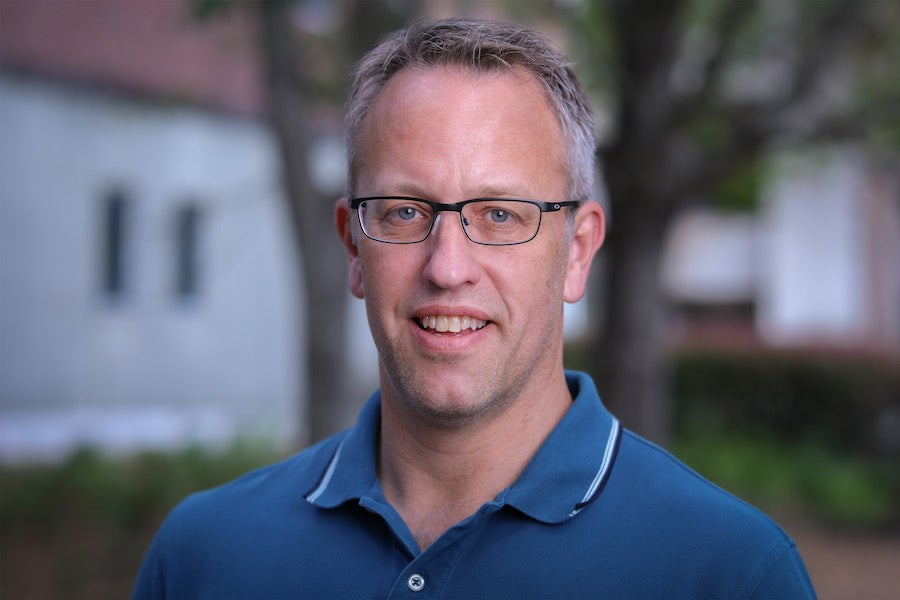
Scott Stagg is the director of the Florida State University Biological Science Imaging Resource and a professor in the Department of Biological Science and the Institute of Molecular Biophysics, all within the College of Arts and Sciences. Stagg’s research focuses on mechanisms of membrane trafficking and cryogenic electron microscopy, cryo-EM — a structural imaging technique that enables high-resolution 3D visuals of biological structures — to understand factors like disease mechanisms. After earning his doctoral degree in biochemistry in 2002 from the University of Alabama at Birmingham, Stagg conducted postdoctoral research at the Scripps Research Institute in San Diego, California, from 2004 until 2007 where he learned cryo-EM. He joined FSU’s faculty in 2007.
Tell us a little about your background.
I grew up in Huntsville, Alabama, where my parents both pursued scientific careers. My dad was an engineer, and my mom trained engineers in the aerospace industry. Following my postdoctoral research in San Diego, I began looking for a job involving cryo-EM.
My wife, associate professor and chair of the Department of Art Anne Stagg, and I were looking for universities where we could both work, and FSU was a great spot for us both.
What inspired you to choose your field of study?
At the start of my undergraduate studies, I wanted to practice medicine, but as I took more science classes, I realized that what excites me the most is discovering new and unexpected things. This led me to pursue my doctoral degree in biochemistry at UAB, where I met Steve Harvey, formerly of UAB and a professor emeritus of biology at the Georgia Institute of Technology. I really connected with his research, so I joined his lab, where I collaborated with a group working with cryo-EM. The topic seemed like the perfect mix of experimental research and applying molecular modeling techniques.
Can you break down the Stagg Lab’s areas of research?
My research has two directions: first, the lab makes tools to study difficult molecular complexes and determine their structures and mechanisms. These tools are broadly applicable, meaning they support others’ research, including research on neurogenetic diseases, alongside the lab’s research.
We also research the structural mechanisms of membrane-remodeling proteins. Inside our cells, we have various membrane-bound compartments and proteins called membrane remodelers, such as clathrin and coat protein complexes, that mediate the materials being transferred from one compartment to the other through elaborate and complicated mechanisms.
What do you want the public to know about the importance of your research?
Most diseases arise from molecules misfunctioning within the cell, so determining the structures and mechanisms of molecules helps us understand the mechanisms of disease.
One protein I study, if mutated, can prevent collagen from exiting the cell and cause craino-lenticulo-sutural dysplasia, a rare developmental disease. The Stagg Lab also collaborates with researchers studying Alzheimer’s disease by investigating A-beta and tau fibril proteins, which, when misfunctioning, can disrupt normal brain functions and lead to Alzheimer’s disease.
Tell us about your position as director of the Biological Science Imaging Resource.
The BSIR houses high-end imaging instruments, both electron microscopes and light microscopes. These instruments are usually more expensive than what an individual can afford, which is why the shared resource is necessary for researchers at FSU.
I’m also the primary investigator of the Southeastern Center for Microscopy of Macromolecular Machines grant, SECM4, which is funded by the National Institutes of Health and housed in the BSIR. The SECM4 is a regional center where scientists from the southeast can apply to gain access to instruments, training, specimen preparation, and data collection conducted by our team. The idea is to enable researchers to gain access to expensive and technically demanding cryo-EM instrumentation that would otherwise be out of reach by providing access to both expertise and equipment through a shared regional resource.
What is your favorite part of your job?
My favorite part of my job is the discovery part; seeing something unexpected is exciting. I enjoy the feeling when you know you’re on the right track to discovering something interesting.
Tell me about Structure Club, the podcast and YouTube channel you co-created.
The idea for the channel, which I created with assistant professor of biological sciences Ashwanth Francis, is to have a virtual journal club for those interested in structural biology. Each episode, the author of a recently published scientific paper leads a discussion on their research. This makes it easier to understand scientifically dense papers and helps individuals keep up with new literature. At the end of each episode, we also interview the authors about their inspirations and favorite memories from conducting research.
Who are your role models?
One of my role models is Steve Harvey, my former professor, who introduced me to the field of cryo-EM. Another scientist in my field, Jacques Dubochet, who won a Nobel Prize for this work, inspires me with his ability to convey his love for science in his papers. Lastly, my postdoctoral advisers and the co-founders of NanoImaging Services, Clint Potter, a scientific adviser at NanoImaging Services, and Bridget Carragher, a technical director at the nonprofit research organization Biohub, inspire me through their nearly two decades of collaboration. Seeing how each of their strengths complement the other’s strengths, like a well-oiled machine, influenced how I conduct my own research.
Do you have any exciting upcoming projects you’re working toward?
Currently, to conduct molecular characterization, researchers purify and isolate a molecule from a cell to determine the molecule’s structure. I’m researching a new technique called cellular cryo-EM, which allows us to determine a molecule’s structure while it’s still in the cell.
If your students only learned one thing from you, what would you hope it to be?
I hope my students learn to follow their curiosity, even when the results they’re getting seem unexpected or wrong. Data not fitting our expectations isn’t a problem we have to fix — it’s a clue that’s trying to tell us something.