
Faculty Spotlight: Alda Balthrop-Lewis
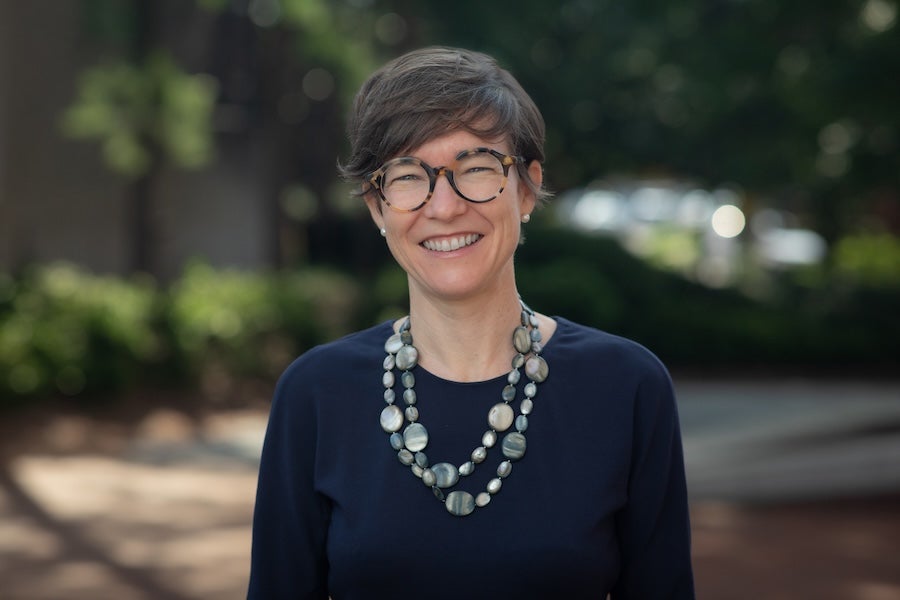
Alda Balthrop-Lewis is an associate professor in Florida State University’s Department of Religion, part of the College of Arts and Sciences. Her research focuses on religious ethics, environmental justice and asceticism, a form of religious and ethical discipline often marked by renunciation. In 2021, she published “Thoreau’s Religion: Walden Woods, Social Justice, and the Politics of Asceticism” with Cambridge University Press, and she’s now writing her latest book, “Contemplation and Complicity: Studying Politics with Thomas Merton.” Before joining FSU’s faculty in January 2025, Balthrop-Lewis was a senior research fellow at the Institute for Religion and Critical Inquiry at Australian Catholic University in Melbourne, Australia, for seven years.
Tell us about your background and your journey to FSU.
I was born in Tallahassee but left Florida when I was 14 and have lived in seven states and three continents since. I was excited to return and begin my dream job teaching religious studies in my hometown. FSU is an inspiring place to teach, and I’m grateful every day that I get to be part of it.
Break down your research for us.
My research focuses on ethics, using research methods from history, literary studies and philosophy. I’m especially interested in environmental ethics and how varied environmental ethical perspectives have been represented among American religious writers.
What makes you passionate about your research?
In 2010, the Deepwater Horizon oil rig collapsed into the Gulf of Mexico, causing the largest marine oil spill in the history of the petroleum industry. My father was a clam farmer at Alligator Harbor, south of Tallahassee, and the time that followed was devastating for Gulf Coast communities like ours.
I started studying environmental ethics following that disaster, and my work has been motivated by understanding that frontline communities bear ecological costs for the rest of us. I love North Florida’s land, wetlands, beaches and waterways. Every day I learn more about how to nurture this ancient place of human habitation and fight for people elsewhere suffering from disasters like ours.
Religious ethics has allowed me to pursue these interests. Religion can motivate people to advocate for causes they value, and while that influence can be used in harmful ways, it can also support efforts to promote the well-being of communities facing significant challenges.
What’s something people might not know about the intersection of religion and environmental justice?
“Environmental justice” refers to political efforts that rectify inequitably distributed environmental risks often caused by race and class discrimination. The concept emerged among community activists who were resisting a toxic waste dump in their community in Warren County, North Carolina, in the early 1980s.
Multiple religious leaders and the United Church of Christ Commission for Racial Justice sponsored the 1987 study, “Toxic Wastes and Race in the United States: A National Report on the Racial and Socioeconomic Characteristics of Communities with Hazardous Waste Sites,” which was the first documentation of discriminatory toxic waste siting. In this way, Christians were among the first to describe the importance of “environmental justice” in one of the main senses we use it now.
What’s your favorite part of your job?
I teach my students to use writing for thinking. My favorite part of my job is to read the writing of students who are learning that writing is a tool for their own freedom. It’s exciting to see them shift away from the strict standards they’ve been taught and toward a feeling of home in their own minds.
What’s your best memory so far from working at FSU?
The other day, I was speaking with some students about changing climate patterns. They were taught that ongoing climate trends would yield colder winters and hotter summers. They didn’t see that pattern emerging, so they expressed skepticism about change. We discussed how greenhouse gases from emissions trap heat in the atmosphere, raising Earth’s temperature and affecting different regions in different ways; some places get wetter while some get drier. Ocean currents can slow or speed up. Climate is a complex system, and as temperatures rise, we’re seeing chaotic effects that are less predictable than before. My students found that explanation helpful.
I’m not a climate scientist, but sometimes my position means I can meet students where they are. When that happens, it feels like I’m in the right place.
Who are your role models?
I’ve always looked up to my grandparents. My grandmother, Clifton Lewis, was a Tallahassee icon. She ran for city commission once, and she taught me how to be an active member of a community, engaged in trying to make it better.
What exciting projects are you working on?
Next year, I’ll participate in a collaborative initiative exploring transcendentalism — a philosophical movement concerning a tradition of piety toward nature — as a living tradition, hosted by the Center for the Study of World Religions at Harvard Divinity School. The initiative will advance work on my book about contemplation and politics in the 1960s, which focuses on one Trappist monk, Thomas Merton. When Merton moved to rural Kentucky to join a monastery in 1941, he thought he was leaving behind something he called “the world” — the site of greed, sin and injustice. At that time, he thought the monastery was the place where you refuse all that and live in a different way. He renounced the pleasures of his life in New York and adopted the practice of the most ascetic order of the Roman Catholic Church. But over the course of Merton’s monastic life, living among rolling hills and forests in Kentucky, his view of the world shifted.
My book follows Merton’s reconciliation with the world in the 1960s. In this period, while reading some of the most challenging and enduring voices in 20th-century American politics like Hannah Arendt, James Baldwin, William Melvin Kelley and Rachel Carson — all of whom were influenced in various ways by transcendentalism – Merton reconceived the significance of contemplation as he tried to navigate between panicked political affect and guilty inaction.
What do you hope students take from your classes?
I hope my students learn that part of what it means to live well is to cultivate their own intellectual lives, and I hope my classes help them sustain the independence of mind and commitment to the pursuit of truth that democracy requires.