
Student Spotlight: Eva Mustian
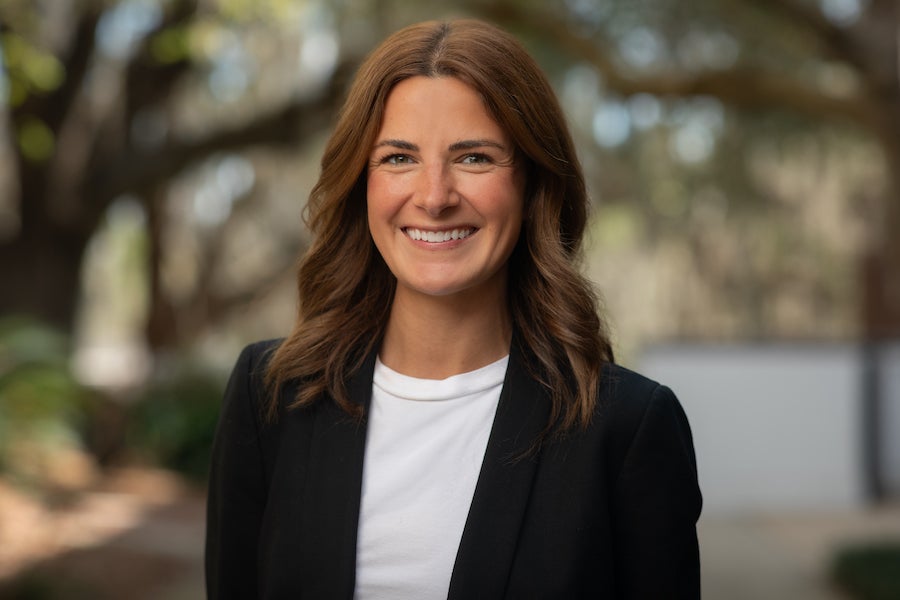
Eva Mustian is a third-year doctoral student studying environmental science in Florida State University’s Department of Earth, Ocean and Atmospheric Science, part of the College of Arts and Sciences. She researches how sargassum, a type of seaweed that washes up in large amounts along beaches, breaks down on sandy shores along the equatorial Atlantic and Gulf coasts and how that process affects coastal ecosystems, including wildlife, water quality and beach conditions. At FSU, Mustian is a teaching assistant and research assistant under the mentorship of her adviser, Distinguished Research Professor of Oceanography and Environmental Science Markus Huettel, and president of the FSU Thalassic Society, a student organization focused on ocean and coastal science. She earned her bachelor’s degree in environmental science from FSU in 2019 and a master’s degree in wildlife and fisheries biology from Clemson University in South Carolina in 2021.
Tell us about your background, where you’re from and what brought you to FSU.
I was born and raised in Tallahassee. Growing up just a few miles from campus, I thought I knew FSU well, but as an undergraduate, I realized it felt like an entirely different world. After earning my bachelor’s degree, my path was anything but linear. I worked as an elementary school teacher and assistant cross-country and track-and-field coach at Maclay School while completing my master’s, and later, I worked as a district aide in the Florida House of Representatives and as a natural resource contract manager for the Florida Department of Education. I realized that my passion remained in environmental research and that I wanted to better understand how human activities influence our planet. Returning to FSU for my doctoral studies felt like coming full circle with a greater purpose.
What inspired you to pursue a degree in environmental science?
I took an Advanced Placement environmental science course in high school and immediately felt drawn to the field. I was fascinated by how ecosystems connect the past, present and future. I’ve always wanted to contribute to something larger than myself, and environmental science offers a tangible way to do that.
What aspects of your studies do you find most rewarding?
Pursuing a doctorate requires resilience; research rarely works perfectly the first time. While challenging, those moments push you to think more creatively and critically. This is true in both fieldwork and data analysis, and I’ve learned that patience, adaptability, and confidence will bring you a long way.
Break down your areas of research for us.
My research focuses on what happens when large amounts of sargassum seaweed wash ashore on Florida’s beaches. As this seaweed breaks down, it releases carbon dioxide and other organic compounds into coastal ecosystems. I study how much carbon is released and how it varies depending on the type of sand, such as the silicate sand of Pensacola Beach or the carbonate sand of the Florida Keys.
What do you want the public to know about the importance of your research?
Sargassum is often seen as a nuisance because it smells and affects tourism. However, sargassum degradation has significant environmental impacts. When large amounts accumulate, they can alter oxygen levels in sand and the nearby water, affecting marine life and contributing to greenhouse gas emissions. Understanding how sargassum decomposes helps determine whether repeated beaching events are short-term issues or have long-term effects on coastal ecosystems. This research can inform coastal management decisions as these events become more frequent.
Tell us about your role as president of the FSU Thalassic Society.
Graduate school can feel intense, and building a supportive community is essential. Through the Thalassic Society, I’ve enjoyed helping create a space where students can connect on a more personal level. My role includes organizing events, facilitating community-building activities, and creating opportunities for students to connect beyond academia.
What are some current projects you’re working on?
My current research focuses on identifying the molecules released as sargassum breaks down and understanding how they interact with different types of sand in Florida. I also enjoy playing piano and guitar in my spare time.
Are there any faculty or staff who have helped or inspired you?
I cannot speak highly enough of the faculty in my program. I have consistently been met with kindness, curiosity and encouragement. My adviser, Dr. Huettel, has been an unwavering source of inspiration for me. He continuously challenges me to think more deeply while emphasizing the importance of maintaining a healthy work-life balance.
What on-campus resources have helped you achieve success?
FSU offers countless resources, from FSU Libraries to research facilities like the National High Magnetic Field Laboratory, that have supported my academic growth. The most valuable resource has been the people around me. My colleagues and fellow graduate students have been a constant source of support, feedback and motivation.
What advice do you have for fellow students? What advice do you have for undergrads?
Growth is rarely comfortable. It comes from asking questions, trying things that may not work, and taking on challenges outside of your comfort zone. Approach challenges with a mindset of curiosity rather than fear and remember that mistakes are part of the process. For undergraduates especially, don’t be afraid of a nonlinear path. Some of the most meaningful growth comes from unexpected experiences.