
Student Spotlight: Diego Lebron
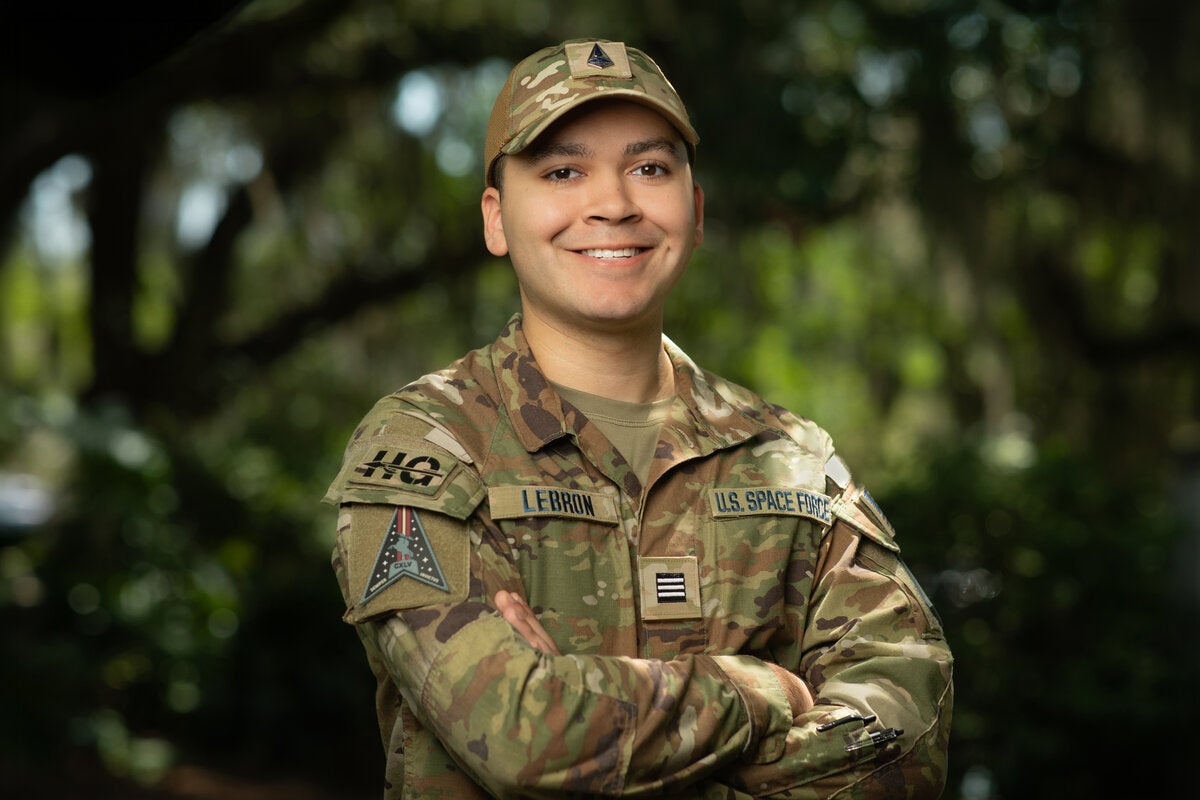
Diego Lebron is a senior in Florida State University’s Honors Program pursuing a degree in chemistry through the Department of Chemistry and Biochemistry, part of the College of Arts and Sciences. He additionally serves as a cadet in FSU’s Air Force ROTC program, where he has held multiple leadership roles including honor guard commander, drill and ceremonies officer, and training support squadron commander. Upon his expected graduation in Spring 2027, Lebron will commission as second lieutenant in the U.S. Space Force and begin job training at Peterson Space Force Base in Colorado Springs, Colorado.
Tell us about your background and what brought you to FSU.
Growing up in a military family, I’ve lived all over the country and in many parts of Europe, eventually graduating from high school in Germany. I was drawn to FSU’s prestigious chemistry program and was selected by the U.S. Space Force for the Air Force ROTC Type 1 High School Scholarship Program, which provided tuition benefits in exchange for military service with an intention to pursue a Space Force career upon graduation.
What inspired you to pursue a degree in chemistry?
I’ve always had a passion for science and knew I wanted to pursue a STEM career. During high school, I excelled in advanced chemistry courses and realized I had a strong aptitude for the subject. The Air Force ROTC scholarship I was pursuing at the time required a STEM degree, so it worked out perfectly.
How has being involved in the Air Force ROTC program shaped your FSU experience?
Being involved in AFROTC has developed my leadership skills and greatly prepared me for a career in the military. The program also created a strong sense of community within a large university. My high school only had 900 students, so being a part of a cohort of about 140 other undergraduate and graduate students made the transition to college easier.
Tell us about your internship with the Hercules Innovation Lab in Ramstein-Miesenbach, Germany.
The lab is an Air Force initiative focused on introducing modern technology and outside perspectives into established military processes. During my senior year of high school in Germany, from August 2022 to May 2023, I served as a student intern with the team. We advised Air Force units on how to use innovation funding to invest in new technologies and ideas.
I helped develop evaluation criteria for proposals so units could determine which projects were worth funding. As part of the lab’s outreach efforts, local high school students were brought in for weekly instructional sessions, and I helped write and teach that curriculum.
Tell us about your roles in FSU’s Air Force ROTC program.
I’ve been lucky enough to serve in multiple roles. During Spring and Fall 2024, I managed the honor guard, a ceremonial unit responsible for presenting the colors and representing the program at official events including student government inaugurations, sporting events, and on-campus student organization appearances. In Fall 2025, I taught drill and ceremonies to underclassmen cadets, which is a major component of Air Force ROTC training and leadership development.
In Spring 2026, I designed realistic training scenarios called group leadership problems to evaluate underclassmen's leadership skills. Freshman and sophomore cadets, operating simulated U.S. Air Force logistics units, were presented with a problem to solve or a task to accomplish. They were evaluated not on whether they completed the task, but on how effectively they led their peers throughout the exercise.
I currently serve as the training support squadron commander, so I oversee many of the cadets responsible for training and evaluating the underclassmen cadets on U.S. Air Force standards.
How do you balance honors-level coursework while serving in multiple AFROTC leadership roles?
The balance has been manageable thanks to the honors faculty’s flexibility, as they understand that many students have demanding schedules. You must have a bachelor’s degree to commission into the U.S. Air Force or Space Force, so the AFROTC program emphasizes academic success and allows cadets to focus on classwork when needed. Effective time management is critical, so I input due dates, exams, and AFROTC responsibilities into my Google Calendar.
What on-campus resources have helped you achieve success?
The honors counselors have been an immense help during my time at FSU. Through them, I’ve stayed on track with both my honors and chemistry graduation requirements. They always answered any questions I had and went out of their way to get the information I needed.
What are some current goals or projects that you’re working on?
Since Day 1 of college, my goal has been to commission in the U.S. Space Force, so I’ve been doing everything I can to prepare for that, mainly taking astrophysics courses through the Department of Physics, as I recently learned the training leans toward that field. My top priority right now is preparing myself for the mental transition once I graduate.
Are there any faculty or staff who have helped or inspired you?
The AFROTC cadre’s support has been invaluable to my development within the program. As active-duty U.S. Air Force officers and enlisted members serving in faculty roles at the university, they have provided both professional mentorship and personal guidance.
Honors teaching faculty Meghan Martinez and instructor of chemistry Kevin Little provided two of my best FSU classroom experiences. Their teaching styles and course structures were engaging and made complex material easy to understand. I’ve used many of their teaching principles in my training of underclassmen cadets.
Following your graduation, what are your plans? Even though you might miss FSU, what are you looking forward to once you graduate?
After graduation, I’ll be stationed at Peterson Space Force Base in Colorado Springs to begin Space Force training. Even though the initial contract is four years, I plan to spend my full 20 years in the military, provided I enjoy it as much as I predict I will. I also hope to earn a master’s degree in a space-related field during my service.