What they did
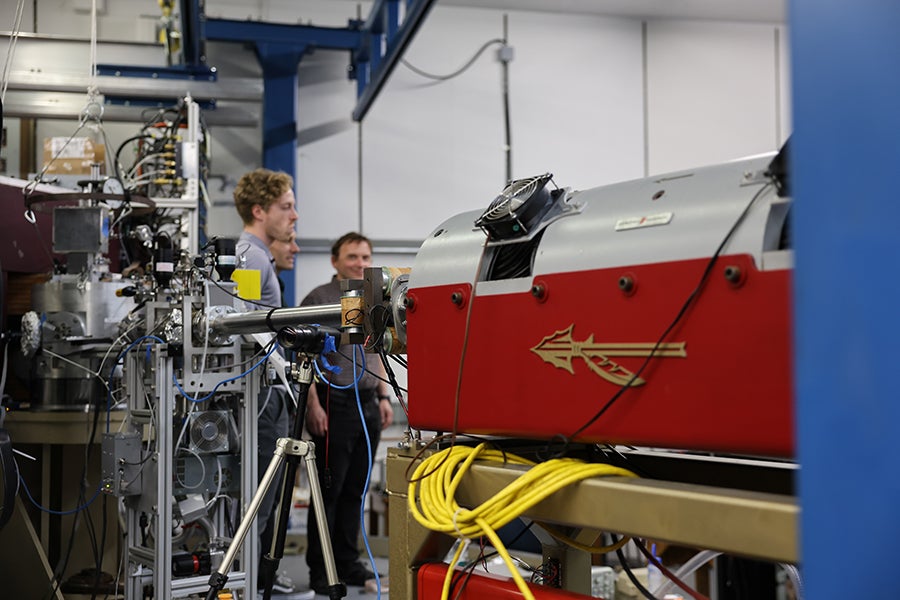
The researchers conducted a neutron-transfer experiment at the John D. Fox Superconducting Linear Accelerator Laboratory, using the facility’s Tandem Van de Graaff Accelerator to direct a deuteron — a nucleus made of a proton and a neutron — beam at a thin foil of titanium-49. During the reaction, the neutron from the beam was transferred to titanium-49, producing titanium-50 and leaving a residual proton.
Scientists used the Super-Enge Split-Pole Spectrograph at the Fox Lab to measure the different angles at which the proton was emitted in the reaction, allowing them to analyze how the neutron was transferred to titanium-49.
“You could say that the deuteron beam hits the titanium-49, transfers a neutron, and in this process kicks it up a set of stairs. Depending on the nucleus, that set of stairs looks very different,” Spieker said. “With the spectrograph, we can measure how high the different steps are. How high we get up the set of stairs depends on the excitation energy that we give to the nucleus.”
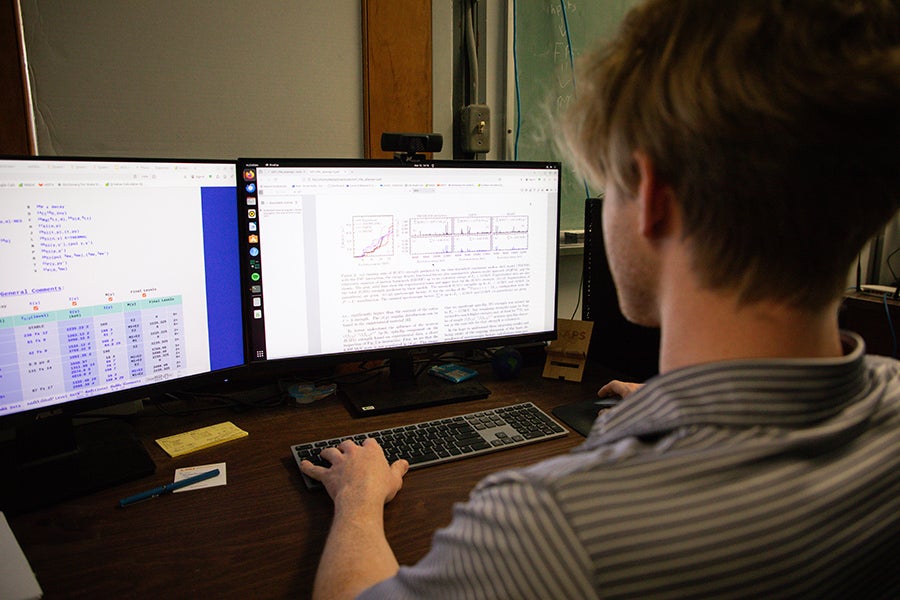
They combined their results with previously published electron- and proton-scattering data and with data from new photon-scattering experiments conducted at collaborating universities. By combining all these approaches, they were able to closely examine how neutrons flip their spin and how much those flips contribute to the nucleus’s overall magnetic behavior.
The researchers saw that the magnetic signal observed in their experiments was not of the same strength as models predicted — a sign that something else must be contributing to the magnetic signals they measured for titanium-50.
“Without combining all these data sets, the story cannot be stitched together cleanly,” said Bryan Kelly, a graduate student at FSU and study co-author. “Seeing the other magnetic excitations, that the other probes are sensitive to, allowed us to conclude that the spin-flip mechanism between spin-orbit partners is not the sole factor of magnetic strength generation.”