
Faculty Spotlight: Cameron Gaddis
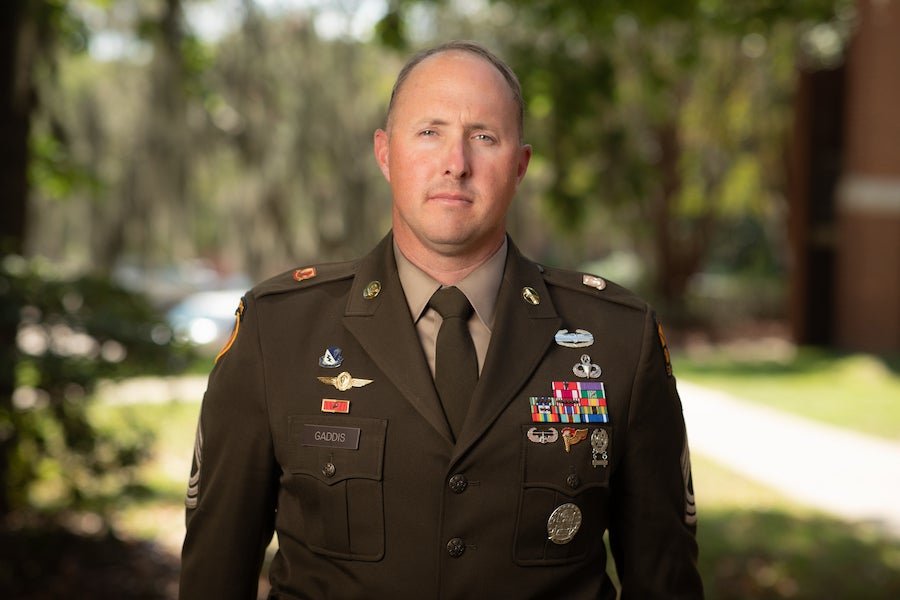
Cameron Gaddis is a master sergeant and senior military science instructor in the Department of Military Science, part of Florida State University’s College of Arts and Sciences. Gaddis has served in the U.S. Army since 2007, and he earned his bachelor’s degree in interdisciplinary social science from FSU in 2025.
Tell us a little about your background, where you’re from and what brought you to FSU.
I’m originally from Tyler, Texas, and I first joined the U.S. Army in 2007. Throughout my time in the Army, I have been stationed in Alaska, New York, Germany, Texas and Georgia. In August 2021, I was sent to Tallahassee as a military science instructor.
What inspired you to pursue a career in the military?
Both of my grandfathers, several of my uncles, and other members of my family had served in the military, so I always knew I wanted to serve. The year I joined, 2007, was the height of the surge of forces in support of Operation Iraqi Freedom, and I didn’t want to miss out on my generation’s conflict.
I also wanted to get out of East Texas and see what the world had to offer. I love my hometown –– it made me who I am –– but I wanted to see what else was out there.
What does a typical day in your job look like?
We typically train from 5:45–7 a.m., with classes starting around 8 a.m. and lasting until 2 p.m. In the department, we mainly teach Army tactics, focusing on the leadership aspects of those skills. This helps prepare our cadets for cadet summer training in Fort Knox, Kentucky –– a requirement for commissioning that cadets complete in-between their junior and senior years.
After classes, I transition into administrative tasks. I’m responsible for the health and welfare of all the cadre, or military personnel who train and lead cadets in the department; I make sure that they have everything they need to be successful.
What’s your favorite part of your job as a senior military science instructor?
My favorite part of my job is getting to interact with the cadets. The cadets are anywhere from 18 to 22 years old, and being around college students keeps me young and grounded. I also enjoy the number of individuals I’m able to influence. Each year we graduate approximately 23 cadets who each will go on to lead an Army platoon, or unit, of 20 to 40 people.
Tell us about your experiences serving in the U.S. Army.
While serving, I deployed twice to Afghanistan, once with my unit out of Alaska from 2009 to 2010 and again with my New York unit. Both times I was located between the cities of Gardez and Khost. During my first deployment, my unit was responsible for maintaining a hold on a road between the cities. I was a squad leader on my second deployment, and our squad was responsible for base defense. I’m still in touch with many of the people I was deployed with today.
Between my deployments, I moved to El Paso, Texas, where I was stationed in an armored unit responsible for testing different equipment like communication devices and vehicles in the desert. After deploying with my unit out of New York, I moved to Fort Benning, Georgia, where I taught people how to jump from a plane 1,200 feet above the ground and safely land as an airborne instructor. After this, I got the chance to go to Europe to be in the 173rd Airborne Brigade, a very historic airborne combat unit. I had just been promoted to sergeant first class and was in charge of squadron level operations until I transitioned into a platoon sergeant position and oversaw about 20 individuals and six vehicles.
What do you want the public to know about the importance of your work?
Serving in the Army is hard work, but if there are people willing to do the job, it’s very rewarding. You’re serving for the person to the right and to the left of you. The brotherhood and camaraderie in the military are very special. I know I can pick up the phone anytime and the people I’ve worked with would answer and be willing to help me.
What is your best memory so far from working at FSU?
My favorite memories are definitely the football tailgates that our department hosts in front of the Harpe-Johnson Building. Family and friends are invited, and department alumni often come back to visit. Many of the Cadre have young children, so we’ll throw the football around with them, grill hot dogs and hamburgers, and then take the color guard over to the stadium on a golf cart.
Who are your role models?
My mother, who was an educator, and my father, who worked in an oil refinery, are two of my biggest role models. Another one of my role models is my wife, Whitney Gaddis; we’ve been married since 2007. She’s one of the most independent women I’ve met, and she amazes me constantly.
Do you have any exciting upcoming projects or goals you’re working toward?
I graduated with my undergraduate degree in interdisciplinary social science last August, and I just applied to enroll as a non-degree-seeking graduate student at FSU. I’m planning to complete the project management program. This year, I’d also like to enroll in the master educator course at the University of Louisville in Kentucky.
I’m also retiring from the Army in July of 2027, so I’m focusing on transitioning into something new in the Tallahassee area, possibly working for the ROTC program, FSU, or the state government.
If your students only learned one thing from you (of course, hopefully they learn much more than that), what would you hope it to be?
Although being in the Army is difficult work, it’s extremely purposeful. When these students enter the Army, they’re already in leadership roles and responsible for enlisted soldiers. I hope I’ve instilled upon them the gravity of their work.