
Faculty Spotlight: Vladimir Dobrosavljevic
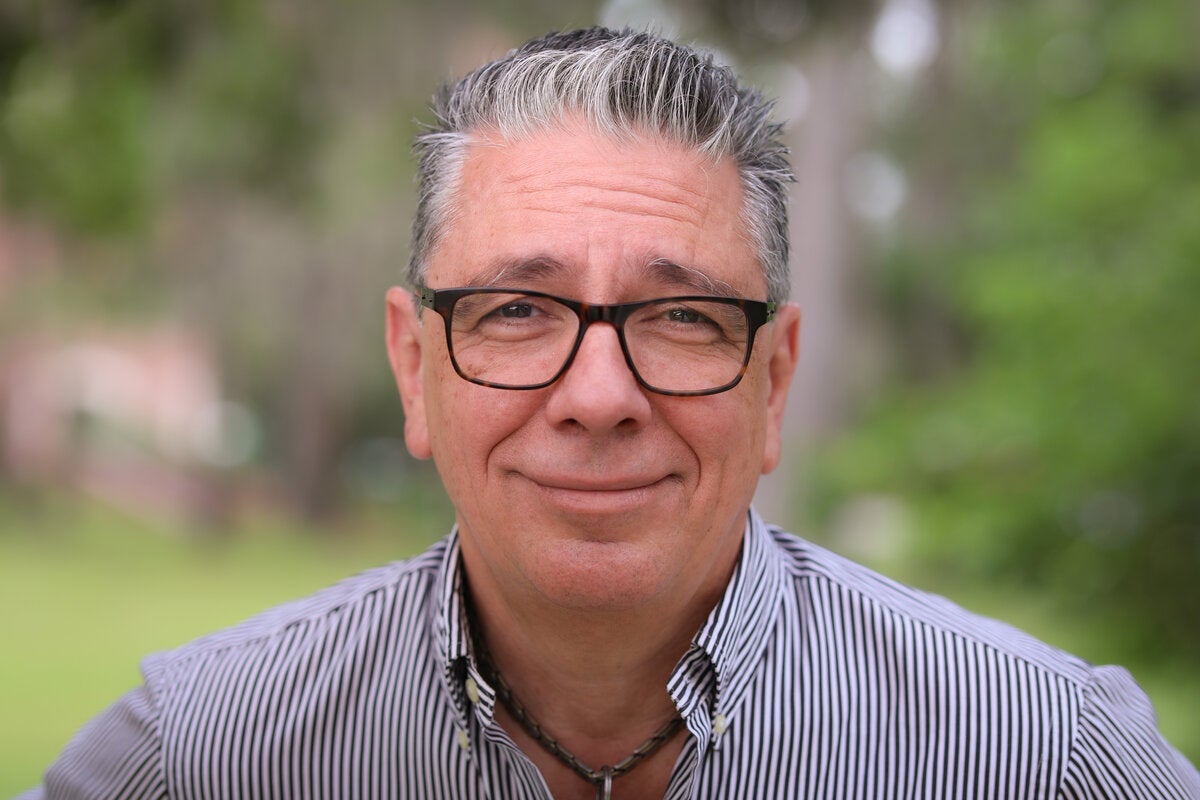
Vladimir Dobrosavljevic is a Distinguished Research Professor in Florida State University’s Department of Physics, part of the College of Arts and Sciences. As a condensed-matter theorist, his research focuses on phenomena that occur in complex objects and systems, especially electronic phenomena in metal systems and metal-insulator transitions. Dobrosavljevic earned his bachelor’s degree in physics in 1983 from the University of Belgrade in Belgrade, Serbia, before moving to the U.S. to pursue his doctoral degree in physics from Brown University in Providence, Rhode Island, which he earned in 1988. He joined FSU’s faculty in 1995 and has worked at FSU since.
Tell us about your background, where you’re from and what brought you to FSU.
I grew up in Belgrade, Yugoslavia, which is now a part of Serbia, and earned my bachelor’s degree in physics there. I decided to come to the U.S. for graduate school after learning about international programs that help fund students’ education, and I came to Brown University for my doctoral degree in 1988. After graduating, I worked as a postdoctoral research associate at the University of Maryland in College Park until 1991 and at Rutgers University in New Brunswick, New Jersey, until 1995 when I moved to FSU.
I was drawn to FSU because of the physics research made possible by the NSF-funded, FSU-headquartered National High Magnetic Field Laboratory, which had opened the previous year in 1994. My wife, Dragana Popović, also got a job at FSU as a research scientist at the National MagLab. We were both very happy to get these positions.
Can you break down your areas of research for us?
Condensed-matter physics describes what’s happening inside large, complex objects, both organic and manmade, like the human body and cars. These large objects consist of many particles that, when put together, can create unique phenomena like magnetism, superconductivity and electricity, which aren’t present in small objects with few particles. There are so many particles in these objects, and condensed-matter physics uses statistical mechanics to simplify equations and capture the most relevant motions. This allows us to understand what’s occurring inside these complex objects.
What inspired you to study physics?
I have a lot of family members who studied physics, including my mother, Ljiljana Dobrosavljević-Grujić, who was a prominent physicist. I didn’t understand how interesting and relevant physics was until I came to college and my grandmother bought me the Berkeley Physics course textbook for freshman students. The book was so brilliantly written and really interested me, so I decided to study physics. I enjoy the discipline because it allows people to understand complicated things that can seem impossible to comprehend.
Tell me a bit about the funding you’ve received from the NSF. How has this support benefited your research?
I’ve been receiving NSF funding since 1999, and I’m currently the primary investigator on a 2024-2028 NSF grant researching strong-coupling phenomena that occur during the metal-insulator transition, an abrupt change in a material’s electrical conductivity.
It’s critical to be able to present your work to experts and find other scientists to collaborate with, and the NSF has been helpful and supportive in that over the years. This summer, I’m going to several conferences across Europe, from Serbia to Italy and even Germany, to present findings thanks to my NSF funding.
What do you want the public to know about the importance of your field of study?
Without physics and an understanding of other basic sciences, we wouldn’t have inventions like the steam engine, cars, planes, computers, TVs or iPhones. People’s understanding of basic principles of how things move is the reason we can make these life-changing creations.
What’s your favorite part of your job?
My favorite part of my job is that it allows me to do what interests me every day: researching and teaching physics. While there’s a lot of responsibility in my job, there’s also a lot of personal freedom. It’s a privilege to be able to choose research subjects that interest me and make decisions that guide the research process.
What’s your best memory from your time at FSU?
My best memory from my time at FSU is when I first realized how much I enjoy explaining complicated materials to students in engaging ways. I knew I’d enjoy teaching, but I didn’t know how much I’d enjoy sparking students’ enthusiasm, triggering their interest, and hopefully steering them in a direction that’s more appreciative of science in general.
Who are your role models? Are there certain people who have influenced you most in your life and career?
One of my role models was Myriam Sarachik, a physicist who provided the experimental evidence for a physical phenomenon called the Kondo effect. During her early career, she overcame male prejudice in the field, and later, after taking a decade-long break from her career due to a personal tragedy, she returned and continued her successful physics career. I look up to her personal courage, enthusiasm, and the ferocious passion she had for the sciences.
Do you have any exciting upcoming projects or goals you’re working toward?
I’m currently working on a few different projects that I’m looking forward to. One project I’m working on studies how silicon acts as an insulator, but when enough phosphorus is added, it suddenly becomes a metal. How this works has never really been understood, so we’re hoping to make some major discoveries during our research.
If your students only learned one thing from you (of course, hopefully they learn much more than that), what would you hope it to be?
I hope my students learn that everything has a cause and a consequence. There’s an explanation for everything that happens, and our job is to determine the reason and then understand how the process works.