
Faculty Spotlight: Neil Van Leeuwen
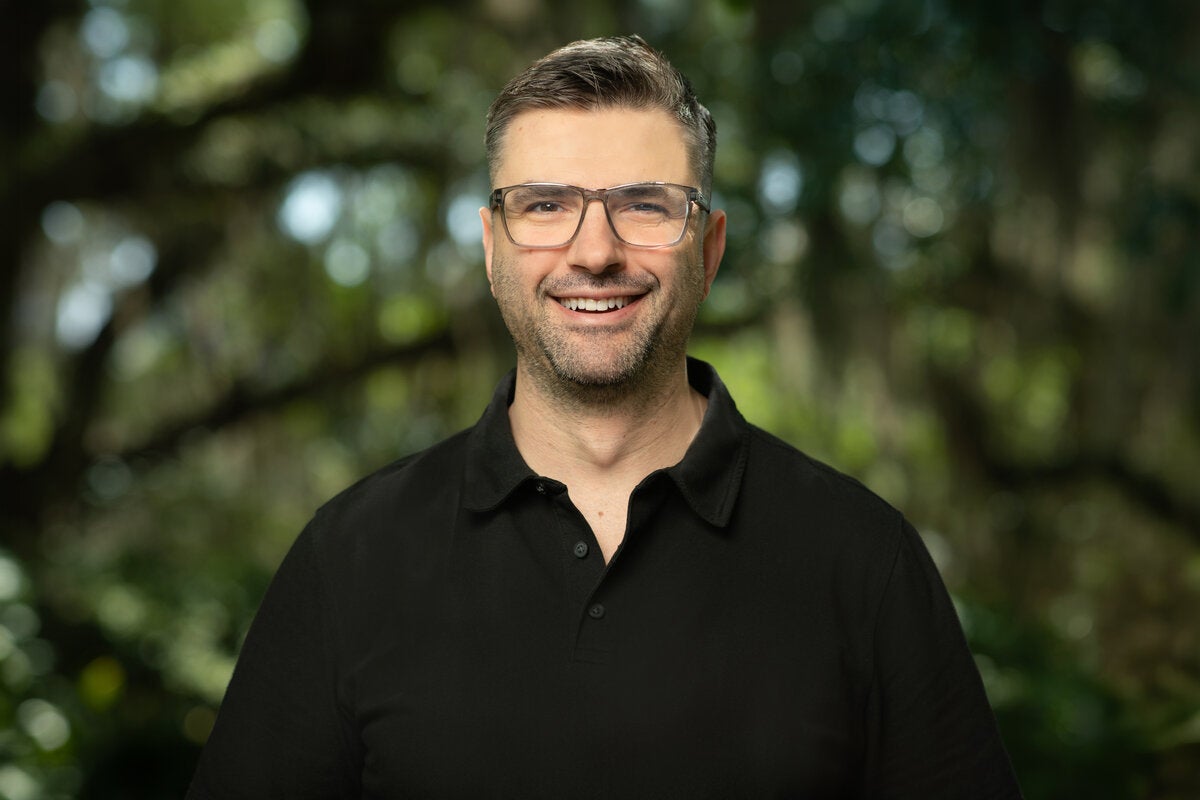
Neil Van Leeuwen is a professor in the Department of Philosophy, part of Florida State University’s College of Arts and Sciences. Van Leeuwen earned his doctorate in philosophy from Stanford University and taught at several institutions, including Rutgers University and Georgia State University, before coming to FSU in 2024. His work incorporates anthropology and neuroscience into the study of philosophy of mind and action, including research on how religious beliefs and practices shape human behavior. Van Leeuwen’s work has been recognized in multiple national news outlets. In 2023, his first book, “Religion as Make-Believe: A Theory of Belief, Imagination, and Group Identity,” was published by Harvard University Press.
Tell us about your background, where you’re from and what brought you to FSU.
I was born in Toronto, Canada, and grew up in Michigan and Philadelphia. I completed my doctorate in philosophy at Stanford and came to FSU in 2023 after publishing my first book. I wanted to join a department I respected, and I’ve known Alfred Mele, the William H. and Lucyle T. Werkmeister Professor of Philosophy, since my graduate studies.
Please break down your areas of research for us.
As a philosopher of mind and action, I ask what it means to believe something in the first place. I define belief, or different kinds of belief, in a way that can be empirically tested and seek to discover how those beliefs guide action.
There’s a large difference between factually believing an idea and imagining it. For example, if you factually believe there’s a cat on your desk, you treat it as reality. You might try to pet it or work around it, but either way, you know it’s there. If you imagine a cat on your desk, your attitude is different. Imagining the cat is voluntary, so it doesn’t guide your actions in the same way. The content — in this case, the idea of a cat — isn’t the difference; it’s your attitude toward it.
A lot of my work looks at religious belief. I maintain factual belief is a different attitude from religious belief; I refer to the latter as religious credence. On my view, religious credence is a type of imagining that helps define your group identity and activates sacred values. Sacred values guide actions differently from ordinary values.
Tell us about your book, “Religion as Make-Believe: A Theory of Belief, Imagination, and Group Identity.”
The book applies my distinction between factual belief and imagination to the cognitive science and anthropology of religion. It also uses qualitative data to argue that a lot of religious belief is, cognitively speaking, more like the imaginings that guide make-believe play than it is like factual belief. The book challenges previous assumptions within philosophy of religion, cognitive science of religion, and even anthropology of religion.
What makes you passionate about your research?
My parents, when I was growing up, worked as academics who were heavily involved in religion and psychology. My father was a biblical scholar who focused on the Hebrew Bible, and my mother was an academic psychologist.
We went to church three times a week, and even as a kid, I always felt there was a kind of make-believe element to it. People would be deeply devotional inside the sanctuary, but upon leaving, they’d just go back to their normal lives. That separation felt very stark to me.
It made me question my own religious beliefs, which were important to me but didn’t always feel real. That curiosity eventually pushed me toward studying the psychology of religious belief, particularly how people move so easily between religious and everyday contexts and behave differently in each.
What do you want the public to know about the importance of your research?
Distinguishing factual belief from religious credence gives researchers more precise hypotheses to investigate and expands the kinds of empirical questions they can ask. I would prefer the public decide whether this framework is actually important for individuals in their own lives, but I believe this distinction is valuable to psychological research and the way we see religion in general.
What’s your favorite part of your job?
Having productive arguments with people, which happens a lot in academia. Those disagreements often lead to lively and enjoyable discussions. I also love being able to continue thinking, writing and learning new things. It’s rare that people get to have a job where they can research what’s interesting to them, and I’m grateful to have that opportunity.
What’s been your best memory working at FSU?
In Spring 2025, I led a seminar focused on reasoning in faith contexts versus scientific contexts. We explored whether reasoning differs between these domains, how, and if it even should. The discussions were consistently strong, especially across topics that blended philosophy of science, philosophy of religion and anthropology. The students produced thoughtful, creative papers, and overall, it was an excellent seminar.
Do you have any role models?
Daniel Dennett, the late philosopher, was my postdoctoral mentor at Tufts University in Medford, Massachusetts. He had an extraordinary way of making philosophical arguments intuitive and engaging. To a large extent, he influenced how I write and think.
Tanya Luhrmann, the Albert Ray Lang Professor of Anthropology at Stanford University, was also especially influential to me. She’s very philosophically engaged and a beautiful writer. I resonate with her thinking and enjoy her books. A few that are especially influential to me are “When God Talks Back” and “How God Becomes Real.” The latter is her most recent theoretical book, which synthesizes a lot of her research.
Do you have any exciting projects or goals you’re working toward?
I plan to write a couple more books, but I think I’d like to keep my cards close to my chest about what they’re likely to be.
If your students could only learn one thing from you, what would you hope it to be?
I’d hope they learn how to rigorously pursue answering the questions that interest them most.