
Postdoctoral Spotlight: Evan Lloyd
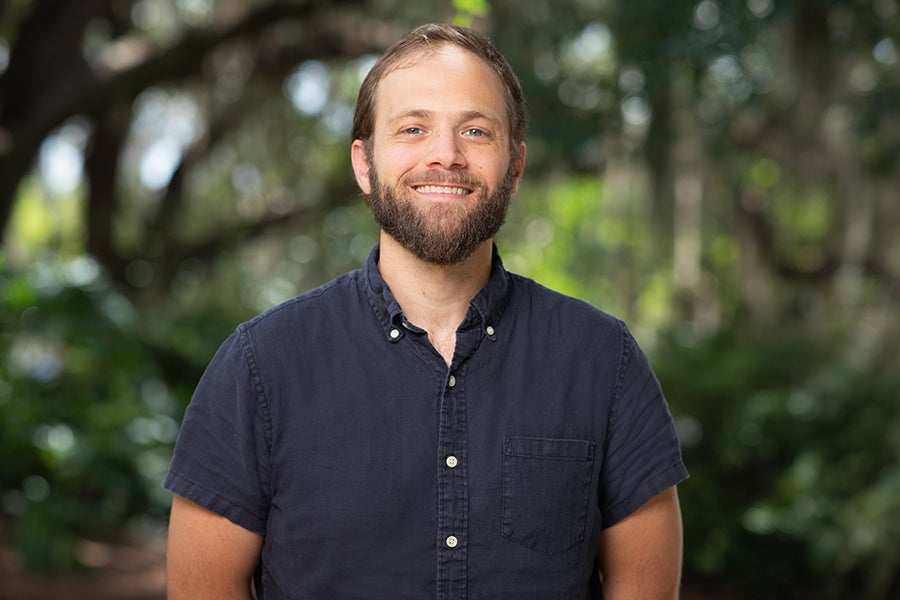
Evan Lloyd is a postdoctoral researcher in Florida State University’s Program in Neuroscience, which includes participation from the Department of Biological Science and the Department of Psychology, part of the College of Arts and Sciences, and FSU’s College of Medicine. Lloyd’s research focuses on how evolution shapes the brain, specifically how the sense of smell evolves and how our brains integrate multiple senses in extreme environments, and he works with assistant professor of biological science and neuroscience Doug Storace in the Storace Lab. Lloyd earned third place in FSU’s 2025 Five-Minute Research Competition for his presentation, “How Evolution Shapes the Brain.” He earned his bachelor’s and master’s degrees from Florida Atlantic University in 2017 and 2019, respectively, and his doctorate in biology from Texas A&M University in 2023 before joining FSU as a postdoctoral researcher that same year.
Tell us about your background, where you’re from and what brought you to FSU.
I was born and raised in South Florida, and I studied evolution while pursuing my doctorate in biology at Texas A&M University. My wife, Dr. Elizabeth Brown, who I met at FAU, got a job as a professor in FSU’s Department of Biological Science after we earned our doctorates. FSU has a great chemosensory training program, so I adapted the model I was already working on, met my mentor, Doug Storace, and we designed my current research project.
Break down your research for us.
I study two populations of fish: One is a normal river fish, and the other is a totally blind albino cave fish. I’ve been looking at the genetic basis for why cave fish lose their eyes to understand more about how eyes develop. These fish also exhibit differences in activity levels, which made me interested in understanding the evolution of behavior. I initially studied changes in their sleep behavior and eventually became interested in understanding the constructive adaptations they’ve developed over time. I’m trying to understand how the brain builds or refines features when it’s presented with an environmental challenge.
Why is studying genes so important?
We’re constantly trying to understand the function of genes, which are often multifunctional. Evolution points you toward important genes and functions, and you can use the context of the animal’s natural environment to interpret results. For instance, we’ve discovered the olfactory sensory neurons in these cave fish — neurons in their noses that are specialized to detect odors — also express a protein that detects touch and is pressure sensitive. This is an example of evolution acting on a trait, which allowed me to discover that there’s a novel protein in the olfactory sensory neurons that has implications for our understanding of the evolution of smell.
Tell us about taking third place in FSU’s 2025 Five-Minute Research Competition.
That was a lot of fun — it was a great opportunity and learning experience to try to pare down my research and make it understandable for a general audience. I highly value that third place finish because it means that, at least for some of the audience, I made them excited about my research.
Do you have any exciting upcoming projects or goals you're working toward?
I’m finalizing a paper submission about pressure-sensitive proteins in the olfactory sensory neurons in the cave fish I study, and I hope to detail those findings in a publication soon. The plan afterward is a new project that will remove the gene in the sensory neuron, and we’ll observe how that affects olfactory function. That's very exciting for me because gene editing in these fish is an approach that’s rarely used in neuroscience research.
What makes you passionate about your research?
I took a class on animal behavior as an undergrad to fill an elective slot, and the current biology department head at TAMU, professor Alex Keene, ended up being my graduate adviser. He showed how to use very diverse model organisms to understand things about the brain that you couldn’t get from a typical model organism, like mice. I joined his lab studying cave fish, and I came to appreciate the approach of using evolution as a tool to understand brain function.
What does a typical day of research look like?
It can vary, but the most exciting research I do is live imaging. We have some transgenic fish, which means we have added new DNA to their natural genes, and we can monitor their brain activity. My favorite experiment is taking my little microscope setup and imaging their brains in real time.
What’s your best memory so far at FSU?
Earning third place in the Five-Minute Research Competition was fun and memorable. Overall, though, I’ve enjoyed the collegial environment at FSU. I’ve received help from professors at various levels and in different departments and have felt intellectually stimulated by the environment here.
Who are your role models? Are there certain people who have influenced you most in your life and career?
My dad is a big role model — he was very helpful to me throughout all stages of my life. Also, my adviser, Dr. Storace, has helped me grow a lot. He’s collaborative, kind and open to input. This has been a real period of growth for me as a researcher, thanks in part to him.
What’s your favorite part of your job?
The opportunity to ask novel questions while focusing on what interests me day-to-day is important to me, and that’s essentially what I get to do every day. I’m very lucky.
What advice would you offer to undergraduate students, graduate students and fellow postdoctoral researchers?
Don’t be afraid to get in the lab and start making mistakes. For me, the fastest way to progress is making a lot of mistakes, so don't be afraid of failure.