
FSU physicists secure DOE Genesis Mission awards to advance groundbreaking research in technological innovation

Tue, Sep 15, 2026
FSU researchers
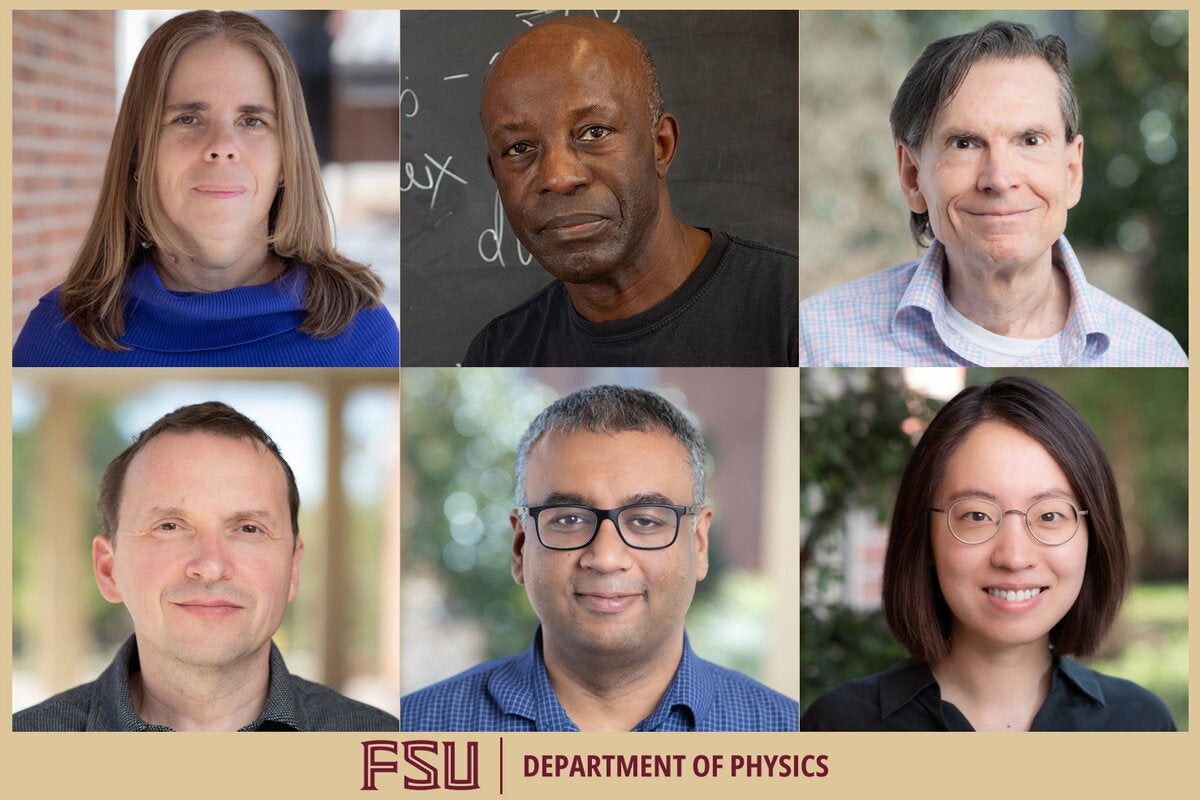
Clockwise from top left: Wyatt-Green Chair of Physics Mayly Sanchez, Robert O. Lawton Professor of Physics Harrison B. Prosper, professor of physics Nicholas Bonesteel, professor of physics Alexander Volya, associate professor of physics Hitesh Changlani and assistant professor of physics Yanzhu Chen. Sanchez, Bonesteel, Volya, Changlani and Chen photos by Devin Bittner. Prosper photo courtesy FSU Photography.

Six Florida State University physicists will lead major projects as part of the U.S. Department of Energy’s Genesis Mission, tackling some of the nation’s most complex scientific challenges and advancing research in artificial intelligence, quantum computing and nuclear physics.

Professor of physics Nicholas Bonesteel, Wyatt-Green Chair of Physics Mayly Sanchez, Robert O. Lawton Professor of Physics Harrison B. Prosper, professor of physics Alexander Volya, associate professor of physics Hitesh Changlani and assistant professor of physics Yanzhu Chen will lead three of the four FSU projects funded by the Genesis Mission. These projects pioneer the use of AI and machine learning to accelerate breakthroughs in energy dominance, physical sciences and national security.

“Our faculty answered the call in abundance for DOE’s Genesis Mission grants program,” said College of Arts and Sciences Dean Sam Huckaba. “Given the high level of competition, it’s a remarkable achievement that we secured four collaborative awards led by FSU faculty, with three of them from the Department of Physics. These successes are more important than ever, and the funding will support continued cutting-edge research.”

The Genesis Mission unites technical expertise from DOE, national laboratories, private-sector companies, and academic institutions with 278 awards granted to accelerate U.S. innovation. Each award funds an initial nine-month phase, and researchers can present preliminary results to apply for a second phase of funding the next year.

“The success my colleagues had in the Genesis Mission competition is a testimony to their talent, discipline, and the way they and other department members collaborate across traditional boundaries of their subfields,” said Department of Physics chair Paul Cottle. “Our project leads are extraordinary researchers, educational innovators and leaders.”

Correcting quantum errors

Professor of physics Nicholas Bonesteel and assistant professor of physics Yanzhu Chen will lead a team developing AI models that can help make large-scale, fault-tolerant quantum computers possible through error reduction. While quantum computers perform complex computations and tasks more efficiently than classical computers, they rely on delicate quantum states to store and process information. These states can be easily disrupted by the computer’s environment, such as magnetic interference and changes in temperature, which can cause computational errors.

Bonesteel, Chen and their team are training AI models to interpret indirect clues from the computer and identify potential errors before they interfere with calculations, laying the groundwork for the next generation of powerful quantum computers.

“Machine learning and AI are transforming the way we do science,” Bonesteel said. “Problems that were impossible to solve with classic computers may become possible to solve with quantum computers through this research.”

Co-principal investigators on the project include professor of computer science Xiuwen Liu, FAMU-FSU College of Engineering professor William Oates, and Layla Hormozi, a scientist at the  Brookhaven National Laboratory.  The project also includes collaborators at Quantiuum, a quantum technology company, and NVIDIA, a multinational technology company.

Uncovering matter mysteries

Wyatt-Green Chair of Physics Mayly Sanchez and Robert O. Lawton Professor of Physics Harrison B. Prosper will jointly lead a project that will use AI to investigate one of the universe’s greatest mysteries: Why is everything made of matter rather than antimatter?

Their work supports the Deep Underground Neutrino Experiment, or DUNE, a large international collaboration that uses giant underground neutrino directors at DOE’s Fermilab National Accelerator Laboratory near Chicago, Illinois, and the Sanford Underground Research Facility in South Dakota. DUNE will send neutrinos — tiny particles that have never been measured successfully because they rarely interact — 800 miles into the earth to study the rare interactions. By analyzing the interactions, scientists hope to understand why matter prevailed over antimatter in the early universe.

However, with tens of millions of neutrino interactions documented from multiple experiments, interpreting the data requires highly accurate computer simulations. Improving simulations is slow, hand-guided work, but AI can consolidate these huge amounts of data into compact equations that physicists can read. The team will then transfer what the AI learned from the data to DUNE, which can open the door to a more comprehensive understanding of how neutrinos interact with matter.

“If we use AI to improve simulations, we could see breakthroughs and have a more accurate neutrino interaction model,” said Sanchez, who’s also a member of DOE’s Office of Science Advisory Committee. “This is the first time physicists are using AI to break down all this experimental data, and we’re only limited by imagination. It’s an incredible moment to be living through.”

Building better predictive quantum models

Professor of physics Alexander Volya, associate professor of physics Hitesh Changlani and assistant professor of physics Yanzhu Chen will lead a multi-institutional team using AI and next-generation quantum computing to improve scientists’ understanding of atomic nuclei and other quantum systems.

The team will analyze and interpret an array of experimental nuclear data to create predictive models that help scientists anticipate how atomic nuclei and quantum systems will behave under varying conditions and interactions.

Beyond advancing fundamental science, this project has applications in progressing quantum technologies, clean energy and national security.

“The Genesis Mission is a revolutionary approach to science,” Volya said. “One of the reasons nuclear data is so complicated is because there’s so much of it, and combining new tools like AI and quantum computing to look at this data from a big picture viewpoint will allow us to advance our research in ways not possible before.”

Bonesteel, Changlani and Chen are joined by Grigory Rogachev, co-principal investigator and head of Texas A&M University’s Department of Physics and Astronomy, associate research professor of physics and astronomy Richard J. deBoer of the University of Notre Dame, and collaborators at Quantinuum.

To learn more about research conducted in FSU’s Department of Physics, visit physics.fsu.edu.