
Postdoctoral Spotlight: Phong Võ Tiến
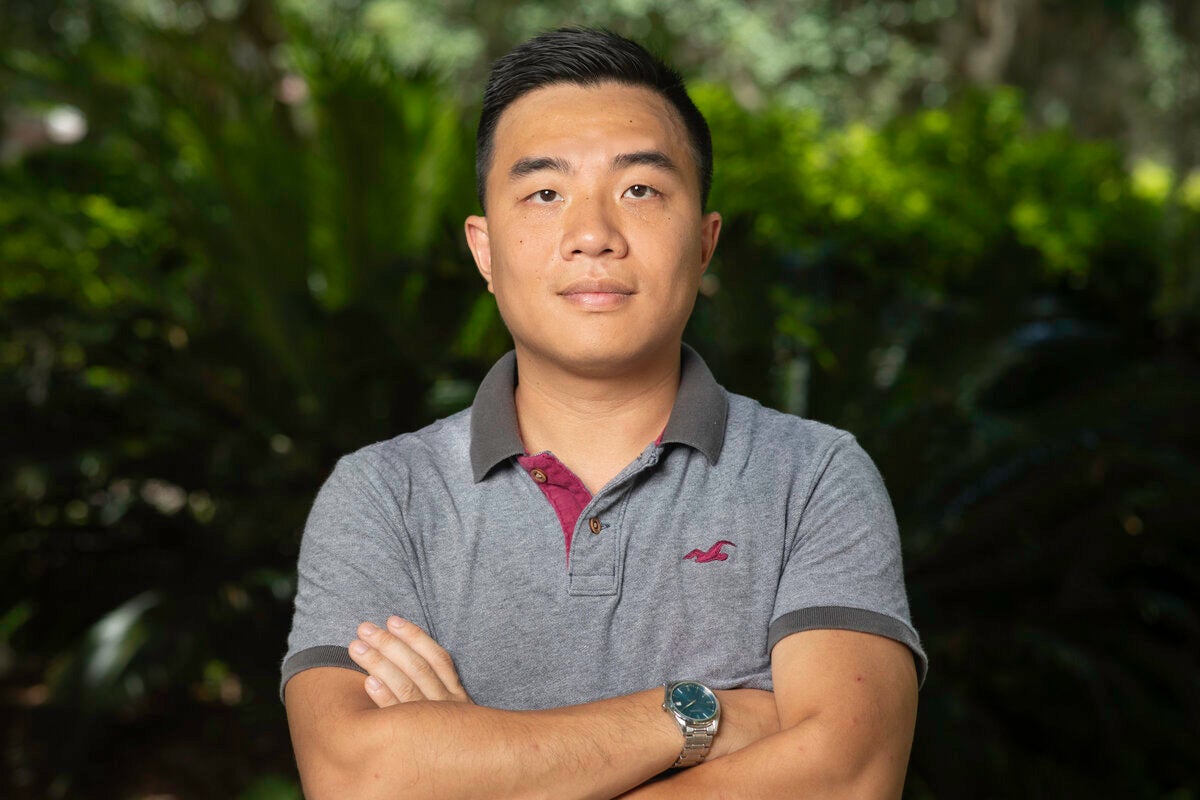
Phong Võ Tiến is a postdoctoral researcher in Florida State University’s Department of Physics, part of the College of Arts and Sciences. He joined FSU in 2023 after earning his doctorate in theoretical physics from the University of Pennsylvania in Philadelphia, and his work examines how layered systems of graphene, a material commonly used in modern technology for its strength and conductivity, can achieve new levels of conductivity when their electrons form exotic quantum states. In 2025, he was awarded an FSU Postdoctoral Scholars Career Development Travel Award to travel to Anaheim, California, and present his work at the largest physics research conference in the world, the American Physical Society Global Physics Summit. Võ Tiến’s research has also been published in leading academic journals including Nature Communications, Nature Materials and Nature Physics.
Tell us about your background and what brought you to FSU.
I was born in Sài Gòn, Vietnam, and my childhood education prioritized early exposure to mathematics, which led me to choose a career in theoretical physics after relocating to the United States. Having spent many cold winters in Massachusetts and Pennsylvania for my previous education, I sought a warmer environment for my postdoctoral training. FSU combined the warmth of a tropical climate and a collaborative collegiate environment.
Break down your research for us.
My work develops theoretical models to study the motion of charged particles in materials like graphene, a single layer of carbon atoms forming a honeycomb network that’s used in technologies like touchscreens and solar panels.
I’m interested in graphene’s ability to conduct electricity without heat loss, known as a superconducting state, and its ability to maintain conduction at boundaries that are obstructed by impurities or defects, called a topological state. To study these states, I construct simplified models of graphene-based structures in various conditions such as differing twist angles, run simulations using FSU’s High Performance Computing Cluster, and make predictions about how the graphene particles will react that will hopefully be confirmed by future experiments.
What inspired you to choose your field of study?
I’m fascinated by the ability of mathematics to describe physical reality with an elegant precision seldom matched by other mediums. My early schooling’s emphasis on mathematics showed me the beauty of physics at a young age, and it’s brought me joy to this day.
What makes you passionate about your research?
The relationship between my theoretical work and the data produced in an experiment shows that theories I propose could be proven in the laboratory and have applications in future technologies, which I find exhilarating.
What did earning the FSU Postdoctoral Scholars Career Development Travel Award mean to you?
I’m honored to have been awarded a travel award through FSU’s Office of Postdoctoral Affairs to attend the 2025 American Physical Society Global Physics Summit. This meeting is the largest annual gathering of physicists in the world, and it allowed me to network and present my work to an audience that shared my interest in graphene.
Tell us about your most recent co-authored publication, “Coulomb Interaction-Stabilized Isolated Narrow Bands with Chern Numbers C > 1 in Twisted Rhombohedral Trilayer-Bilayer Graphene,” featured in Nature Communications. What are the applications of this research?
In collaboration with Cyprian Lewandowski, assistant professor in the Department of Physics, I study a system constructed by stacking three sheets of graphene on top of two sheets of graphene with a relative twist angle. This creates a 3D maze that prevents electrons from moving quickly inside it and forces them to interact with each other more strongly, the same way that humans walking around each other slowly have a greater opportunity to chat than if they were running past.
When electrons interact, they form exotic quantum states. We predict that the possible quantum states in our system can feature conducting modes at the boundary and defy conventional physics seen in simpler systems using fewer layers or no twist.
I have also recently co-authored two other papers with Cyprian, which complement this Nature Communications paper by showing how stacking and twisting graphene layers can create materials with stable electrical properties, which could be useful for applications advancing electronics and quantum computing.
What do you want the public to know about the importance of your research?
My work aims to understand the fundamental principles governing electronic quantum states that could lead to new design principles that benefit humanity. In a world where computing technologies have become indispensable, I think our research makes a meaningful contribution.
What’s your best memory so far at FSU?
I especially enjoy learning and meeting new researchers at the annual Theory Winter School, an educational workshop focused on advanced topics in condensed-matter physics and quantum matter, hosted by the National Science Foundation-funded, FSU-headquartered National High Magnetic Field Laboratory.
What role models have influenced you most in your career?
I’m inspired by the groundbreaking contributions and the tenacity and humility of Michael Faraday, a 19th-century physicist who discovered foundational principles of electromagnetism, and Paul Dirac, one of the founding fathers of quantum mechanics, a Nobel Laureate, and a former FSU professor of physics. I spend a lot of time at the Dirac Science Library and often stop by Dirac’s statue to soak in the prestige of the humble giant.
I’ve been fortunate to work with the kindest human beings, from my middle school physics teacher and my undergraduate, master’s and doctoral research advisers, to my present postdoctoral research adviser at FSU. They taught me that a career in physics is a marathon, not a sprint, so the ability to enjoy it for a long time is paramount to sustainable success.
What advice would you offer to undergraduate students, graduate students and fellow postdoctoral researchers?
Acquiring new technical skills is always a valuable endeavor. When difficult problems arise, only those with the right tools and ample confidence can solve them. Also, having fun along the way never hurts.