
Faculty Spotlight: Andrea Meltzer
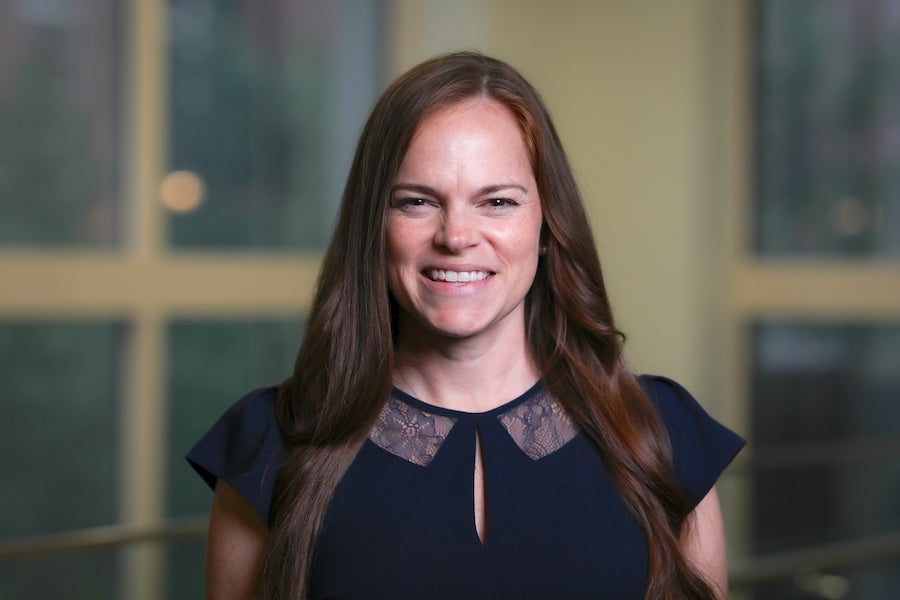
Andrea Meltzer is a professor in the Department of Psychology, part of Florida State University’s College of Arts and Sciences. She leads the FSU Attraction and Close Relationships Lab, which combines evolutionary psychology — the study of how the human mind and behavior have evolved over time — with relationship science, or the study of how people interact, connect and sustain bonds. Meltzer’s research investigates the biological and psychological factors influencing successful relationships, and her work also aims to better understand marital cognition, emotions and behaviors.
Tell us about your background.
I’m originally from Florida. In 2004, I earned my bachelor’s in psychology from Appalachian State University and in 2006, I earned a master’s in experimental psychology from Western Carolina University, both in North Carolina. I earned a doctorate in psychology from the University of Tennessee in Knoxville in 2012, specializing in social psychology with a focus on romantic relationships. I joined FSU in 2015 because of the university’s emphasis on social psychology.
What inspired you to pursue psychology?
I enjoy answering questions about people in general, especially when I can do so using data. I initially thought I was interested in clinical psychology, which is common among psychology majors. However, I later realized I preferred studying everyday behaviors like decision-making, social interactions and routine habits. I then discovered relationship science and evolutionary psychology — now my research lies at the intersection of these two fields.
Break down your main areas of research.
I study romantic relationships from an evolutionary perspective to identify those traits that may have been adaptive in the past, such as physical attractiveness and personality characteristics, and how they may influence modern relationships. That’s mainly what motivates many of my questions, but I'm generally interested in initial attraction, how relationships form and how they’re maintained. I also study newlywed couples over time to understand what factors influence changes in relationship satisfaction and the potential end of those relationships.
What makes you passionate about your research topics?
Evolutionary mismatch, or the idea that our minds evolved for a very different environment than the one we live in today, is quite fascinating. In some ways, the human brain consists of an ancient psyche functioning within a modern context. For example, our natural preference for sweetness made sense when fruit was scarce, but it becomes problematic with today’s abundance of sugary foods. I’m particularly interested in how our evolved psychology interacts or conflicts within contemporary relationship dynamics. My research examines how modern-day evolutionary mismatches like social media and hormonal contraceptives influence romantic relationships.
Tell us about your role as head researcher of FSU’s Attraction and Close Relationships Lab.
As the head researcher of FSU’s ACR Lab, I supervise a team of four doctoral students and a dozen undergraduate researchers. I design studies, guide data collection and analysis, and lead meetings where we share updates and troubleshoot ongoing projects. Every day looks different; some days, my undergrads meet with participants, prepare questionnaires, or set up lab tasks, while other days are focused on large projects like our on-campus speed-dating study, which requires a big team to host events, match participants and oversee first dates.
Can you share an exciting breakthrough in your research?
In a recent study, I found that changes in women’s sexual satisfaction are linked to variations in hormonal contraceptive use during their relationship. Women whose current hormonal contraceptive use differs from their use when they met their partner, such as initially using contraceptives and later stopping, report lower satisfaction. Conversely, women whose current hormonal contraceptive use is congruent with their use at relationship formation, such as those who initially used contraceptives, later stopped, and then started again, report higher sexual satisfaction.
What do you want the public to know about the importance of your research?
I want the public to understand my research uses scientific methods to gather reliable evidence and deepen our understanding of our most intimate relationships. Romantic relationships significantly influence our health, happiness, and overall well-being, and thus we should use rigorous evidence to examine them. Research can vary in strength and reliability, and the design of a strong study greatly influences conclusions that can be drawn. I want to help people see through catchy, but misleading, claims and instead rely on carefully conducted, evidence-based research when thinking about love, relationships and their own lives.
Who are your role models?
I truly admire the researchers who came before me and helped establish the relationship science field. Their work laid the foundation for my study of romantic relationships, and I’m grateful to contribute to this interesting and important area of human behavior.
What is your best memory so far from working at FSU?
My most cherished memories at FSU are watching my doctoral students graduate. So far, I have graduated four students, and four more are currently pursuing their doctorates. Those moments are incredibly meaningful. Having been a graduate student, I understand the difficulty of that journey, and now, as an educator, I see new challenges in mentoring students through it. Graduation also feels like a celebration for faculty who have devoted so much time, energy and care to their students’ growth. Watching students grow over five or six years and then accomplish great things beyond what I have taught them is truly special.
If your students only learned one thing from you (of course, hopefully they learn much more than that), what would you hope it to be?
If my students learn just one lesson from me, I hope it’s the importance of thorough, careful research and understanding its limitations. No matter what I’m teaching, I want students to leave with the ability to think critically about evidence and ask themselves about the strengths and weaknesses of the study they’re examining, what we can reasonably conclude, and what would be going too far. My goal is for them to become smart consumers of science who are able to tell the difference between solid, evidence-based claims and misleading or exaggerated ones.